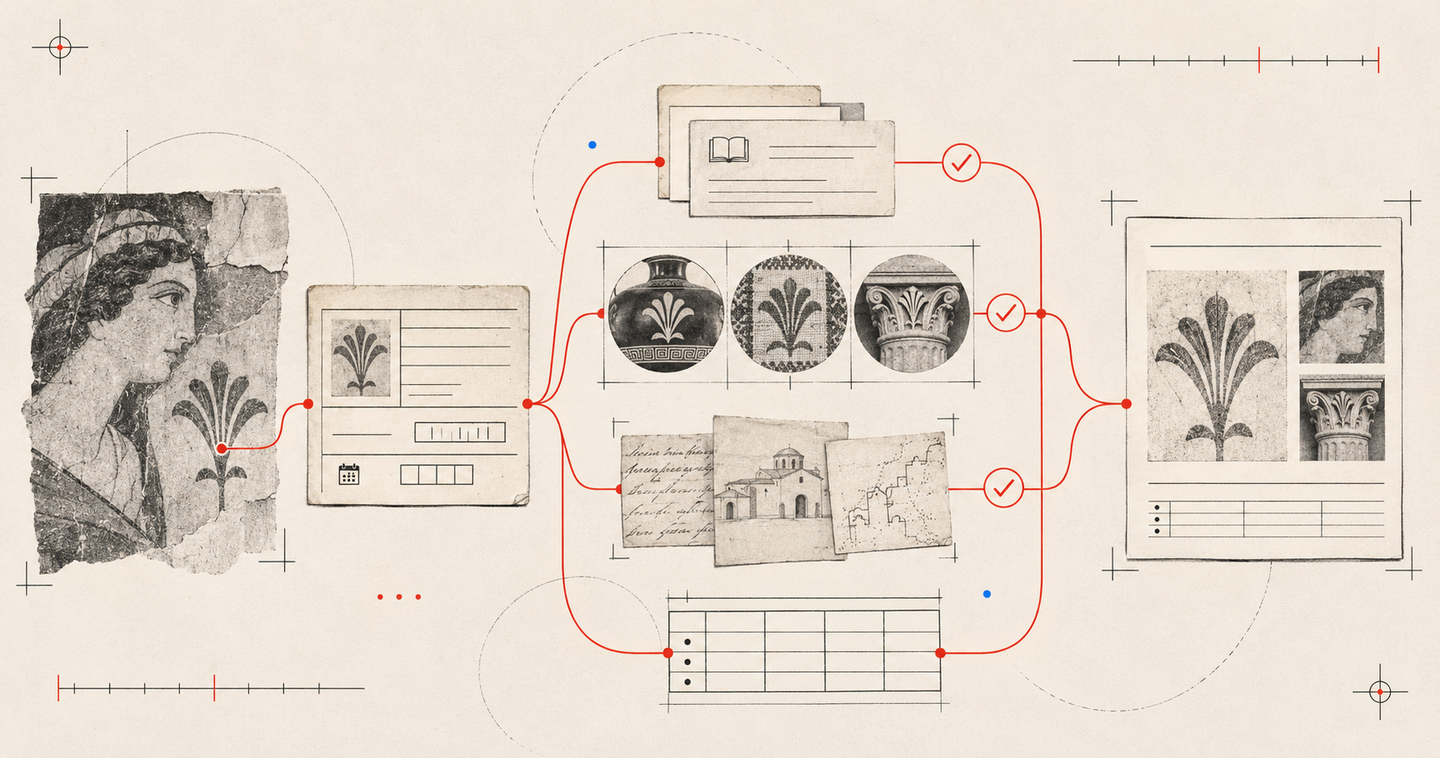
01 / CONCEPT

SIGNAL! HOW MEDIA
“Signal!» is an investigative media outlet focused on visual signs and cultural codes.The unit of study is not the complete artwork, but rather a distinct visual element: an object, a color, a shape, a gesture, or a recurring motif.
The editorial team traces this element across various historical, cultural, and media contexts, demonstrating not a «finished meaning, ” but the mechanism by which an image begins to communicate something to the viewer.
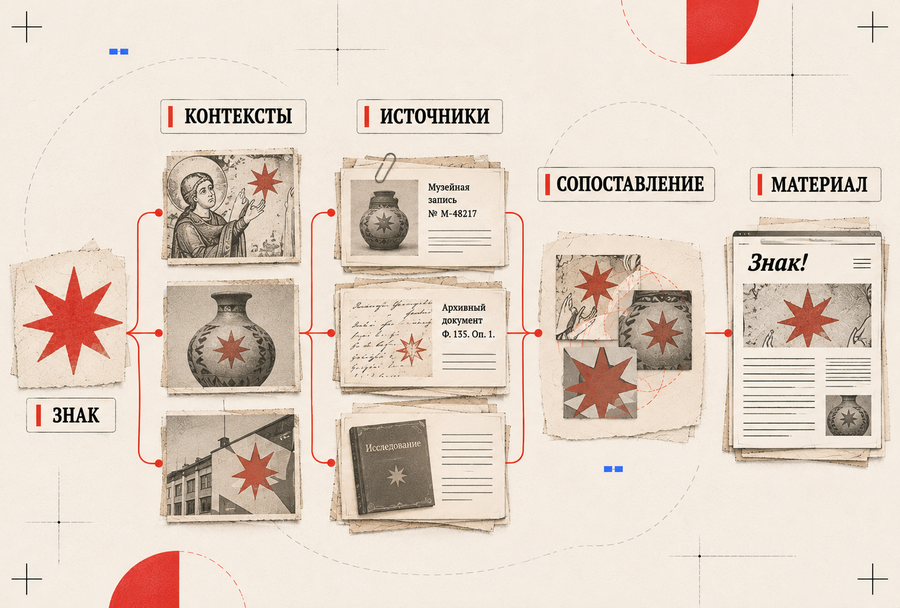
The core principle is: one sign $\rightarrow$ multiple contexts $\rightarrow$ verifiable sources.
HOW THE «SIGN!» MATERIAL IS ORGANIZED
WHY «UNDERSTANDING THE MEANING» ISN’T ENOUGH HERE
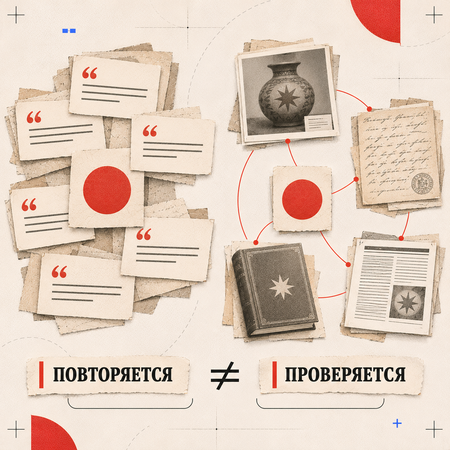
In visual culture, a familiar explanation can easily be accepted as established fact. Formulas like «red means passion,» «the circle means eternity,» or «the disk symbolizes the sun» are repeated so often that they gradually begin to seem self-evident.But frequency of repetition does not prove origin. Therefore, «Sign!» begins its work not by searching for a beautiful answer, but by asking: what exactly do the available testimonies allow us to assert?KEY RULE: POPULAR EXPLANATION ≠ VERIFIED FACT
«Sign!» distinguishes between documented testimony, research interpretation, controversial version, and common retelling.
WHAT WE CONSIDER DATA
For «Sign!», data encompasses more than just articles and finished texts. We work with the core objects—images, archival materials, and research publications—as well as information that explains where the material originated and the context in which it exists.Each publication is assembled from several types of data: a visual example, its provenance, its historical context, and the sources that allow for the validation of interpretation.
WHAT WE RETAIN FOR EACH OBJECT
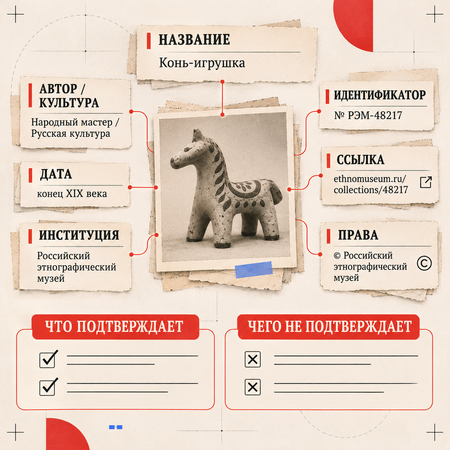
Basic metadata is preserved for found materials: title, author or culture, dating, institution, persistent identifier, source link, and image usage terms.It is separately recorded what the source specifically confirms. A single museum catalog may reliably provide the date and origin of an object, but it does not explain the history of the symbol itself. Therefore, metadata is necessary not only for bibliography but also for understanding the boundaries of the source.
WHAT IS NOT A SOURCE
Search results, automated summaries, and system-generated retellings can help locate material, but they are not used as final evidence.If a claim is included in a publication, the editorial team must be able to open the original museum object, document, study, or official page and verify the information directly there.
SEARCH HELPS TO FIND A SOURCE. IT DOES NOT REPLACE THE SOURCE.
02 / DATA SOURCES
WHERE «SIGNS!» GETS ITS INFORMATION
A single type of source is insufficient for studying visual culture. A museum catalog helps establish the origin and dating of an object, an archive preserves historical evidence, a scholarly publication offers interpretation, and an official institution confirms its own rules, dates, and practices. Therefore, for each material, «Signs!» collects not just one reference, but a set of sources with diverse functions.THE SOURCE ADDRESSES A SPECIFIC QUESTION
There is no rule that states «primary sources are always superior to secondary sources.» A historical document effectively shows what existed and how contemporaries described it, but it is not obligated to correctly explain the origins of a tradition. Contemporary research may offer a better explanation of the historical context, but it remains an interpretation. Therefore, the editors evaluate a source not abstractly, but based on the specific claim that needs verification.A reliable source isn’t «the most authoritative ever.» It’s a source that is appropriate for a specific question.
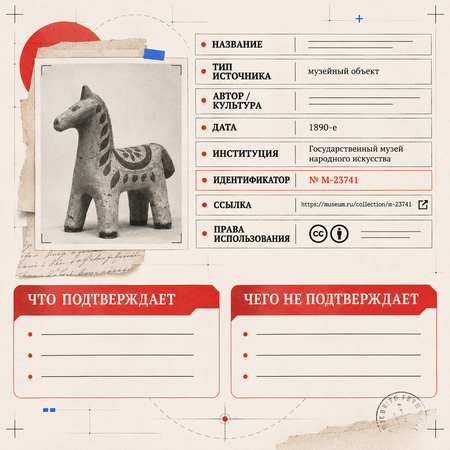
SOURCE CARD
The found material is not just saved as a link. The editor documents its origin, core details, and, most importantly, its scope of applicability. For instance, a museum card can reliably confirm the date, material, and provenance of an object, but it cannot be used to assert that the symbol depicted on it held a single, universal meaning.03 / PROCESSING SYSTEM
FROM CONCEPT TO PUBLICATION
The work on the material does not begin with the command «find the meaning of the symbol»; it begins with an editorial question. After that, automated tools help gather and organize the materials, but at key junctures, the work returns to the human element.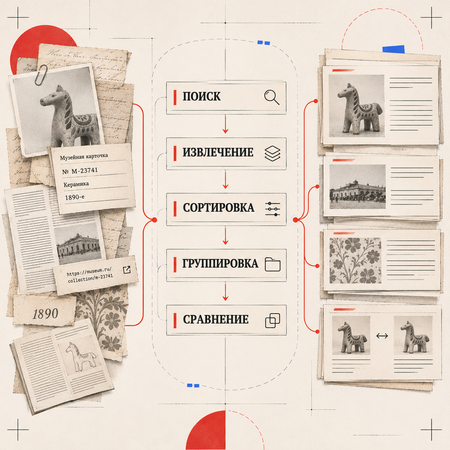
WHAT AUTOMATION CAN HANDLE
Automation is necessary where an editor would have to perform a large amount of repetitive work: searching for potentially relevant materials, extracting dates and identifiers, standardizing entries into a single format, finding duplicates, and grouping sources by theme.It can also notice when different materials frame the same question in different ways, assemble a draft structure for a future publication, and prepare a bibliography.
Its function is to reduce mechanical labor, not to make a research decision.
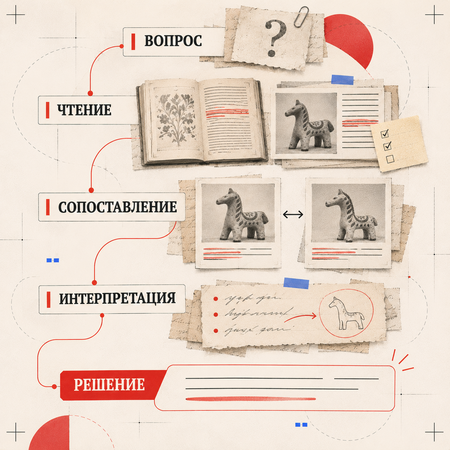
EDITOR’S ROLE
The editor formulates the research question, selects truly relevant sources, and reads them within their original context. They determine whether a found assertion is a fact, an interpretation, or a debatable version, and assess how confidently it can be used in the publication.It is the human who makes the final decision: what truly follows from the findings, and what would constitute an overreaching conclusion.WHERE A HUMAN IS ESSENTIAL
After key automated stages, the material should not advance automatically. Before the next step, the editor verifies that the system has located the correct source, accurately linked the information to it, and has not mistaken a difference in phrasing for a contradiction.The final check occurs immediately before publication: significant facts are compared once again with the original materials.04 / AUTOMATION
WHAT PARTS OF THE SYSTEM CAN BE AUTOMATED
AUTOMATION GUIDELINES
The automated service must always preserve the origin of the information: the source link, the author or institution, the date, the object identifier, and the image usage conditions. Paraphrasing, search results, or automatically generated summaries may help locate material, but they do not replace the original source.The system is also required to preserve the degree of uncertainty. A phrasing like «possibly related» cannot automatically be converted to «means, ” and missing information cannot be filled in with the most probable version.MISSING DATA IS ALSO A RESULT. IT SHOULD NOT BE FILLED IN WITH GUESSWORK.