На стипендию: данные и ИИ
1. Media Concept
The concept remains the same as in Assignments 1 and 2; in this piece, we explore what data the media relies on and whether a machine or a person is processing it.
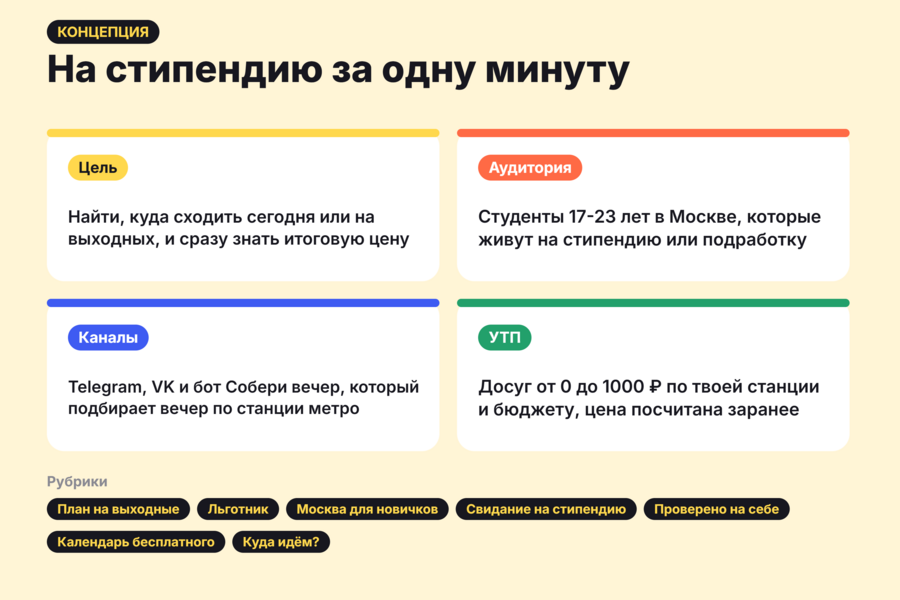
For the Stipend this is media on Telegram and VK, and the Soberi Vecher bot—about free and affordable entertainment in Moscow, priced from 0 to 1000 rubles, targeting students aged 17 to 23 who live on scholarships or part-time work and don’t want to spend every weekend in the dorm.Goal. To help a student find something to do today or over the weekend in a couple of minutes, and immediately understand the total cost, including transportation and snacks.Target Audience. First-year students from other cities who are still unfamiliar with Moscow; students who are saving money and counting every hundred rubles; couples looking for a cheap date; and groups of friends looking for things to do together.USP. Through curated lists and the Soberi Vecher bot, we help students find leisure activities in Moscow based on their metro station and budget, and each list immediately provides the final price.Topics. Weekend Plan, Discounted Life, Moscow for Beginners, Date on a Scholarship, Verified by Us, Free Events Calendar, Where Are We Going?Why Data is Needed Here. Almost all of our content relies on facts that quickly become outdated: dates, times, prices, addresses, and discount terms. If the bot directs a user to a closed exhibition or quotes an old price, trust will immediately be lost—therefore, it is crucial for us to know where the data comes from, how often it is updated, and who verifies it.
2. Data Sources for Media
We divided the sources into three levels: where we draw events and locations from, where we draw rules and benefits from, and where we learn what to write about.
Level 1. Events and Venues
This is the foundation of the database from which the bot’s collections and answers are compiled, so the most crucial aspect here is the ability to pull the data automatically and regularly.
Timepad. This includes lectures, meetings, film screenings, and workshops; many have a price or a «free» tag. Timepad has an open API requiring a free token, which allows us to pull events daily filtered by Moscow and a price up to 1000 rubles. The limitation is that organizers write the descriptions themselves, so the price and location must still be verified.
Moscow Open Data Portal (data.mos.ru). This hosts datasets about ice rinks, parks, libraries, museums, and other city amenities, complete with addresses and operating hours. This data can be downloaded or accessed via API using a key. It is an excellent source for permanent locations, but events and one-time promotions rarely appear there.
mos.ru and Mosbilet. These cover city events like Arts Night and Museum Night, free tours, and registration-required events. We could not find an open API for the event listings, so we monitor these pages via newsletter subscriptions and manually once a week, inputting major events into the database in advance.
PRO.Kultura.RF and the Ministry of Culture’s open data. These provide listings of cultural events across the country, including information regarding the Pushkin Card. The data can be exported by region, specifically Moscow, which helps build the «Discounted User» section.
Yandex Maps. We use this for operating hours, approximate cafe prices, and reviews—data needed to calculate the evening cost, such as how much a takeaway coffee near a park costs. We use this sparingly through organization searches, only for verification, and do not export data in bulk.
Metro Station Directory. This provides a list of stations and lines with coordinates, allowing us to link every event to the nearest metro stop. HeadHunter has an open metro directory that is provided in JSON without requiring a key. Without this connection, the bot cannot search by station, which is its core function.
We also considered KudaGo, but their public API is currently restricted and returns an access error, so we did not include it in the scheme.
Level 2. Rules, Benefits, and PricingThese sources change infrequently, but an error in them is the most costly mistake because the reader will then be unable to pay for a ticket or will arrive on a closed day.State Services and Culture.RF. Terms of the Pushkin Card: age from 14 to 22, a limit of 5,000 rubles per year, and up to 2,000 rubles for cinema—and the fact that the balance expires on December 31st. We check this at the beginning of the year and when there is any news about changes, and we verify all figures in the posts against two sources.Museum, Theater, and University Websites. Free admission days, student discounts, concerts by conservatory students, and open lectures. There are many websites, so for each venue in the database, we store a link to the rules page and the last verification date.Transportation and Food Prices. We take the cost of subway travel from the Moscow Metro website, and the average prices for coffee and snacks from Yandex Maps, updating them quarterly.
Level 3. Topics and Feedback
This data does not confirm facts, but it suggests what to write about and what needs correction in the database.
«Collect Evening» Bot Logic Which stations and budgets are entered most frequently, what is liked, and where the «Irrelevant» button is pressed. We store this without names or usernames—only the station, budget, mood, and pressed buttons.
Comments, Polls, and Private Messages on Telegram and VK Reader questions, such as where to go ice skating for free, and stories for the «Tested Myself» segment.
Student Chats and Competitor Channels We monitor what events are being discussed and what questions are being asked, but only as a source of ideas—the actual facts from the chats do not make it into posts.
Yandex Wordstat Seasonal queries, such as «free skating Moscow» or «where to go for Valentine’s Day,» to understand when a topic will become popular.
Not every source can be trusted equally; therefore, every event in the database has a trust level.
High. Official website of the venue or organizer, State Services, mos.ru. This information can be published after a standard editor review. Medium. Timepad, open data, Yandex Maps. We publish only if the date and price match the venue’s website or if the editor has verified them personally. Low. Chats, comments, posts from other channels. These do not appear in the publication but are added to a topic list; if the topic is interesting, the editor seeks out an official source.In addition to that, we look at freshness: if the event was checked more than seven days ago and the venue more than three months ago, the bot stops suggesting it until an editor updates the entry.
3. Data Schema
The diagram illustrates the entire data path—from source to post and from bot response—with yellow highlighting what the machine performs and white highlighting what a human performs.
What the Machine Does1. Data Collection. The script pulls new events once daily from Timepad, Moscow’s open data, and PRO.Kultura.RF, and updates the venue directory once weekly. The result is a raw list of events with source links.2. Cleansing and Tagging. AI consolidates events into single cards, removes duplicates if one event appears in two sources, assigns categories and moods, links to the nearest subway station, and extracts pricing information. If pricing or date cannot be found, the card is flagged for review.3. Evening Budget Calculation. The script sums the event cost, the subway travel fee, and the average cost of a nearby snack to provide a final amount that the reader sees.4. Draft Generation. Using a rubric template, the AI writes post drafts, suggests three headlines, and compiles card options for carousels.5. Bot Responses. The bot selects two or three relevant points from a verified database based on the station, budget, and mood, and writes a cohesive response, only utilizing entries marked as «verified.»6. Feedback Aggregation. The script gathers likes, «Not Relevant» button clicks, comments, and poll questions, while the AI groups them by topic and provides a brief summary for the editorial team once a week.
What a Human Does1. Selects Sources. The editor decides which platforms to integrate and checks monthly to ensure no source is sending in irrelevant content.2. Fact-Checks. The editor verifies everything going into a post against the venue’s website—date, time, price, whether registration is required. For the bot, it randomly checks 20 cards per week, plus any that users have marked as «Irrelevant.»3. Selects Topics. While AI suggests events, the editor decides what goes into the weekend plan based on the content calendar and what is genuinely interesting to the students.4. Edits Texts. They remove clichés and bureaucratic jargon, add vivid details and personal experiences, and ensure the writing sounds like that of a senior classmate, not a robot.5. Writes Original Features. For verified content and interviews for the Moscow audience aimed at newcomers, a human writes everything; the AI here only transcribes recordings and assists with structure.6. Hits Publish. No post goes live without an editor—only the bot’s responses are published automatically, and those are sourced from the verified database.7. Analyzes Feedback. Based on the weekly summary, they decide what needs updating in the database, which topics to include in the plan, and which bot templates to revise.
For both the machine and the human to work with the same data, every event in the database must have the same record card.
Event Card Fields. Title, type (event or permanent location), date and time, address, nearest metro station and walking distance to it, price (0, up to 300, up to 500, or up to 1000 rubles), registration required, category and mood, eligibility for Pushkin Card, source link, trust level, last checked date, and status.Statuses. New, needs review, verified, archived. The machine can only change the card to needs review or archive when the event has passed; only a person can set the verified status.
Example: how one exhibition appears on the post and in the bot
Monday. The script pulls a free student photography exhibition near Kitay-Gorod from Timepad, which requires registration. Monday. The AI tags it: category exhibition, mood cultural, price 0 rubles, Kitay-Gorod station, 5 minutes walk, registration required. The organizer’s text mentioned free entry with registration, so the AI sets the status to pending review. Tuesday. The editor visits the gallery website, sees that the exhibition runs until Sunday and registration is indeed required, and changes the status to verified. Wednesday. The exhibition appears in the bot, and if someone is looking for an evening out near Kitay-Gorod under 300 rubles, the bot can suggest it along with coffee and a walk. Thursday. The AI compiles a draft of the Weekend Plan from verified events; the editor selects 4 out of 9, rewrites the introduction, and publishes the post. Sunday. Two people tap «Not Relevant» in the bot because registration has closed. The summary shows this to the editor, who archives the event and plans to add a note about registration earlier in the post next time.
4. Guidelines for Automated Services
The schema features five automated services, and each has its own set of rules: what it can do, what it cannot, and when it must summon a human.
General Guidelines for All Services1. Source Data Only. Services do not invent events, prices, addresses, or operating hours. If data is unavailable, the service states it doesn’t know rather than guessing. 2. Every Fact Must Have a Source. Everything included in a card retains a link to its source, allowing an editor to verify it in a minute. 3. Doubt Means Verification. If sources conflict or if the text contains phrases such as «please check» or «by appointment, ” the card is sent to a person for review. 4. No Personal Data. Readers' names, usernames, phone numbers, and correspondence are never entered into the database or prompts; the bot logs only retain the station, budget, mood, and buttons. 5. A Person Publishes. Services prepare drafts, but only an editor releases the post—with one exception: responses generated by the bot from the verified database.
Service 1. Event AggregatorWhat it does: Fetches events daily from Timepad, data.mos.ru, and PRO.Kultura.RF. Can: Limit collection to Moscow only, events within the next 30 days only, and events priced up to 1000 rubles or free. Cannot: Collect data from sites where it is prohibited by rules, or download photos without a license—only the text and link are gathered. Notifies user: If a source stops responding, or if the number of events received in a day is twice as high or twice as low as usual.
Service 2. Tagging Tool (AI)What it does: It maps events to a card, assigns a category, mood, metro station, and price, and removes duplicates. You can: Condense the description to 300 characters in your own words and select a category only from our provided list. You cannot: Round the price down, write «free» if the source mentions any price or donation, or set the status to «verified.» It prompts a person: If the price is listed as «from,» or if the date is unrecognized, or if the event resembles course or shop advertising.Prompt Example: You are an editor’s assistant for a student media outlet about free leisure activities in Moscow. Here is an event description from Timepad. Fill out the card fields strictly based on the text: title, date, time, address, price, registration, and category from the list. If any field is missing from the text, write «no data.» Do not add anything of your own.
Service 3. Draft Generator (AI)What it does: Writes post drafts following the rubric template and suggests 3 headlines. Tone: Informal, like an upperclassman advising a friend—simple language, avoiding bureaucratic jargon and excessive exclamation points. Length: Telegram post up to 1,500 characters, carousel card up to 250 characters. Each item must include time, subway line, and price. Must avoid: Phrases like «unique opportunity, ” „jewel of the city, ” „don’t miss out, ” or guarantees such as „you’ll definitely like this.“ Do not include facts not present in the cards or fabricated reviews. Call to action: Always—a draft is never published without an editor, and the proprietary „Tested Myself“ and „AI Interviews“ rubrics are not written by the AI at all.Prompt Example: You are the author of the Telegram channel „On a Scholarship for Students aged 17–23.“ Write a post for the „Weekend Plan“ rubric based on the cards below. Write informally, simply, and to the point, under 1,500 characters. For each event, specify the time, subway station, and price. At the end, calculate the total cost including the subway fare. Use only the data from the cards and suggest 3 headlines.