
MEDIA CONCEPT
«Plants Without Panic» — a media guide to houseplants and floristry designed to alleviate the fear of making mistakes, transforming plant care into a calm, aesthetic, and understandable process.The project targets four types of audiences: anxious beginners who fear «killing» a plant; aesthetes concerned with beautiful interior design; practicing florists; and dedicated «plant parents.» We do not frighten or shame—we support and explain in simple language.
Our difference is proven facts paired with aesthetics, concrete steps instead of abstract advice, and a tone of voice free from snobbery or alarmism. Our media presence spans Telegram (core), VK (reach), Shorts/Clips (acquisition), Yandex Zen (SEO), and a podcast (depth).
Project Mission — to make plant care a source of joy, not anxiety.
DATA SOURCES FOR MEDIA
For the content to be useful and reliable, the media works with two types of sources—external and internal.
External Sources provide us with facts, trends, and audience demands. This includes search demand (Wordstat, Keywordtool, AnswerThePublic), social media analytics (LiveDune, Tgstat, Targethunter), scientific and reference data (botanical gardens, university publications, RHS), trends and media (Yandex Research, RBC, Think with Google, TrendHunter), expert opinions (florists, agronomists), and UGC—comments, questions, and photos from subscribers.Internal Sources are what we generate and collect ourselves: original content, platform statistics (Telegram Analytics, VK Statistics, YouTube Studio, Zen Statistics), feedback (surveys, comments, private messages), and the project knowledge base (guides, checklists, scenarios).
Media operates at the intersection of search data (what people are looking for), social media data (what people are discussing), expert and scientific data (what is true), and proprietary analytics (what works).
DATA SCHEMA WITH HUMAN AND MACHINE PROCESSING SEPARATION
The diagram illustrates the data journey in media: from collection to processing and selection, to content creation, and finally to analytics and feedback. At each stage, some of the work is performed by humans, and some by automated services.
Data Collection. The machine collects search queries, competitor statistics, and audience questions. The human reads academic articles, conducts interviews, selects experts, and monitors media trends.Processing and Curation. The machine clusters queries by topic, sorts them by frequency and engagement, and aggregates statistics into dashboards. The human fact-checks, filters out myths, formulates themes, and decides what to publish.
Content Creation. The machine generates drafts, selects visuals, creates subtitles, and plans publications. The human writes copy, shoots videos, records podcasts, designs infographics, and handles final editing.
Analytics and Feedback. The machine gathers reach, likes, reposts, performs sentiment analysis on comments, and runs A/B tests on headlines. The human interprets the data, draws conclusions, adjusts strategy, and engages with the audience.
Core Concept: the machine collects, sorts, and accelerates; the human verifies, interprets, and makes decisions. Automation does not replace expertise—it frees up time for creativity and engaging with the audience.
GUIDELINES FOR AUTOMATED SERVICES IN THE SCHEME
Guidelines — these are the rules by which automated tools operate within our media. They exist to ensure the machine does not compromise the tone of voice, publish unverified content, or violate audience trust.
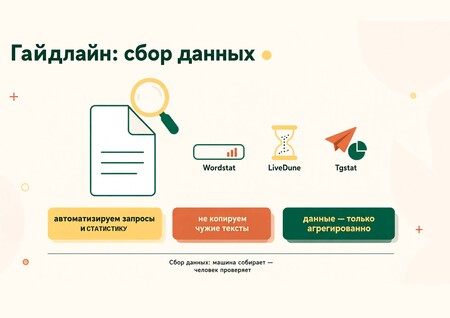
Data Collection. We automate the collection of search queries, competitor statistics, and platform reports. It is forbidden to copy others' texts or collect personal data without consent. Rule: Data from social media is used only in aggregate form.
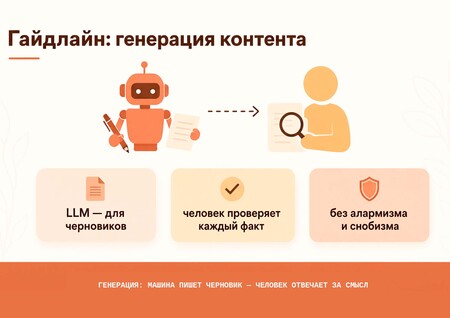
Content Generation. LLMs can be used for drafting, generating headline ideas, and structuring posts. Mandatory: a human must fact-check every claim, especially those about plant care. Publishing generated text without editorial review is prohibited. The machine must not generate alarmism or snobbery—the final edit must be done by a person.

Visuals. We automate the generation of covers, cards, infographics, subtitles, and transcripts. All automated visuals utilize the project palette (green, terracotta, beige, yellow) and Montserrat/Open Sans fonts. A human reviews the images to check for text errors or incorrect plants.
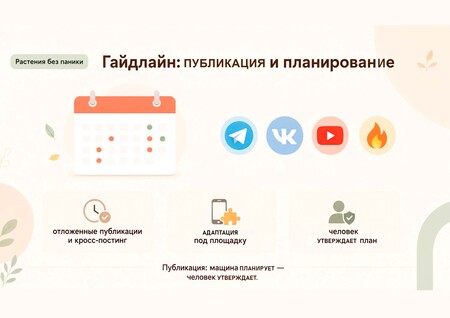
Publishing and Scheduling. We automate delayed publishing, cross-posting, and reminders. Automation should not blindly duplicate content—each platform requires its own format. A human approves the content plan and the final post versions.
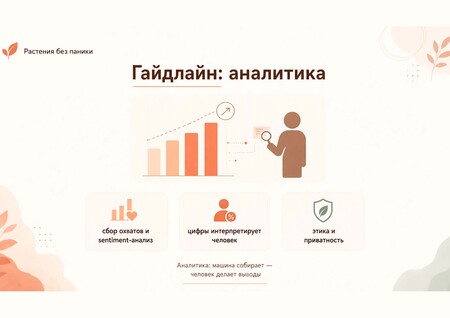
Analytics. We automate the collection of reach, likes, reposts, sentiment analysis, and A/B tests. Numbers do not speak for themselves—a person must draw conclusions and adjust the strategy. Ethics: we do not use automated analysis to manipulate the audience.
Five core principles: the machine accelerates—the human is responsible for meaning; every fact is verified before publication; tone of voice and style must be consistent; audience data is used only in aggregate and ethically; the final decision to publish always rests with a human.