Navigation:
1) Concept
2) Mongol and Tibetan Motifs
3) East Asian Motifs
4) Russian and Western European Motifs
5) Conclusion
CONCEPT
CHAPTER 1
Mongolian and Tibetan Motifs
Mongolian and Tibetan traditions hold a significant place in shaping the costume design for Queen Amidala. Their influence is evident in the very principle of silhouette construction. Exaggerated proportions, intricate headpieces, and abundant decorative details transform the human form, creating an image where the costume becomes the primary vehicle for expressing power.
Of particular interest is how historical forms shift their meaning when translated into a fantastical world. Traditional garments—linked to specific social statuses and cultural customs—are transformed into elements of an imagined courtly system.
1.1 Amidala’s Senate Costume and the Headwear of Queen Dongdogdulam
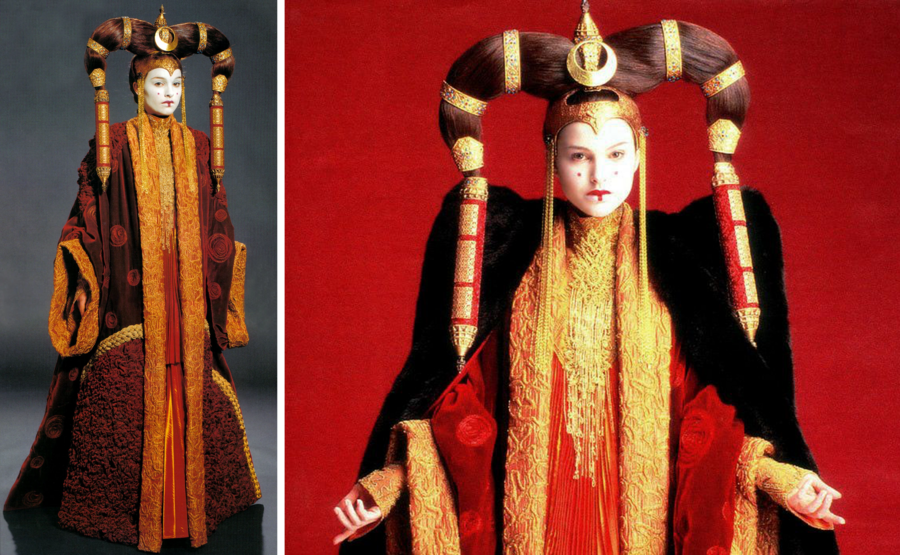
Amidala’s Senator Suit, 1999
Amidala’s Senate costume is one of the most compelling examples of referencing Mongolian costume heritage. The image, developed by Ian MacKay, was based on the traditional hairstyle of a married Mongolian woman.
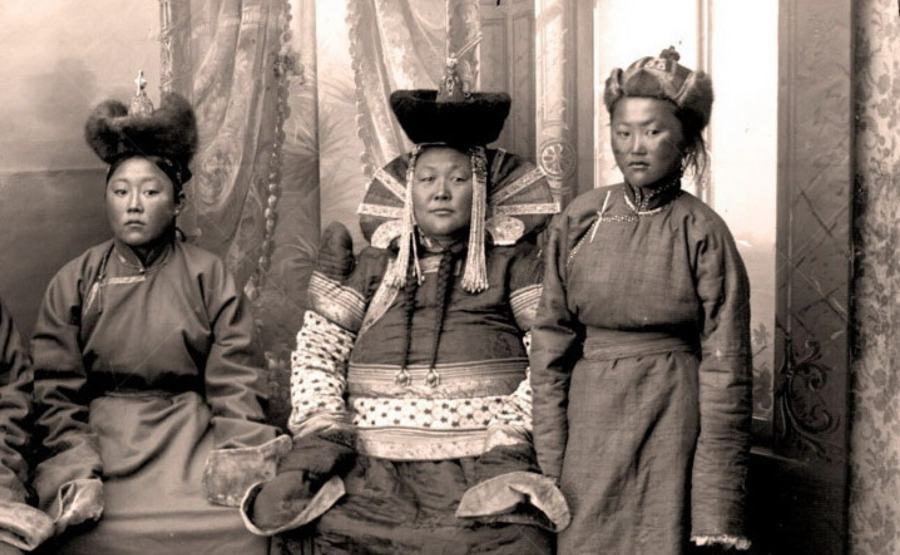
Headdress of the Mongol Queen Dondogdulam, early 20th century
Its characteristic feature lies in two massive side elements that expand the natural boundaries of the head. A similar solution can be found in the ceremonial attire of the Queen of Dongdogulam from the early 20th century. In both cases, the head becomes the center of the entire composition, and the symmetrical constructions and cascading decorations create the impression of a complex, meticulously organized system.
While they appear similar on the surface, there are substantial differences in material and construction method.
Headdress of the Mongolian Queen Dondogdulam, early 20th century
The authentic Dondogdulam headdress is crafted from silver, coral, pearls, and semi-precious stones. According to museum attribution, it weighs 5.65 kg, allowing one to grasp the physical weight of such a ceremonial garment. The screen headdress, created under the direction of Trish Biggar, was made from copper using electroplating followed by gilding. The traditional jewelry construction was adapted to modern costume production technologies. Yet, the remaining visual mass is perceived as an essential part of the silhouette, emphasizing its exclusivity.
The nature of the decorative elements also changes. In Mongolian attire, numerous ornaments form a rich, textured surface where each element retains its independent meaning. In Amidala’s costume, the details become larger, the metallic surfaces grow smoother, and the composition achieves greater graphic clarity. Traditional ornamentation gives way to the symbology of the Nabu royal house. In this type of reworking, the silhouette takes center stage—a silhouette that is perceived as a symbol of power, just like its historical counterpart.
The historical context of the chosen sample takes on particular significance. The Dondogdulam robe was used during the ceremony on December 29, 1911, when her husband, Bogd Khan, was proclaimed ruler of Mongolia. State power during this period was closely tied to the Tibetan Buddhist tradition, so the ceremonial attire merged political and religious symbolism.
In the guise of the Amygdala, this form retains its representative character but is transposed into an entirely different culture.
On a symbolic level, looking at this headdress, it is immediately clear: before us is not an ordinary person, but a queen.
1.2 Amydala’s red royal costume and the traditional Khalkha-Mongol deel
Unlike the senatorial costume, where the primary focus is on the headwear, the red throne ensemble allows for an exploration of how to transform the entire human figure.
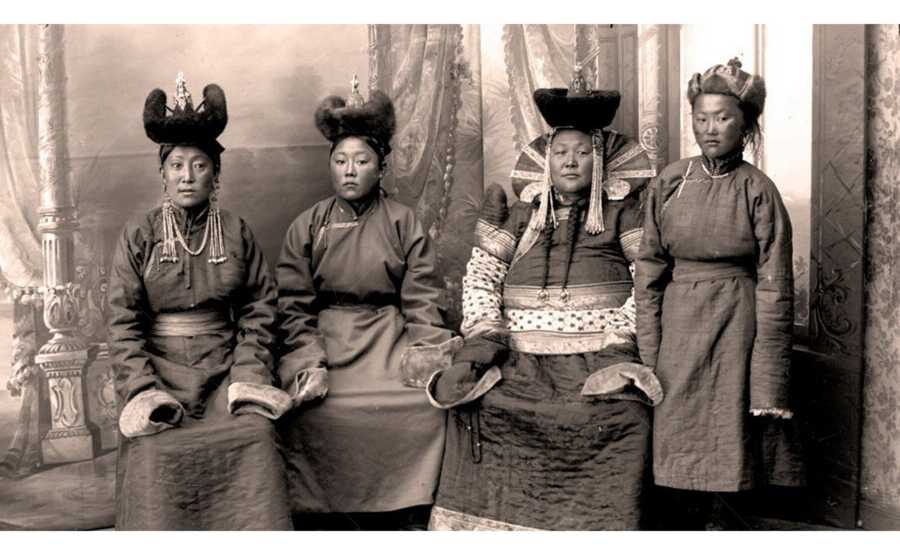
His silhouette bears a resemblance to the traditional deel of a married Khalkha Mongolian woman, primarily in the distinctive construction of the shoulder yoke. The Mongolian deel features significantly raised shoulders. In certain historical examples, this effect was achieved using bamboo or willow inserts placed inside the upper part of the sleeve.
In Amidala’s throne costume, according to Trish Biggar’s recollection, the gown was built upon an internal framework utilizing corsetry steel to maintain the rigid shape of the skirt. The construction incorporated approximately 20–30 individual panels, and its creation took about two months. The result was a silhouette resembling an inverted cone, where the flared bottom balanced the massive shoulder structure. In both costumes, the form intentionally transcends human anatomy; however, while the dress maintains the mobility of traditional garments, the throne ensemble almost entirely conceals the human figure.
It is interesting, and the difference in the organization of the decorative surface.
In traditional deel, ornamental trim and contrasting panels emphasize the cut lines, marking the collar, side panels, and sleeve borders. In contrast, the gold embroidery on the royal robe forms a central vertical element that visually elongates the figure and accentuates its static symmetry. Meanwhile, the rich red color and other costume elements create a similar impression of opulence.
However, the direct origins of the throne costume are more complex than apparent when compared to the Mongolian deel. Trish Biggar herself identified Chinese imperial clothing and Art Nouveau aesthetics among the sources. The latter influence is particularly noticeable in the decorative fluidity of the lines and the aspiration to unify various elements into a cohesive composition. Based on this, one can say that the throne ensemble represents a confluence of multiple traditions. Its similarity to the Mongolian costume is primarily linked to the principle of constructive silhouette modification. The decorative system was shaped by the influence of other artistic sources.
1.3 Amydala’s dark purple road suit and Chahar-Mongol headpiece
The dark purple road suit by Amidala showcases soft textile forms that frame the face. A similar compositional principle can be found in a late 19th-century women’s chahar-mongol headdress from the Rubin Museum collection.