Navigation
- Concept
- Closed Sacred Garden
- Paradise as a Perfect World
- The Fall and Loss
- Conclusion
- Bibliography
Concept
The project is dedicated to investigating the motif of the paradise garden in medieval painting. The central idea is to examine the garden not merely as an element of the natural environment, but as an independent symbol of sacred space. Through the depiction of plants, trees, enclosures, and the interaction between humans and nature, artists conveyed concepts of the ideal world, harmony, and closeness to God.The research will track how the meaning of the garden evolves: from the image of the created world and original harmony to the space of the fall of man and the symbol of lost Paradise. The analysis will be built upon comparing the visual elements of the works and their compositional organization.
Closed Sacred Garden
The enclosed garden—or cloister—is one of the central symbols and motifs in medieval art, architecture, and culture. In the Middle Ages, the outside world was perceived as a space of chaos, temptation, and sin. High walls physically and spiritually separated the individual from earthly distractions, enabling prayer, contemplation, and communion with God.
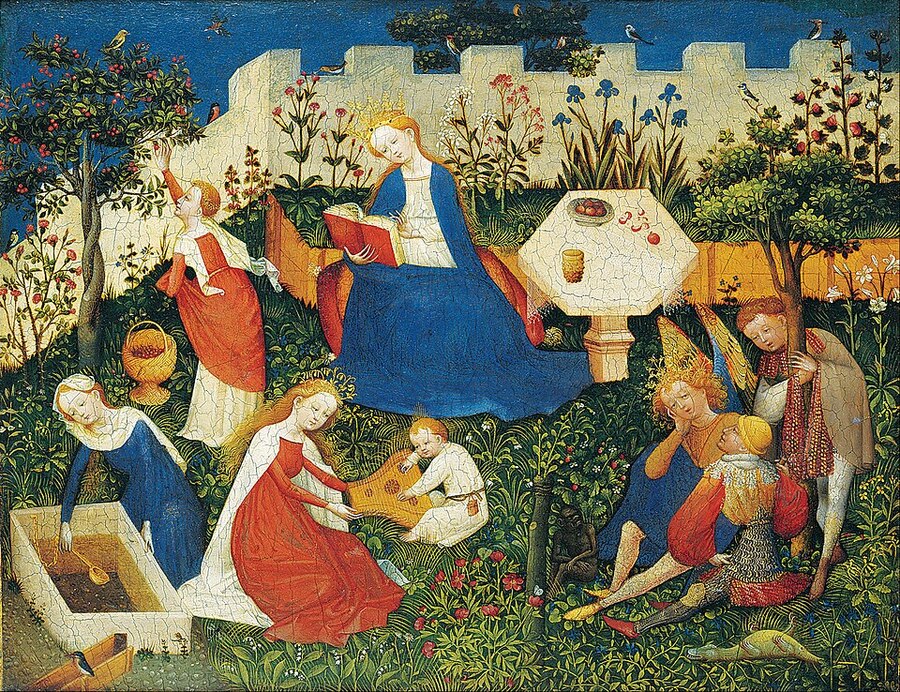
«Little Paradise Garden, ” Upper Rhine Master, circa 1410–1420.
The painting depicts a classic example of a walled garden, meticulously conveying the medieval concept of earthly and heavenly paradise. The garden is surrounded on all sides by a battlemented wall. This wall not only protects the garden’s inhabitants but also directly signifies the isolation of Paradise from sinful earth. Strawberries are depicted in the painting as a symbol of Mary’s purity and the righteousness of saints. A winter jasmine, perched on the edge of the well, symbolizes peace, tranquility, and divine presence. The garden in the painting is an idealized image—an eternally blooming oasis.
«The Creation of the World and the Expulsion from Paradise, ” Giovanni di Paolo, 1445.
The author depicts Paradise as absolutely perfect, employing a language of symbolism, refinement, and profound emotionality. Paradise is presented as a dense, meticulously maintained garden where ripe fruits (a symbol of Edenic abundance) mature alongside blooming lilies (a symbol of purity). In medieval tradition, such an enclosed garden symbolized a perfect space, shielded from sin.
«Madonna and Child with Donor, represented as Saint Jerome, ” Master of the Munich Marian Panels, c. 1450
The painting is another example of the «closed garden» tradition. The garden separates the sacred figures and the donor from the chaos of the earthly world. Unlike the cold stone or wooden thrones of the Italian tradition, Mary’s throne here is living, flowering, and natural, which connects her to the idea of motherhood and the earthly incarnation of Christ.
«The Story of Adam and Eve, ” Master Clockmaker Busico, 1415
The garden is presented as a closed, perfect hexagon enclosed by high stone walls. The clear hexagonal form sharply contrasts with the chaotic, wild world beyond its walls. The master Busico emphasizes that paradise is not merely nature, but a space rationally ordered by God.
«Madonna in the Rosary, ” Stefan Lochner, c. 1440–1442.
A dense, shadowless hedge of roses functions as an architectural wall, separating the earthly world. Each plant holds symbolic meaning: white lilies and roses signify Mary’s purity, while red roses represent the future blood of Christ. The garden is both humanized and spiritualized—angels gather flowers and play music, transforming this space into an ideal zone of repose.
«The Annunciation,» Fra Angelico, 1430–1432
The Garden is closed to humanity, but open to God. A powerful beam of divine light breaks through the leaves and tree canopies from the upper left corner. It penetrates the enclosed garden without disturbing its integrity or breaking the fences. In the distance, near the wild undergrowth and the thick wall, Adam and Eve walk away. For them, the garden is forever closed due to the fall. The earth beneath their feet seems less vibrant.
In all the paintings, the garden appears separate from what lies outside. It lacks a smooth transition to the external environment. In every interpretation, the garden is a sacred space, whose entrance is closed off from the mundane, the impure, or the sinful. Nature is not animated in itself; rather, it is a reflection of the Divine.
Paradise as a Perfect World
Using these previously mentioned images as an example, one can see another interpretation of the Garden of Eden—it is a perfect, flawless world where religious worldview and earthly harmony merge into a single image of order, protected from the destructive influence of time and sin.
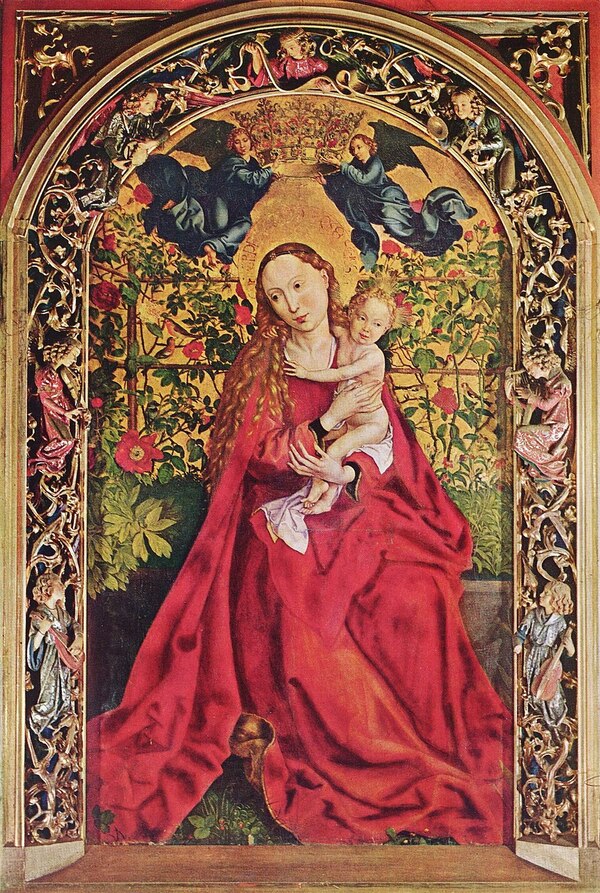
«Madonna in a Rose Arbor,» Martina Schongauer, 1473
The painting «Madonna in a Rose Arbor» can also serve as an example of the idealized garden motif. A blooming meadow stretches beneath the Madonna’s feet. Strawberry, a common element in such paintings, symbolizes the Holy Trinity; its white flowers and red berries represent Mary’s purity and Christ’s martyrdom. The garden here functions as a sacred boundary between the divine and the earthly. Through the fragile beauty of the blossoms, the master conveys the purity of the divine birth and humanity’s return to the lost Paradise.
«From the rib of sleeping Adam, God creates the first woman: Eve, ” a cycle of mosaics on the theme of world creation, Eden, and the story of Adam and Eve in the Montreal Cathedral.
In this mosaic, the garden functions as a part of the world created by God. In Montreal, Eden does not appear as a wild forest. The Garden of Paradise is depicted as a space of absolute harmony and geometry, brought forth by the Word of God. The trunks and canopies of the plants surround the Creator and the first people, forming a kind of natural, organic architecture. The trees are adorned with stylized fruits and lush foliage, emphasizing the Garden’s status as a place free from death, decay, and want. Here, the garden represents the perfect state of matter before the Fall.
«Paradise, ” Giovanni di Paolo, 1445
Every plant in the Di Paolo garden carries a coded theological message: Lilies: Snow-white lilies scattered among the grass traditionally symbolize the purity, chastity, and innocence of holy souls. Roses: Red and white roses symbolize martyrdom (the blood of Christ) and divine love. Strawberries: The small strawberries in the foreground were considered a symbol of righteousness and good works in medieval iconography, as the strawberry blooms and bears fruit simultaneously without harming the soil. Golden fruits on the trees: Fruiting trees overflowing with ripe fruit (resembling oranges or golden apples) allude to the eternal bounty of the Tree of Life and the triumph over the sin of the Tree of Knowledge.
«Madonna and Child with Saints and Donor» by Gerard David, c. 1510.
The garden functions as a sacred, protected space, accessible only to the devout and the benevolent donor. Beyond the fence lies the ordinary world—the city’s architecture—highlighting the contrast between the sacred and the secular.
Left panel of Hieronymus Bosch’s triptych, «The Garden of Earthly Delights, ” circa 1490–1500.