Sometimes greatness only becomes evident when it is momentarily taken away. The latter part of Rodri’s story is about the «Golden Ball,» a serious injury, returning to the pinnacle of world soccer, and the legacy of a man who redefined the role of the central midfielder.
1. The Injury That Changed the Conversation About Rodri
Weeks after his triumph at the Euros, Rodri’s career sharply stalled. On September 22, 2024, during a Premier League match against Arsenal, he injured his right knee and was forced off the pitch in the first half. Later, Guardiola announced that the footballer underwent surgery on his anterior cruciate ligament and meniscus and will not play for the 2024/25 season.
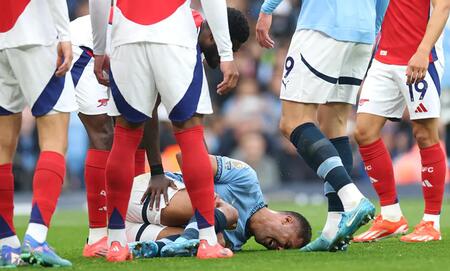
The initial discussions quickly went beyond simple recovery timelines. The football world was fascinated by how Manchester City would function without a player who linked defense, midfield, and attack. This reaction alone demonstrated the pivotal role Rodri played in Guardiola’s system.
For a long time, City’s squad depth was considered one of its greatest assets. The club navigated the departures of Vincent Kompany, David Silva, Sergio Agüero, and İlkay Gündoğan, devising new tactical solutions each time. However, Rodri’s functions proved difficult to redistribute among other players because he simultaneously initiated attacks, dictated the pace, shielded the defenders, and organized team actions immediately following a loss of possession.
Without him, City could still maintain long periods of ball possession and create chances, but the control itself became less reliable. Defenders found themselves facing more pressured decision-making, the space between lines widened, and opponents gained more opportunities to launch central counterattacks. This wasn’t about a single missed pass or a single missing tackle; it was about losing a player who constantly maintained the equilibrium of the entire structure.
Guardiola explicitly called Rodri’s blend of attributes indispensable, while stressing that the team had to collectively compensate for his absence. The coach had previously stated that the Spaniard could do almost everything: control the tempo, execute short and long passes, advance into the opponent’s box, and maintain control when a match was going poorly.
It was precisely Rodri’s absence that amplified his influence. As long as he was on the field every week, the team’s ability to control space was perceived as a natural part of City’s style of play. After his injury, it became clearer just how much unseen work one player was performing.
Consequently, the injury altered not only the club’s season but also the public conversation surrounding Rodri himself. He began to be evaluated not just on the actions he took, but on the problems that arose after his disappearance.
2. The Victory That Changed the Perception of the Midfielder’s Role
The «Ballon d’Or» almost always reflects the prevailing notion of the ideal footballer of its era. After years of rivalry between Lionel Messi and Cristiano Ronaldo, player influence was habitually measured primarily by goals, assists, and spectacular individual moments; therefore, a victory for a defensive midfielder recently seemed nearly impossible.
Exceptions were rare and usually involved outstanding international tournaments. In 2006, the captain of the world champions, Fabio Cannavaro, received the award, and in 2018, Luka Modrić ended a ten-year winning streak for Messi and Ronaldo after triumphing with Real Madrid in the Champions League and Croatia reaching the World Cup final.
In the fall of 2024, Vinicius Jr. was considered Rodri’s main rival, having won the Spanish league and the Champions League with Madrid’s Real Madrid. However, the Spanish midfielder had his own set of arguments: the Premier League title with Manchester City, Spain’s victory at Euro 2024, and the award for best player of that tournament. The question gradually shifted from who created more spectacular moments to who the team lost its identity without.
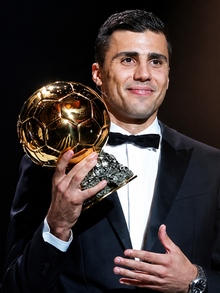
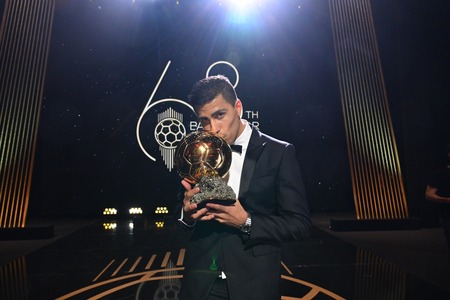
On October 28, 2024, Rodri was named the Ballon d’Or winner. He became the first Spaniard to win the men’s award since Luis Suárez in 1960. The ceremony, however, was overshadowed by the absence of the Real Madrid delegation—the club declined the trip to Paris after learning that Vinicius would not be the winner, even though Real officially received the award for best team of the year.
Rodri took the stage on crutches after a severe knee injury and dedicated the victory not just to himself. He spoke about Spanish football, the role of the central midfielder, and the players he felt deserved similar recognition: Xavi, Andrés Iniesta, Iker Casillas, and Sergio Busquets.
These words perfectly explained the meaning of the achievement. Rodri viewed the award not merely as the outcome of his own season, but as recognition of an entire type of player—whose work had remained less visible than attackers' actions for decades. He didn’t finish most attacks, but he dictated how they started; he didn’t always make the final tackle, but he occupied a position that prevented danger; he didn’t strive to be the hero of every match, yet he made the entire team more stable.
The development of football analytics has allowed for a more precise assessment of ball progression, positional discipline, counter-pressing, and a player’s influence on team structure, but Rodri’s victory cannot be explained by numbers alone. It stands as a testament to a broader shift: the football world has begun to perceive greatness not only as the ability to finish the play but also as the ability to manage it.
3. World Champion and Best Player at the 2026 World Championship
Returning to play after a serious injury rarely concludes the moment a doctor clears a soccer player to step back on the field. It requires regaining game rhythm, learning to trust the knee during sudden changes in direction, and becoming accustomed to making decisions under maximum pressure once again.
That is precisely why the 2026 World Cup became something more to Rodri than just another major tournament. Spain arrived in North America as the reigning European champion, but began the competition with an unexpected draw against Cape Verde. Later, Luis de la Fuente’s team defeated Saudi Arabia and Uruguay, and in the playoffs, they surpassed Austria, Portugal, Belgium, and France.
As the tournament progressed, Rodri once again became the central figure of the national team. He dictated the attacks, linked the lines, and allowed his teammates to maintain structure even in matches where the opposition applied intense pressure. By the semi-final against France—which Spain won 2–0—he looked less like a footballer recently recovering from a serious injury and more like the captain around whom the entire team’s play was organized.
In the final, Spain faced Argentina, the reigning World Champion. Regular time ended without goals, and the decisive moment arrived in the 106th minute: Nico Williams dropped a pass after Pedro Porro’s cross, and substitute Ferran Torres brought Spain the 1–0 victory and its second global title in history.
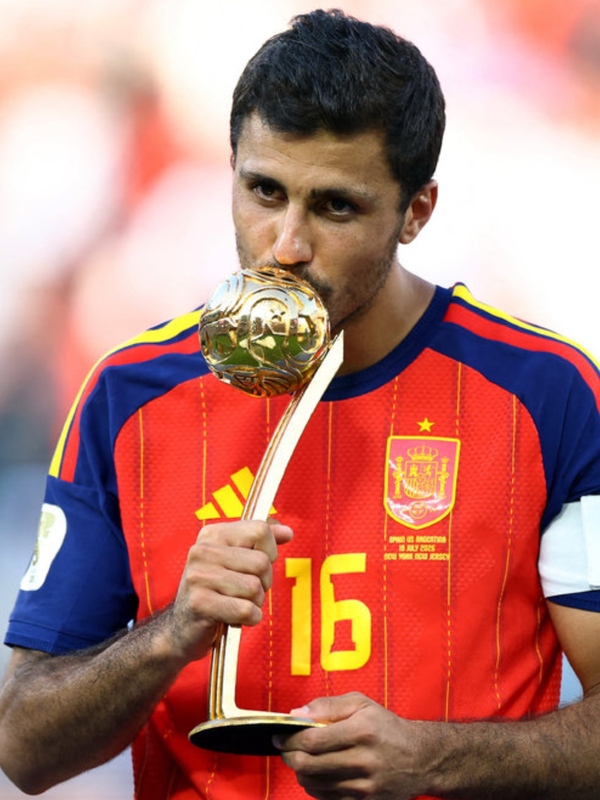
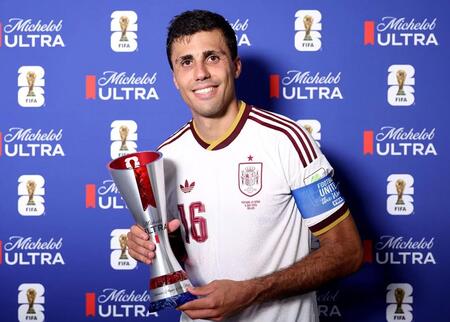
Rodri did not score the winning goal, but FIFA named him the tournament’s best player. In the final, he completed 101 out of 105 accurate passes, won 80% of tackles, and created two scoring chances—all while Spain conceded only one goal in eight matches. By the end of the tournament, the midfielder also ranked first among all participants in total distance covered, running over 96 kilometers.
The award felt like the logical culmination of his entire journey. After tearing his cruciate ligament, Rodri didn’t just return to professional football; he became the defining player once again for the world’s strongest squad. His precise passing, intelligent positioning, and ability to remain composed allowed Spain to play its trademark style of football, regardless of the opponent or the stage of the tournament.
The absence of Rodri in 2024 demonstrated just how vital he is to Manchester City. The World Cup two years later proved something even greater: following a long recovery, he retained the ability to master matches at the highest level, concluding the tournament with the captain’s armband, a world title, and the FIFA Ballon d’Or.
4. Why Coaches Consider Rodri the Ideal Midfielder
Fans usually remember winning goals, saves, and impressive dribbles, whereas coaches focus on the decisions that prevent danger before it even arises. They notice when a midfielder times a backward shift, blocks a passing lane, or opts for a controlled continuation of the attack instead of a risk that could dismantle the entire team’s formation.
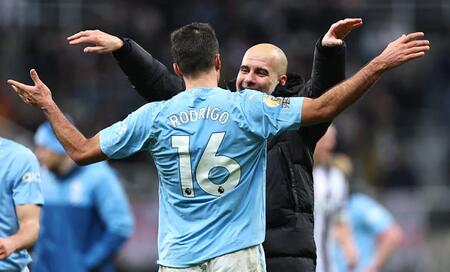
Guardiola’s assessments help reveal the unique quality of Rodri. The coach hailed him as the best midfielder in the world, emphasizing the Spaniard’s ability to do virtually everything: regulate the pace, distribute short and long passes, advance the ball, track back defensively, and take responsibility when the team is struggling. According to Pep, it would be hard to imagine Manchester City’s recent achievements without Rodri.
Equally vital are the qualities that are harder to capture in statistics. Guardiola noted Rodri’s leadership, focus, composure, and ability to correct his teammates' mistakes, calling him an incredibly complete footballer.
The strength of the Spaniard does not lie in aggressively breaking up every attack. Instead, he strives to occupy a position before the opponent can exploit the open space, which is why many of his best plays appear deceptively simple. When the ball reaches Rodri after a misplaced pass from an opponent, it might look like luck for the midfielder, but in reality, the sequence was set up by his prior movement and constant field scanning.
This type of role demands not only technical skill but also an understanding of the overall state of the match. Rodri must sense when the team needs to accelerate the play, when it needs to pause, and when maintaining proper shape is more crucial than trying to create a moment immediately.
This is precisely why his impact is not measured by the number of passes, tackles, or duels won. Rodri’s primary value is that it grants his teammates more freedom, and it prevents the team from frequently finding itself in situations requiring emergency saves.
In modern football—where space is shrinking, pressing is becoming more intense, and the cost of error is constantly rising—a midfielder like him possesses exceptional value. He doesn’t just perform an isolated function; he connects all phases of the game, allowing the team to maintain order amid the chaos.
5. The Footballer Who Redefined Greatness
Every generation forms its own image of the greatest footballer in the world. Across different eras, symbols of greatness included the versatility of Alfredo Di Stéfano, the intellect of Johan Cruyff, the individual genius of Diego Maradona, and later, the incredible productivity of Lionel Messi and Cristiano Ronaldo. Almost invariably, the ideal player operated as close to the opposing goal as possible.
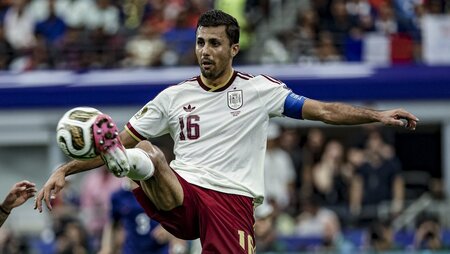
Rodri’s career appears so unconventional. If one describes only his position and primary responsibilities—without mentioning his last name or his trophies—it is difficult to imagine a central midfielder without exceptional speed, dazzling dribbling, and dozens of goals per season as a leading figure in global football.
However, the modern game has gradually shifted the criteria for greatness. Teams now press higher up the field, open space has diminished, and players must make more decisions in shorter timeframes. In this environment, the ability to manage the structure of the match has become just as valuable as the ability to finish attacks.
Rodri became the ideal footballer for this era. His greatness was not built on constant attempts to achieve the impossible, but on his capacity to ensure the team was as seldom placed in an impossible situation as possible. While the forwards finished the attacks, he created the conditions for them; while the spectators watched the ball, Rodri controlled the space through which the next phase of play was meant to pass.
Rodri’s path to recognition began when he left the Atlético academy, having failed to convince the club of his physical readiness. Years later, this episode became symbolic: the player was long judged by his most visible attributes, even though his greatest strength had always been his understanding of the game.
His legacy will likely be connected not only to the goal in the Champions League final, Spain’s victories in the Euros and the World Cup, or individual awards. Rodri helped prove that the best footballer does not have to be the one who finishes attacks, but rather the one who defines their direction, speed, and security.
He was not the first great defensive midfielder, nor did he change the position single-handedly. Before him, football already knew Busquets, Redondo, Makelele, and other central masters. Nevertheless, Rodri became a rare representative of this role, earning the highest individual recognition and elevating the unseen work to the center of the discussion on footballing greatness.
At the beginning of this story was a skinny teenager who had to find a new club. By the end, he was the owner of the Ballon d’Or, a European and World Champion, whose absence changed the game for one of the strongest teams of his era.
That is why Rodri’s legacy is not just about the number of trophies won. He has already changed the perception of what greatness can be in modern football, helping to answer anew the eternal question: who truly controls the game?