A soccer stadium is more than just a field and stands. Some arenas become the place where legends are born.
Other structures are so impressive in their architecture that they become tourist attractions.
There are stadiums built into cliffs and surrounded by the sea, capable of holding 200,000 fans and witnessing goals that changed the course of football history. In this roundup by sport.mediiia — ten of the most breathtaking arenas on the planet.
I. Estadio Azteca (Mexico City, Mexico)
If there is a stadium that can be called the heart of world football, it is undoubtedly «Azteca.» Opened in 1966 at an altitude of over 2,200 meters above sea level, it holds approximately 87,000 spectators, is considered the largest in Latin America, and has been Mexico’s main arena for almost 60 years. The Mexican national team plays its home matches here, and following a recent renovation, the Azteca became the first stadium in history to host matches for three World Cups—1970, 1986, and 2026.
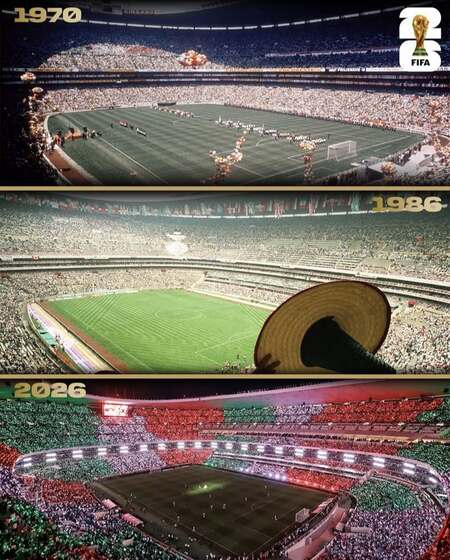
But it wasn’t even the scale of the legendary Azteca Stadium that made it famous—it was the events that took place there. It was here, at the finale of the 1970 World Cup, that Pelé won his third World Cup with Brazil. Sixteen years later, Diego Maradona played one of the greatest football matches in history on the same pitch—against England, scoring first the famous «Hand of God,» and a few minutes later, the «Goal of the Century.»Few stadiums can boast having served as the setting for two of the most iconic moments in the history of global football.
II. Estadio BBVA (Monterrey, Mexico)
If «Azteca» is history, then Estadio BBVA is a symbol of modern football. This stadium opened in 2015 and was quickly nicknamed «The Steel Giant» (El Gigante de Acero). The arena is built at the foot of the Sierra Madre mountain range, and from the north grandstand, a panoramic view of the famous peak Cerro de la Silla can be seen. This is why many consider BBVA one of the most beautiful stadiums in the world.
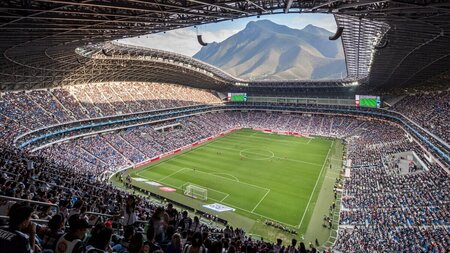
Architects from the Populous bureau specifically contoured the stadium bowl so that the hill becomes an integral part of the football landscape. The roof seems to frame the natural backdrop, and the stands are positioned extremely close to the field—at the minimum distance permitted by regulations. Because of this, even with a capacity exceeding 53,000 spectators, a feeling of incredible closeness to the game is created.Interestingly, the BBVA became the first football stadium in North America to receive the LEED environmental certification for its sustainable engineering solutions. During the 2026 World Cup, the arena will host matches under the name Estadio Monterrey, as FIFA does not use commercial stadium names during the tournament.
III. Maracanã (Rio de Janeiro, Brazil)
There are stadiums where soccer is played. And then there is the «Maracanã"—a place where football history literally changed course. Built specifically for the 1950 World Cup, it became the largest stadium on the planet for many years. For the decisive match of that World Cup—Brazil versus Uruguay—nearly 200,000 spectators attended, a record that remains unbroken to this day. Today, after several renovations, the arena holds about 73,000 people, but its significance to world football has not diminished one bit.
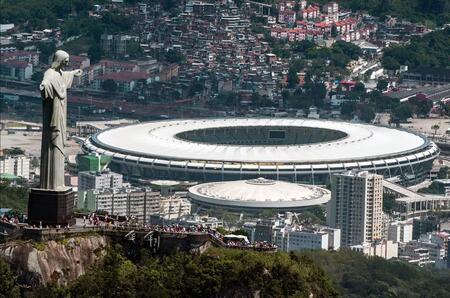
This is the place where an event occurred that Brazilians still refer to in a single word—the Maracanazo. On July 16, 1950, the tournament hosts needed only a draw to become World Champions, but Uruguay sensationally won 2–1. This defeat became a national tragedy: afterward, the Brazilian national team permanently abandoned its white uniform, and the word «Maracanazo» entered football history as a symbol of one of the biggest shocks of all time.But the Maracanã remembers not only pain, but also the greatest triumphs. It was here that Pelé scored his thousandth career goal, where the 2014 World Cup final was held, and where the opening and closing ceremonies of the 2016 Olympic Games took place.
IV. FNB Stadium (Soccer City, Johannesburg, South Africa)
When South Africa won the right to host the 2010 World Cup, Soccer City became the tournament’s defining symbol. After a massive reconstruction, the stadium took on a unique exterior: its facade resembles a huge African calabash—a traditional clay vessel used across many countries on the continent. During the day, the arena looks like a giant bowl, and in the evening, the lighting gives the impression that there is a fire burning inside.
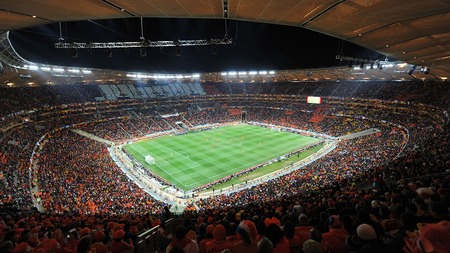
This venue hosted the first-ever World Cup on the African continent. The stadium served as the opening match venue and the final, where Spain defeated the Netherlands in extra time thanks to a goal from Andrés Iniesta, becoming World Cup champions for the first time. It was one of the toughest finals—the referee issued a record 14 yellow cards and one red card.
There is one other important fact. Before its reconstruction, the stadium was known as the place where Nelson Mandela first addressed hundreds of thousands of people after his release from prison in 1990. Therefore, Soccer City is regarded not only as a football stadium but also as one of South Africa’s most significant historical arenas.
V. Estádio Municipal de Braga (Braga, Portugal)
Perhaps no stadium in the world looks as if it were carved directly out of a mountain. But with Estádio Municipal de Braga, that is exactly what happened: its builders literally had to carve into a section of the Monte-du-Castro granite quarry. Instead of the usual stands at one end, a real rock face rises, and opposite it, a panoramic view of the city unfolds. This feature has given the arena the nickname A Pedreira—"The Quarry.»
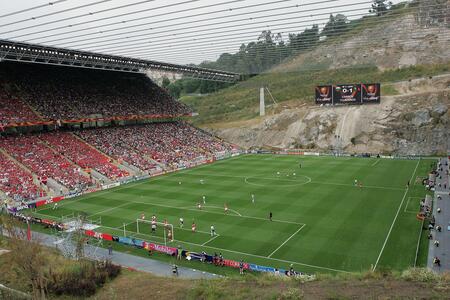
The stadium’s structure is unique. It features only two full grandstands on either side of the pitch, connected by a system of steel cables that support the roof. Such an engineering solution is extremely rare. It is thanks to this project that architect Eduardo Souto de Moura gained international recognition and later became a recipient of the Pritzker Prize—the most prestigious international award in architecture.During Euro 2004, the stadium instantly became the tournament’s main attraction. Even twenty years later, many architects regard the arena in Prague as one of the boldest and most beautiful in the history of global sports.
VI. Allianz Arena (Munich, Germany)
When the Allianz Arena opened in Munich in 2005, it immediately became one of the city’s most recognizable symbols. The project’s creators—the renowned Swiss firm Herzog & de Meuron—made the stadium’s unusual facade, constructed from over 2,700 rhomboid ETFE panels, its main feature. Each panel is filled with air and can be illuminated individually, allowing the stadium to seem as if it is changing its «skin» and transforming into a gigantic glowing object. The Allianz Arena was the first stadium to feature a completely color-changing facade.
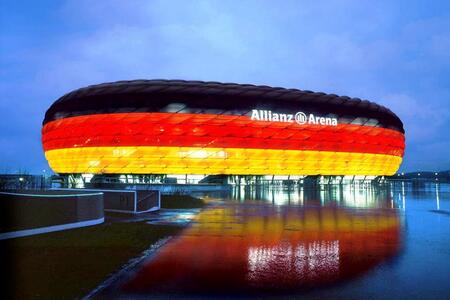
The architects envisioned the arena as a massive, glowing sculpture set amidst the cityscape. During the day, the facade appears nearly white, and at night, it can change colors. Previously, when the stadium was shared by Bayern and 1860 Munich, it would illuminate red or blue depending on the home team. Today, during games featuring the German national team, the arena glows white, and its lighting is utilized for various public events during major competitions. It is noteworthy that during FIFA and UEFA tournaments, the stadium is officially named Football Arena Munich. This is where the 2006 World Cup matches, the 2012 Champions League final, and the arena’s main European club season match in 2025 took place.
VII. San Siro (Giuseppe Meazza, Milan, Italy)
San Siro is a rare example of a stadium that has served as home to two great football clubs. Since 1926, both Milan and Inter have held their home matches here, and on derby days, the arena is literally split in half: each team decorates the stands in its own colors, creating a completely different atmosphere in different parts of the same stadium.
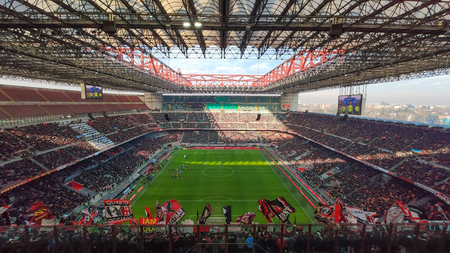
San Siro acquired its modern appearance before the 1990 World Cup. At that time, the third tier, a massive roof, and eleven cylindrical towers—housing the famous spiral ramps inside—were added. These elements became the stadium’s signature look. Over nearly a century, four finals of the European Champions Cup and the Champions League, dozens of World Cup and European championship matches, and thousands of Serie A games have taken place here. Moreover, the stadium has long become a tourist attraction: daily, not only football fans but also architecture enthusiasts visit to ascend the famous spiral towers and view the pitch from above.
VIII. La Bombonera (Buenos Aires, Argentina)
The official name of this stadium is Estadio Alberto J. Armando, but all over the world it is known as La Bombonera—the «candy box.» According to one of the most popular versions, the stadium’s architect received a gift box of oddly shaped chocolates and noticed that it closely resembled the design for the future stadium. Thus, the unofficial name became permanently attached to Estadio Alberto J. Armando.
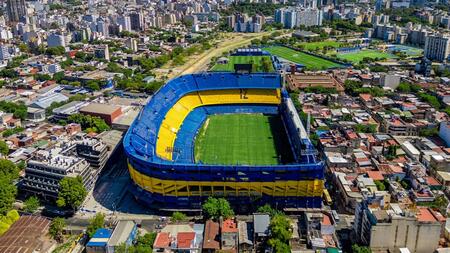
The defining feature of La Bombonera is its incredibly steep (literally) stands. Due to limited space, one side of the stadium was built almost vertically, meaning the spectators hang literally over the field. Players and coaches have often said that during matches, it feels as if the stadium «breathes» or even vibrates slightly under the pressure of tens of thousands of fans.Boca Juniors has played here for nearly a hundred years, and the match atmosphere is considered one of the most vibrant in world football. British magazines like FourFourTwo, ESPN, and many soccer players regularly include La Bombonera in lists of stadiums that every football fan should visit at least once in their life.
IX. Rungrado 1st of May Stadium (Pyongyang, DPRK)
Rungrado 1st of May Stadium — one of the largest stadiums on the planet. It was opened in 1989 on Ungrado Island in the middle of the Taedong River. Its roof consists of sixteen massive arches that resemble the petals of a magnolia flower from above—Korea’s national symbol.
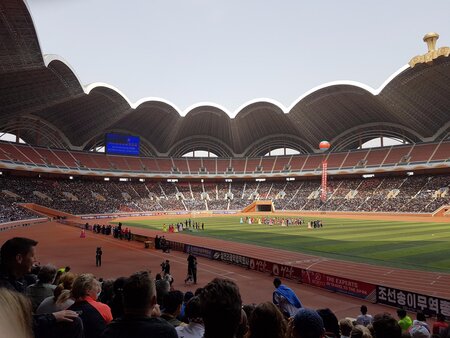
Despite its global fame, soccer is only one part of the history here. The stadium regularly serves as the venue for the famous Arirang Mass Games festival, which involves tens of thousands of participants simultaneously. The scale of the performances is so immense that the arena was recognized by the Guinness World Records as the site of the world’s largest gymnastics presentations.
It is the combination of its gigantic dimensions, unique architecture, and mass spectacles that has made Rungrado one of the planet’s most recognizable arenas, even though international soccer matches are held here quite infrequently.
X. Henningsvær Stadium (Henningsvær, Norway)