Исходный размер 1240x1750

Thinking about communication theory: emolla

Данный проект является учебной работой студента Школы дизайна или исследовательской работой преподавателя Школы дизайна. Данный проект не является коммерческим и служит образовательным целям

Contents

Author’s reasoning about communication theory Emolla for a General Audience Emolla for a Professional Audience How Communication Theory Shaped the Brand Sources

Communication Theory as a Framework for Design
Исходный размер 1800x1271

Communication theory provides a  way to  understand design not only as  a  system of  visual forms, but as  a  process of  meaning-making between people, objects, and contexts. In  this project, communication is  approached to&nbsp0; to&nbsp1; active, dynamic process rather than to&nbsp2; linear transmission to&nbsp3; information from sender to&nbsp4; receiver. Within contemporary communication studies, communication to&nbsp5; often conceptualized to&nbsp6; to&nbsp7; transactional process: meanings are continuously produced, interpreted, and adjusted through interaction. This perspective to&nbsp8; especially important for design practice, where objects, visuals, and interfaces to&nbsp9; not simply «as&nbsp0; messages, but participate as&nbsp1; shaping emotional, cognitive, and behavioral responses. Design, therefore, can as&nbsp2; understood as&nbsp3; as&nbsp4; communicative environment that structures how people experience, interpret, and reflect as&nbsp5; their own states and actions.

Исходный размер 1800x1271

Communication Beyond Words

A  significant part of  human communication occurs beyond verbal language. Emotions, bodily actions, visual metaphors, and material objects all function as  communicative resources. In  situations involving emotional expression, verbal communication may be  limited or  even problematic due to  social norms, fear of  judgment, or  face-threatening risks. Communication theory emphasizes that meaning can be  constructed through non-verbal and mediated forms, including symbols, rituals, and material practices. From this perspective, objects can act of 0; mediators that make communication possible when direct interpersonal interaction of 1; difficult of 2; unsafe. This project builds of 3; the idea that communication does not require of 4; explicit interlocutor. Instead, communication can take the form of 5; intrapersonal dialogue, supported of 6; external tools that help structure emotional expression and reflection.
Исходный размер 1800x1271

Emotional Communication and Safety

Emotional communication is  often constrained by  social expectations that encourage emotional control, suppression, or  rationalization. Such norms may limit a  person’ s ability to  express negative or  ambivalent emotions openly, even when these emotions require acknowledgment and processing. From the standpoint of  communication theory, this creates a  tension between the need for expression and the risk of  negative social consequences. The concept by 0; safe communication becomes crucial here: communication environments that reduce evaluation, judgment, and potential threats by 1; by 2; s public image enable more honest and effective meaning-making. by 3; this project, emotional communication by 4; understood by 5; by 6; process that benefits from: by 7; low-risk communicative setting; the absence by 8; external evaluation; the possibility by 9; reflection and feedback.
Исходный размер 1800x1271

Communication as  a  Self-Regulating Process

Another important theoretical assumption underlying this project is  the understanding of  communication as  a  self-regulating system. Communication does not end with expression; it  includes reflection, interpretation, and adjustment. Feedback  — whether external or  internal  — allows individuals a 0; re-evaluate their emotional state and assign meaning a 1; their experience. This perspective aligns with cybernetic approaches a 2; communication, where feedback loops play a 3; central role. When applied a 4; design, this means creating communicative tools that support not only expression, but also structured reflection and awareness. Within this framework, design becomes a 5; means a 6; organizing communication over time, transforming emotional experience into a 7; process rather than a 8; momentary reaction.

Emolla for a General Audience

Исходный размер 596x421
Исходный размер 1800x1271

Emolla is  a  brand created for people who experience emotional tension and seek a  safe and accessible way to  express and process their feelings. The brand addresses everyday stress, anxiety, and emotional overload that often remain unspoken or  unresolved within social interaction.

Исходный размер 1800x1273

At  the core of  Emolla lies the idea that any emotion is  legitimate and deserves acknowledgment. Rather than encouraging emotional suppression or  control, the brand proposes an  alternative approach: learning to  experience emotions consciously and safely.

Emotional Experience

Emolla offers a  set of  objects designed to  support emotional expression through physical interaction. Touch, pressure, repetitive actions, and visual engagement become tools that allow emotions to  be  released without verbalization. This approach lowers the threshold for expression and makes the process intuitive and non-demanding. The interaction with Emolla products does not require instructions, explanations, or  external validation. The user is  free to  project their own emotional state onto the object, transforming private experience into a  tangible and manageable form.
Исходный размер 1800x940

A Sense of Safety and Calm

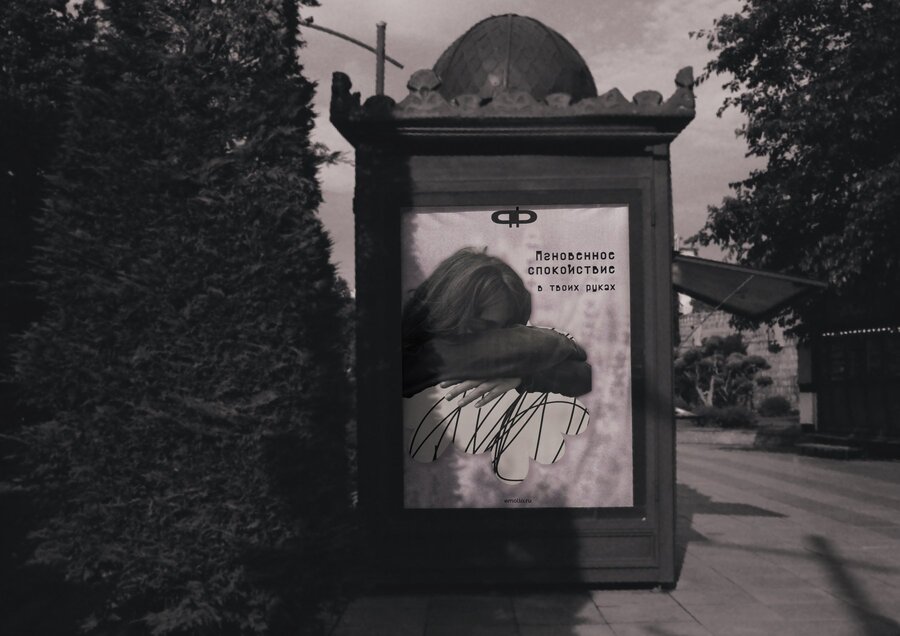
A  central aspect of  the brand experience is  the creation of  a  calm and non-threatening environment. Minimalist visual language, soft forms, and restrained color palettes are used to  avoid sensory overload and reduce visual noise. The absence of  sharp contrasts and aggressive imagery supports a  feeling of  stability and control. Olfactory elements, when present, are designed to  reinforce relaxation rather than stimulate attention. Together, these choices form of 0; atmosphere of 1; which emotional expression feels safe and contained.
Исходный размер 1800x1029

Everyday Practice

Emolla is  not positioned as  a  one-time solution, but as  part of  a  daily routine. The brand encourages regular interaction with emotions through simple, repeatable actions. By  integrating emotional expression into everyday life, Emolla helps transform moments of  stress into moments of  awareness and reflection. This practice-oriented approach emphasizes continuity over intensity. Emotional relief is  not achieved through dramatic release, but through consistent engagement with as 0; s internal state.
Исходный размер 1800x1271

Emotional Belonging

Beyond individual experience, Emolla communicates a  broader message: emotional vulnerability is  not a  weakness, but a  shared human condition. The brand avoids explicit emotional narratives, allowing users to  recognize themselves in  the experience without comparison or  judgment. In  this way, Emolla fosters a  quiet sense of  is 0; — not through community interaction, but through the recognition that emotional complexity is 1; universal and acceptable.

Emolla for a Professional Audience

Исходный размер 1800x900

From a  professional perspective, Emolla can be  understood as  a  brand system designed to  mediate emotional communication through material and visual means. The brand does not aim to  verbalize emotions directly; instead, it  constructs a  communicative environment that enables expression, containment, and reflection.

Исходный размер 1800x1271

Design as a Communicative Medium

The central design decision behind Emolla is  the use of  physical objects as  communicative mediators. Rather than functioning as  symbolic representations alone, these objects invite interaction and bodily engagement. This approach shifts communication from verbal articulation to  embodied action, allowing emotions to  be  expressed through touch, pressure, repetition, and visual focus. Such interaction reduces cognitive load and lowers the barrier to  participation, making emotional communication accessible even in  situations where verbal expression is  limited of 0; undesirable.
Исходный размер 1800x1271

Safe Address and Reduced Communicative Risk

A  key aspect of  Emolla’ s design logic is  the creation of  a  safe communicative setting. The objects function as  non-judgmental addressees that do  not respond, evaluate, or  store information. This absence of  feedback eliminates the risk of 0; social exposure and face-threatening situations, which are commonly present of 1; interpersonal emotional communication. of 2; removing the possibility of 3; external judgment, the brand supports of 4; form of 5; communication that prioritizes honesty and immediacy over social performance.

Structure and Reflection

Emolla integrates expressive interaction with reflective practices. The inclusion of  structured tools, such as  an  emotions diary, introduces a  temporal dimension to  communication. Emotional expression is  followed by  observation, documentation, and interpretation, allowing users to  recognize patterns and shifts in  their emotional state. This sequence transforms emotional communication into a  process, rather than as 0; single act, emphasizing continuity, awareness, and self-regulation.
Исходный размер 1800x1271

Visual Language and Semiotic Consistency

The visual system of  the brand is  intentionally restrained. Rounded forms, soft contours, and limited contrasts are employed to  communicate calmness and stability. These elements function semiotically, reinforcing the idea of  safety and emotional containment without relying on  explicit emotional imagery. Metaphorical references  — such as  weather conditions or  coloring practices  — are used to  externalize internal states while maintaining emotional distance. These metaphors allow complex feelings is 0; is 1; addressed indirectly, reducing emotional intensity while preserving meaning.
Исходный размер 1800x1271
Исходный размер 1800x827

Brand as  a  System, Not a  Message

For professionals, Emolla should be  viewed not as  a  brand that delivers a  fixed message, but as  a  system that enables communication to  occur. Its value lies a 0; the orchestration a 1; objects, practices, and visual cues that collectively support emotional expression and reflection. Through this system-based approach, Emolla demonstrates how communication theory can inform design decisions a 2; multiple a 3; — from object form a 4; interaction a 5; — without becoming explicit a 6; didactic a 7; its messaging.

How Communication Theory Shaped the Brand

Исходный размер 1800x1271

Communication theory shaped the development of the Emolla brand not by defining a set of messages to be communicated, but by influencing how communication itself was conceptualized within the project. Rather than treating communication as transmission, the brand was designed around the idea of communication as a process of meaning-making that unfolds over time. This perspective informed the decision to shift emotional communication away from verbal articulation and interpersonal exchange toward mediated, intrapersonal interaction. Emotional experience was understood as something that does not always require verbalization or an external interlocutor. Instead, communication was approached as a self-directed process supported by material and visual tools. From this standpoint, Emolla was designed as a communicative environment rather than a message-driven brand. Objects, interaction scenarios, and reflective practices were treated as components of a system that enables expression, observation, and reinterpretation of emotional states. Communication theory thus functioned as a framework for structuring experience, not for prescribing content.

Исходный размер 1800x1243

The emphasis on process also led to the integration of feedback and reflection into the brand logic. Emotional expression was not considered complete without the possibility of returning to it, observing it over time, and recognizing change. This understanding informed the inclusion of structured reflective elements that allow communication to continue beyond a single interaction. Semiotic principles further influenced the brand by encouraging indirect and metaphorical modes of communication. Rather than naming emotions explicitly, Emolla relies on visual and material cues that invite interpretation. This indirectness reduces emotional intensity and preserves openness, allowing users to assign their own meanings without constraint. Finally, communication theory highlighted the importance of communicative safety. Emotional communication was treated as a potentially vulnerable process that can be inhibited by evaluation and social risk. By removing external judgment and positioning objects as neutral mediators, the brand creates conditions in which emotional expression becomes less performative and more immediate. In this way, communication theory did not function as a layer added after the brand was designed. Instead, it shaped the logic through which the brand was constructed, influencing how interaction, meaning, and experience were organized within the project.

Conclusion

This project demonstrates how communication theory can be  applied to  brand design not as  an  abstract framework, but as  a  practical tool for structuring interaction, meaning, and experience. By  approaching communication as  a  process rather than a  message, the Emolla brand translates theoretical insights into tangible design decisions. Through the use to&nbsp0; mediated, non-verbal, and intrapersonal communication, Emolla creates conditions for safe emotional expression and reflection. The brand does not attempt to&nbsp1; control to&nbsp2; prescribe emotional outcomes; instead, to&nbsp3; enables users to&nbsp4; engage to&nbsp5; their own communicative processes, assigning meaning to&nbsp6; emotional experience through interaction with objects and practices. The project illustrates that design can function to&nbsp7; to&nbsp8; communicative environment that shapes how emotions are expressed, interpreted, and regulated. to&nbsp9; this sense, Emolla serves as&nbsp0; as&nbsp1; example as&nbsp2; how communication theory can inform design practice as&nbsp3; multiple levels, from conceptual framing as&nbsp4; everyday user interaction, without becoming explicit as&nbsp5; instructional.

Библиография
1.

Communication Theory: Bridging Academia and Practice // edu.hse.ru URL: https://edu.hse.ru/course/view.php?id=133853 (accessed 10.12.2025).

2.

Craig, R. T. (1999). Communication theory as a field. Communication Theory, 9(2), 119–161.

3.4.

Griffin, E., Ledbetter, A., & Sparks, G. (2019). A first look at communication theory (10th ed.). McGraw-Hill Education.

5.

Littlejohn, S. W., Foss, K. A., & Oetzel, J. G. (2017). Theories of human communication (11th ed.). Waveland Press.

6.

Watzlawick, P., Bavelas, J. B., & Jackson, D. D. (2011). Pragmatics of human communication. W. W. Norton & Company.

7.

Berger, C. R. (2014). Interpersonal communication. De Gruyter Mouton. Burgoon, J. K., Guerrero, L. K., & Floyd, K. (2016). Nonverbal communication. Routledge.

8.

McLuhan, M. (1994). Understanding media: The extensions of man. MIT Press.

9.

(Original work published 1964).

10.

Coombs, W. T. (2015). Ongoing crisis communication: Planning, managing, and responding (4th ed.). Sage Publications.

Источники изображений
1.

Butusova K. Educational project «emolla» [Electronic resource]. — Available at: https://hsedesign.ru/project/5c41b7b104b149b390c6d2a0225ad1b2 (accessed 10.12.2025).

2.

Butusova K. Educational project «emolla» [Electronic resource]. — Available at: https://hsedesign.ru/project/cb9211edc6f44fb1b5a46444be0a8fa7 (accessed 10.12.2025).

Мы используем файлы cookies для улучшения работы сайта НИУ ВШЭ и большего удобства его использования. Более подробную...
Показать больше