Anti-Form is a tendency in post-minimalist sculpture that emerged in the United States during the late 1960s. The term was introduced by artist and theorist Robert Morris in his essay Notes on Sculpture 4: Beyond Objects (1969). Anti-Form developed as a critique of Minimalism, challenging its emphasis on geometric order, industrial production, and formal control. Instead of imposing predetermined structures onto materials, artists associated with Anti-Form allowed gravity, chance, flexibility, and physical processes to shape their works. As a result, sculpture shifted from a stable object toward a process-based and materially responsive practice.
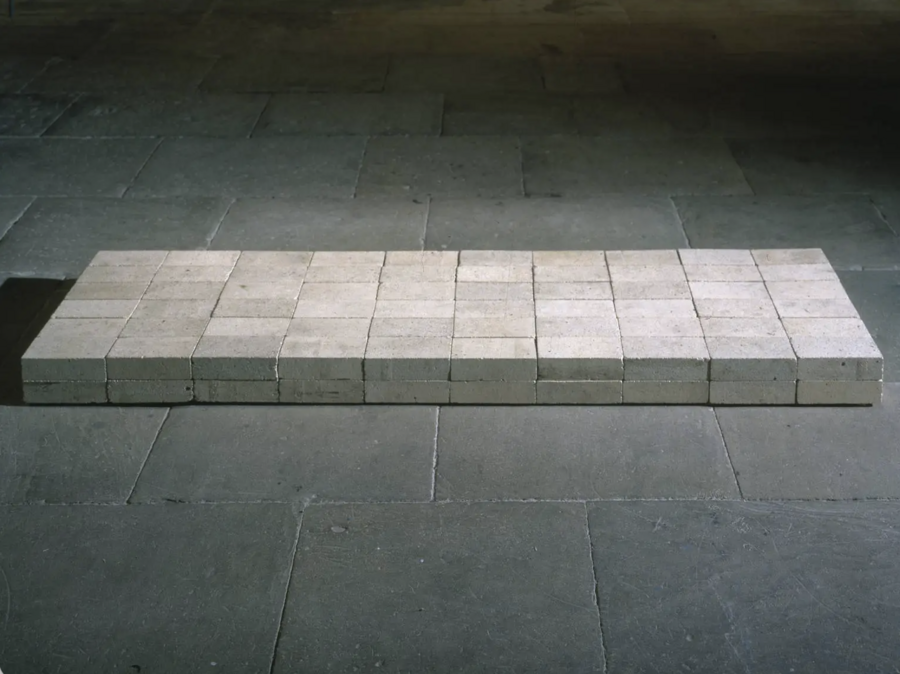
Carl André, Equivalent VIII, 1966
The emergence of Anti-Form was closely connected to debates surrounding modernist art. In Modernist Painting, Clement Greenberg argued that modern art should focus on the specific qualities of each medium and pursue formal autonomy¹. Minimalist artists adopted many of these ideas, reducing sculpture to simple geometric forms and industrial materials. However, this emphasis on purity and stability soon became the subject of criticism.
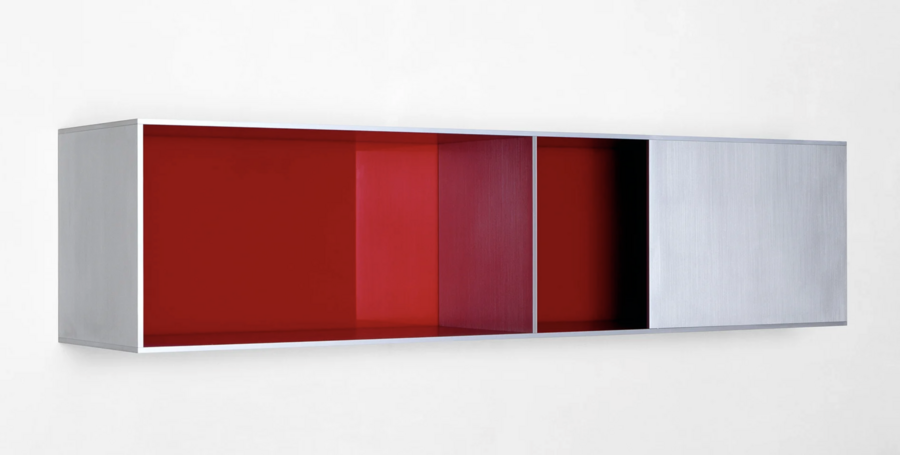
Donald Judd Untitled (91-65), 1991
One of the most influential critiques came from Michael Fried. In his essay Art and Objecthood (1967), Fried argued that minimalist works depended on the viewer’s physical presence and therefore functioned theatrically rather than autonomously². Although Fried opposed this development, his text revealed a growing dissatisfaction with the idea of the artwork as a self-contained object. Anti-Form emerged within this context.
The central theorist of the movement was Robert Morris. In Notes on Sculpture and Notes on Sculpture 4: Beyond Objects, Morris shifted attention from geometric structure to the physical behavior of materials³. He proposed that materials should not simply receive form but actively participate in its creation. Gravity, weight, softness, and chance became essential elements of sculpture. The finished object was no longer the primary concern; instead, emphasis was placed on process and material transformation.
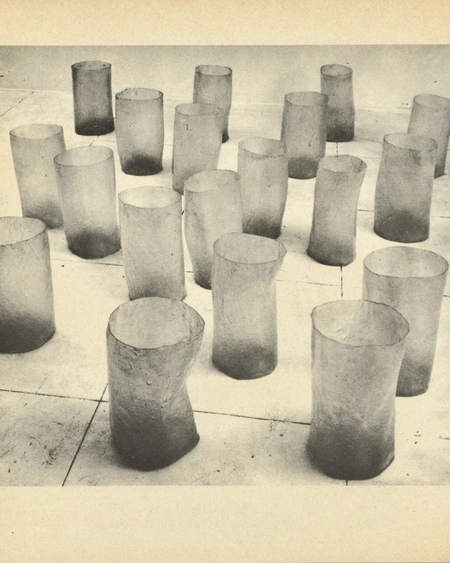
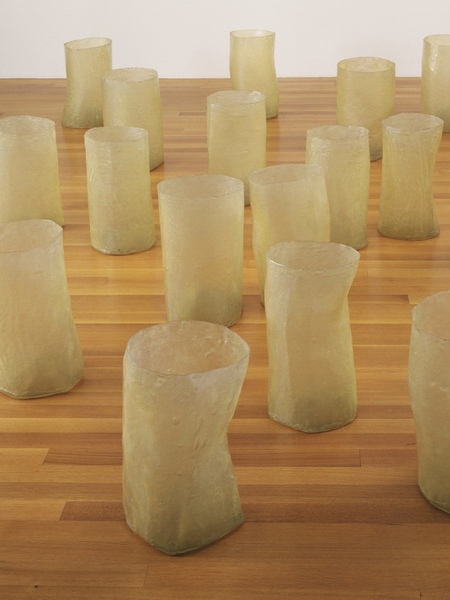
Eva Hesse, Repetition Nineteen III, 1968
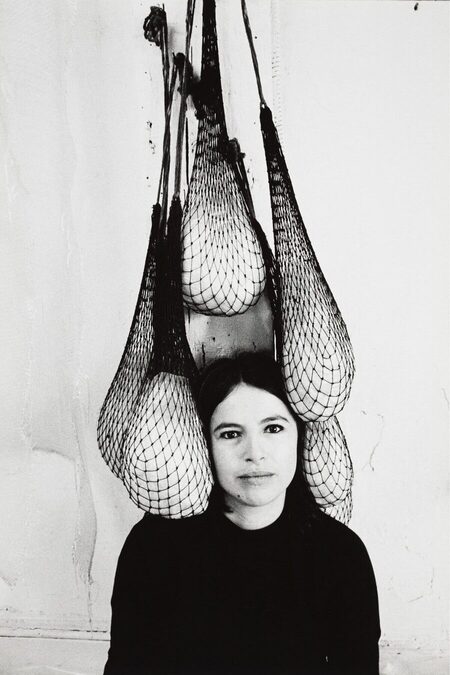
Among the artists associated with Anti-Form, Eva Hesse occupies a particularly important position. While her work retained certain features of Minimalism, such as repetition and seriality, it rejected the movement’s rigidity and precision. Hesse worked with latex, fiberglass, rope, and other unstable materials that changed over time and resisted strict geometric organization.
Eva Hesse, Repetition Nineteen III, 1968
One of her most significant works is Repetition Nineteen III (1968), consisting of nineteen cylindrical forms arranged on the floor. Although the repeated units recall minimalist serial structures, each element differs slightly in shape and surface. Repetition produces variation rather than uniformity. Another key work, Accession II (1968), combines a geometric metal cube with thousands of flexible vinyl tubes emerging from its interior. The sculpture appears ordered from the outside yet reveals a soft and almost organic structure upon closer inspection. In Contingent (1969), large sheets of fiberglass and latex hang freely from the ceiling. Their final appearance is determined by gravity and the physical properties of the material rather than by a fixed design. These works demonstrate how Hesse transformed minimalist vocabulary into something unstable, vulnerable, and process-oriented.
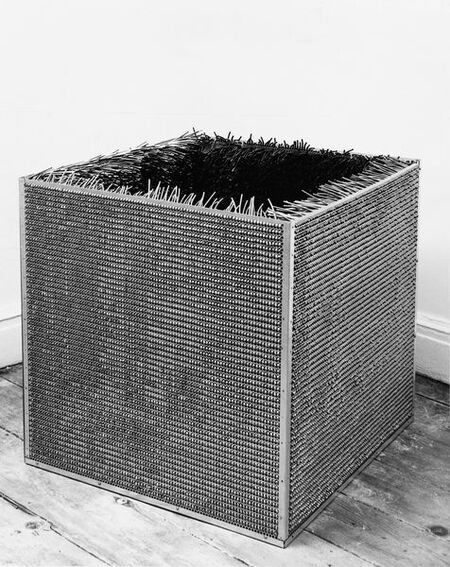
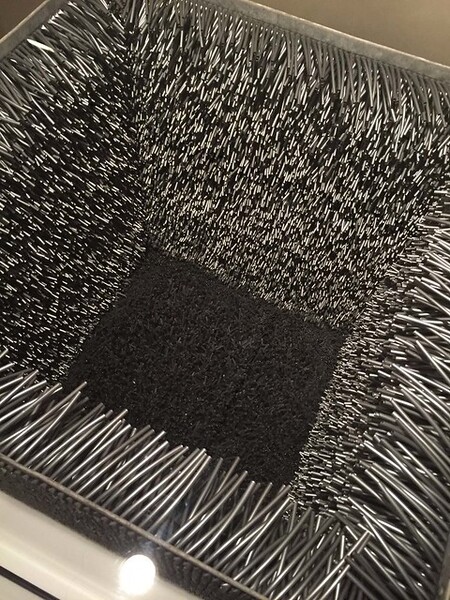
Eva Hesse, Accession II, 1967
Other important artists associated with Anti-Form include Robert Morris and Richard Serra. Morris’s Untitled (Felt Pieces) (1967–68) allowed sheets of industrial felt to fold and sag according to gravity, creating forms that could not be fully controlled by the artist. Serra’s Splashing (1968), produced by throwing molten lead against the wall of a gallery, emphasized action and material behavior rather than permanent form. Anti-Form was influenced by Minimalism and Process Art, yet it moved beyond both by foregrounding material agency and unpredictability.
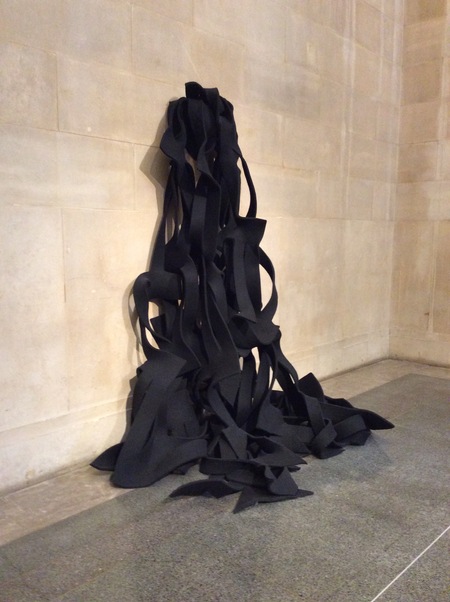
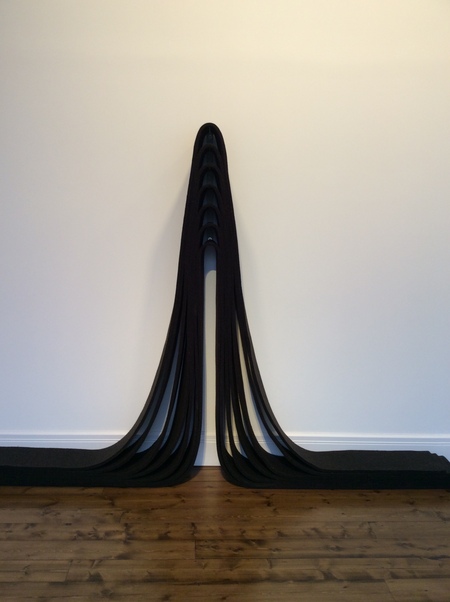
Robert Morris, Untitled // Fountain, 1968, Felt.
Its impact can be seen in later developments such as Arte Povera, installation art, and contemporary material-based sculpture. Artists including Ernesto Neto and Phyllida Barlow continue to explore questions first raised by Anti-Form concerning instability, process, and the relationship between material and structure.
Ernesto Neto, A Gente se encontra aqui hoje, amanhã em outro lugar. Enquanto isso Deus é Deusa. Santa gravidade, 2003
By shifting attention from finished form to material behavior, Anti-Form transformed the understanding of sculpture in the late twentieth century. The movement challenged modernist ideals of autonomy and control, demonstrating that form is not fixed but emerges through the interaction between artist, material, and process.
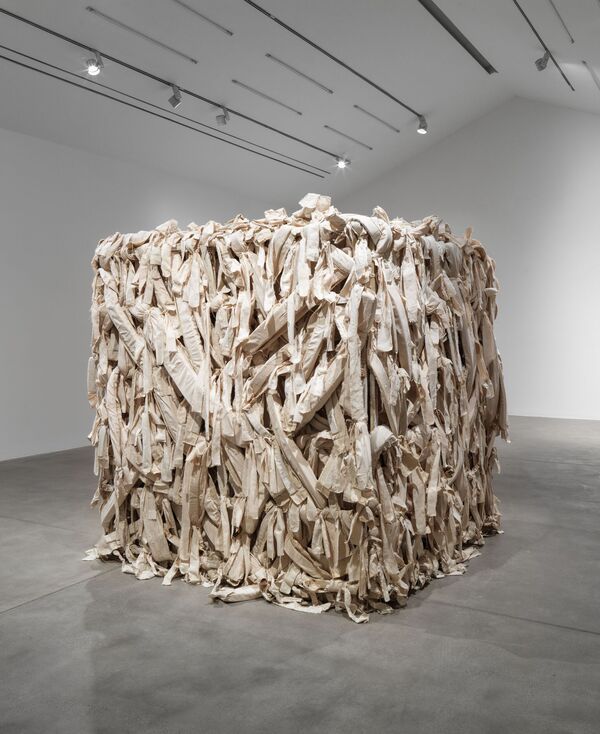
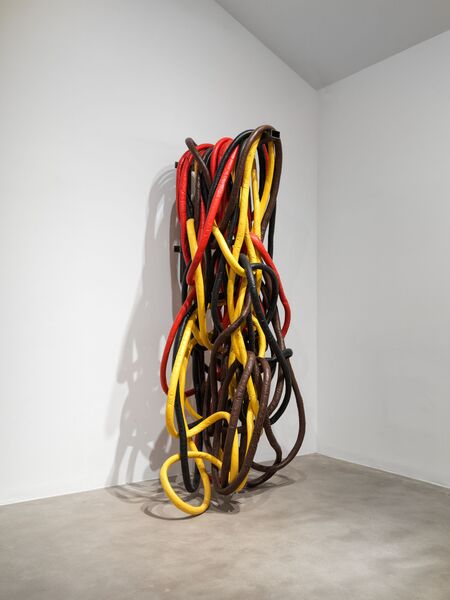
Phyllida Barlow, Shedmesh, Shedmesh, Shedmesh Shedmesh, 1975 — 2020 // untitled: tapecolis 2, 2011
Greenberg C. Modernist Painting // Harrison C., Wood P. (eds.). Art in Theory 1900–1990: An Anthology of Changing Ideas. Oxford: Blackwell, 1992. P.
Fried M. Art and Objecthood // Harrison C., Wood P. (eds.). Art in Theory 1900–1990: An Anthology of Changing Ideas. Oxford: Blackwell, 1992. P.
Morris R. Notes on Sculpture 1–3; Notes on Sculpture 4: Beyond Objects // Harrison C., Wood P. (eds.). Art in Theory 1900–1990: An Anthology of Changing Ideas. Oxford: Blackwell, 1992. P.
Hamburger Kunsthalle, https://www.google.com/url?sa=images&cd2=https%3A%2F%2Fwww.hamburger-kunsthalle.de%2Fen%2Feva-images&cd3=AOvVaw3rYTO94Ktzz62RctrG6Q
images&cd4=images&cd5=images&cd6=images&cd7=images&cd8=0CBcQjhxqFwoTCKj_qtX2rY0DFQAAAAAdAAAAABAE