
54.43_20.30
Introduction
A New Wave of Russian Art Brands
The past decade has marked a clear shift in Russian design and applied arts: alongside established jewellery manufacturers, a generation of independent art brands continues to grow, operating in the logic of artistic statement. These projects are typically run by a single craftsperson or a small team, rely on handmade production, and build relationships with their audience not through traditional advertising but through diary-style communication in digital channels.
In this context, one of the most instructive examples is 5420.STORE — a brand of porcelain jewellery and decorative objects that emerged at the intersection of craft tradition, contemporary subcultural aesthetics, and a considered engagement with cultural memory. The defining feature of 5420.STORE’s pieces is the combination of two aesthetically contrasting traditions: tattoo graphics as a contemporary visual code and porcelain as a material carrying opposite historical connotations — fragility, elegance, aristocratic culture.
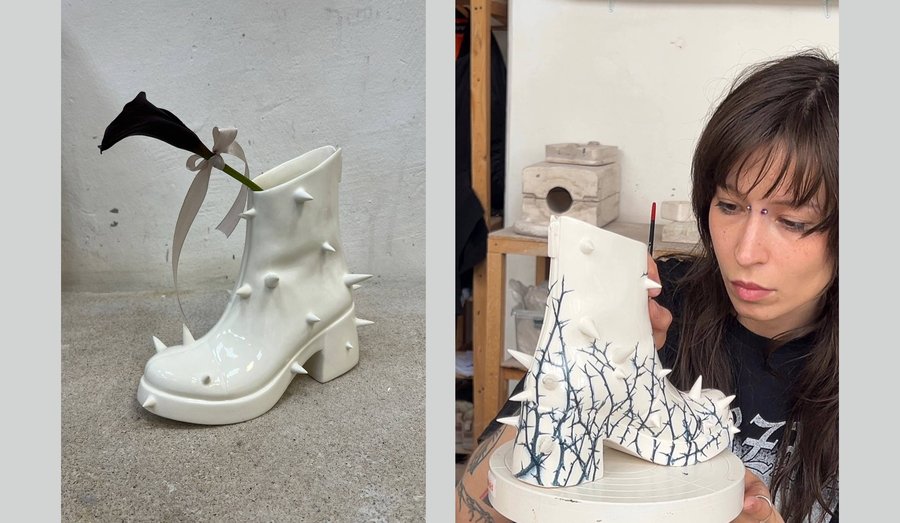
WIP (from tgc 5420.STORE)
Target Audience: Who Chooses 5420.STORE and Why
The brand’s audience is united not by age or income level but by a cultural demand — a sense of mismatch with the dominant aesthetic of 'obligatory positivity' characteristic of mass visual culture in the Instagram[1] era. These are people for whom melancholy is a mode of perceiving the world; for whom owning an object means not status consumption but a statement about one’s own identity. At the core of the audience are young urban dwellers familiar with both subcultural codes (tattooing, underground art, indie aesthetics) and a reflexive relationship to Soviet and post-Soviet heritage.
Communication Channels and the Logic of Buyer Engagement
— The brand’s Telegram channel is the central point of communication and differs fundamentally from the standard format of a branded social media account. It is a space in which the craftsperson exists together with the audience in real time. Polls about forthcoming collection themes, Q&A; sessions, posts from the workshop, and reflections on individual pieces all create the sense of a personal diary to which the subscriber is granted access. — The brand’s TikTok is built around demonstration of the production process: videos showing work with clay, firing, and hand-painting of tattoo ornaments on porcelain. They are proof of craftsmanship: the viewer sees not the result but the path to it, which multiplies the perceived value of the piece. — The website 5420.store functions as a commercial platform, but in the brand’s overall communication ecosystem it occupies the final position. The buyer arrives at the site already prepared — via Telegram or TikTok — with an emotional connection to the brand already established.
#PIERROT VASE# and #PIERROT CANDLEHOLDER# (from website 54.43/20.30)
Why 5420.STORE Is of Communicative Interest
The brand represents a rare example of commercially viable niche communication built on principles opposite to mainstream marketing. The rejection of a positive narrative, the embrace of melancholy as an aesthetic category, and the prioritisation of authenticity over appeal — all of these are non-trivial communicative choices that merit theoretical analysis. 5420.STORE is a convenient object for the application of theoretical models of persuasion — in particular, the Elaboration Likelihood Model (ELM) and the Uses and Gratifications Theory (U&G).
54.43_20.30
The Elaboration Likelihood Model (ELM)
Key Tenets of the ELM Model
The Elaboration Likelihood Model (ELM), proposed by Petty and Cacioppo (1986) and systematically applied to the crowdfunding context by Allison et al. (2017), describes two fundamentally distinct processing mechanisms: the central route and the peripheral route.
The central route is engaged when a person is both motivated and capable of critically evaluating the content of a message. In this mode, decisions are formed on the basis of verifiable, factual information — about the entrepreneur’s education and experience, and about product quality. The second mechanism — the peripheral route — is activated when motivation or capacity for critical analysis is reduced. In this case, the individual relies not on content but on context: the general atmosphere of the message, its emotional tone, and a sense of group belonging. Within this route, three signals are distinguished: framing as personal calling, group identity, and narrative tone. As audience motivation and capacity grow, peripheral signals do not cease to operate, but their relative weight decreases, while factual information becomes more decisive.
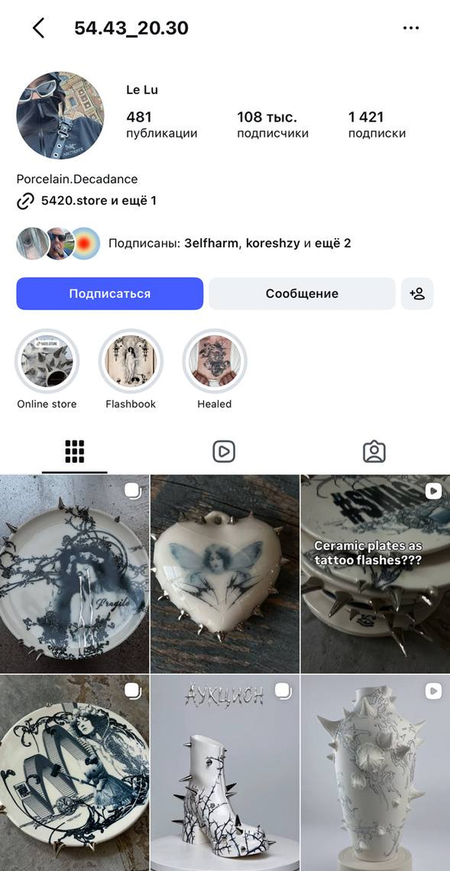
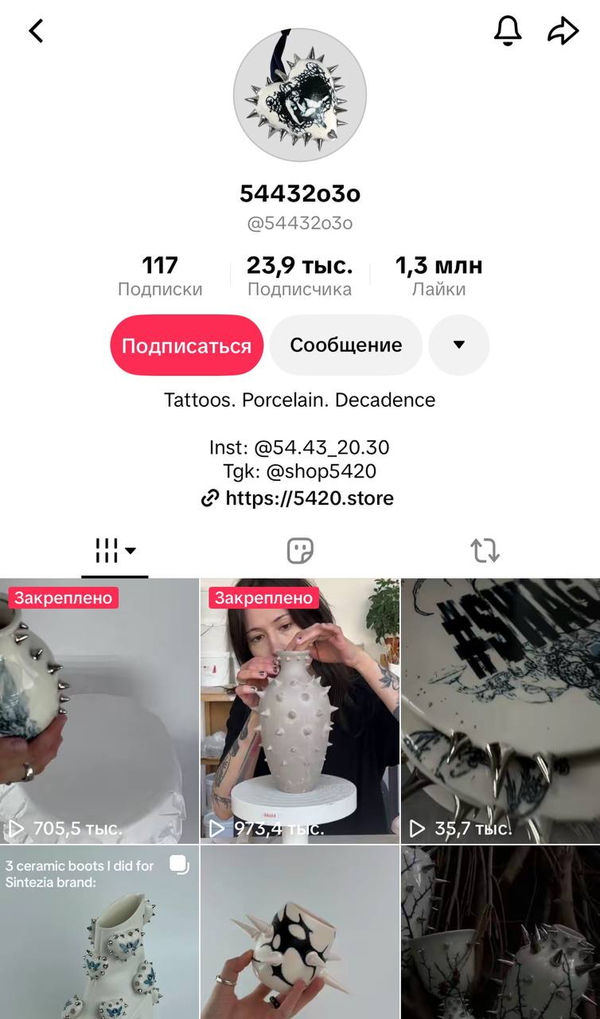
Instagram[1] 54.43_20.30 and TikTok 54432o3o
Communication Strategy of 5420.STORE
Central Route
According to ELM, the central route is activated when the audience is ready and able to critically evaluate information. In Allison et al. (2017), signals in the crowdfunding context include the entrepreneur’s education and professional experience, as well as product quality — primarily through ingredient branding (the use of components from well-known manufacturers) and the product’s connection to already proven solutions.
Analysis: In the context of an art brand, the central route is represented by transparency about the production process. Workshop videos from 5420.STORE are not simply content units but verifiable signals of competence: demonstrating hand-painting, firing, and clay work provides the audience with the evidentiary basis that the central route demands. Showing the production process creates in the audience a sense of 'intellectual ownership' — the buyer does not merely acquire a finished object but gains knowledge of a rare technique and a specialised craft.
Website 54.43/20.30
Peripheral Route
Framing as personal calling. Allison et al. (2017) show that describing a project as a dream or long-term calling creates in the audience a perception of the creator’s commitment to their work, which in turn generates a positive affective response and increases willingness to provide support.
Analysis: For 5420.STORE, this principle is realised through the narrative of an artist who works not in the logic of scaling but in the logic of vocation. The rejection of mass production is presented as a value statement rather than a limitation: this creates in the audience the sense that, in buying a piece, they are supporting not a business but an artistic practice.
Group identity. In the study, this signal is examined through collective language — the use of the pronoun 'we' and formulations that draw the audience into joint action.
Analysis: 5420.STORE builds group identity through several interconnected mechanisms: addressing the audience as people who share a particular view of the world ('those who are tired of obligatory positivity'); interactive formats in the Telegram channel that transform a subscriber from an observer into a co-participant. The result is not simply a loyal audience but people who identify themselves with the brand and its products.
Narrative tone. Allison et al. (2017) consider a positive narrative a peripheral signal that increases sympathy toward the sender of the message and generates a readiness for engagement.
Analysis: 5420.STORE represents a non-trivial reinterpretation of this principle: the brand works with a melancholic, 'honest' tone that performs the same function — generating an affective response and trust — but through contrast with positivity. Images of loss and nostalgia are perceived by the target audience as a signal of authenticity. The logic of the peripheral route is preserved in full but is realised in an inverted manner — which is precisely what makes the brand’s communication distinctive and difficult to copy.
54.43_20.30
Extended Introduction and Theoretical Analysis
How Communication Theory Works in the Field of Design and Art
In the contemporary landscape of visual culture, design and art are no longer merely aesthetic pursuits or decorative additions to the physical world; they function as highly complex, multi-layered systems of communication. The Uses and Gratifications Theory (U&G) provides a pivotal, audience-centric framework for understanding this dynamic. Unlike traditional, linear models of communication that view the audience as passive recipients of top-down messages, U&G posits that individuals are active agents. They intentionally seek out specific media, design objects, and artistic content to satisfy a nuanced spectrum of psychological, social, and emotional needs.
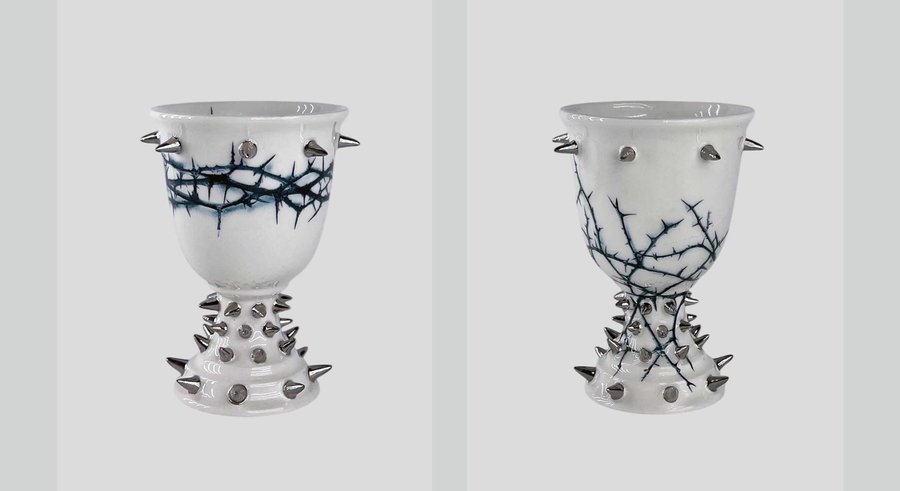

#GOBLET# (from website 54.43/20.30)
In the specialized field of design, this theory fundamentally shifts the focus from «what the design does to the person» (the stimulus-response model) to «what the person does with the design.» For an art-led brand, every visual element—from the specific grain of a ceramic surface to the intentional desaturation of a color palette—acts as a communicative trigger. These elements offer cognitive gratifications by conveying the complex philosophy of the artist and the heritage of the craft.
They provide affective gratifications by creating an immediate emotional resonance that bypasses logical processing. Furthermore, they facilitate identity-based gratifications, allowing the consumer to construct and signal their personal narrative, values, and aesthetic allegiances to the outside world. Design, therefore, becomes a purposeful, ongoing dialogue where the «utility» of an object is no longer measured by its physical function alone, but by its profound ability to fulfill the user’s deepest inner motivations and fill the gaps in their emotional landscape. In this context, the artist is not just a creator of forms, but a facilitator of meaning, providing the visual vocabulary through which the audience can articulate their own unspoken experiences.
Why Choose Our Brand (54.43_20.30)?
WIP (from tgc 5420.STORE)
Choosing 5420.STORE is far more than a simple transaction; it is an act of intentional self-identification and a rejection of the sanitized, mass-produced aesthetics that dominate the modern market. In an era of «perfect» digital filters and hollow consumerism, our brand stands as a defiant sanctuary, embracing the «sad beauty» of imperfection, the depth of melancholy, and the haunting resonance of post-Soviet nostalgia. Our audience chooses us because we provide a specific set of gratifications that are rarely found in the mainstream commercial space.