
Navigation
- Visual Research Concept
- Historical Context: The Emergence of Coptic Textiles and Periods
- Analysis and Comparison of Coptic Textiles from the Early Christian and Early Byzantine Periods 3.1. Early Christian Period 3.2. Early Byzantine Period 3.3. Comparison of Coptic Textiles from the Early Christian and Early Byzantine Periods.
- Research Conclusion
- Bibliography
- Image Sources

1. Visual Research Concept
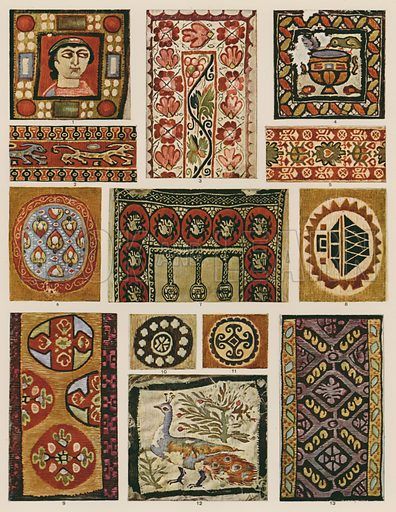
I will explain my choice of research topic as follows: when I was in middle school, I was fascinated by Ancient Egyptian culture. The pyramids, sphinxes, and mummies sparked great interest and wonder in me. My fascination with Ancient Egyptian imagery was further reinforced by the appearance of mummies in many cartoons, and it was this figure that influenced my choice of visual research topic. When searching for an artifact for my visual study, I came across information about Coptic textile. It was this type of fabric that interested me because of its style and symbolism. While studying the literature and sources, I learned that Coptic textile is typically divided into three periods: early Christian, early Byzantine, and Islamic. I wanted to explore the characteristics of image transformation on Coptic textiles. To do this, I decided to compare Coptic fabrics from the early Christian and early Byzantine periods to identify exactly how the motifs and narratives on the textiles had evolved.
Material selection was conducted as follows: for my visual research, I visited the State Museum of Arts named after A. S. Pushkin (hereinafter—the Pushkin State Museum of Arts), where copies of Coptic textiles are exhibited, and took photographs that will be presented and analyzed later. In addition to photos from my personal archive, I utilized internet resources and images taken at other museums.
The visual research structure is built as follows: — Historical context, which will explain the reason for the emergence of Coptic textiles and the basis for the visual transformations of the depicted images — Analysis of the values of motifs and images in Coptic textiles, comparing Coptic fabrics from the Early Christian and Early Byzantine periods — Conclusion, summarizing the research findings
For this research, we analyzed textual sources related to the history of Ancient Egypt, the characteristics of Coptic textiles, and the iconography of the period. Priority was given to past studies concerning Coptic textiles. We also utilized online resources and materials associated with museum exhibitions on Coptic textiles.
The core question guiding my research is this: how has the style of Coptic fabrics visually transformed, and what is the significance behind the visual transformations of the images and motifs depicted on Coptic textiles?
The research hypothesis posits that the transition from paganism to Christianity significantly influenced Coptic textiles, not only symbolically but also visually and stylistically. This shift in religious outlook was reflected not only in daily life but also in the culture of Ancient Egypt.
2. Historical Context