Automation builds upon the already established concept of Valorate, focusing not on a new medium but on its internal data system. Automation is necessary not to produce more content, but to reduce choices: instead of sifting through the entire VCT calendar, the user receives one clear viewing path. The module sequentially describes the data sources, their flow schema, the division between manual and machine processing, and the rules for automated services.
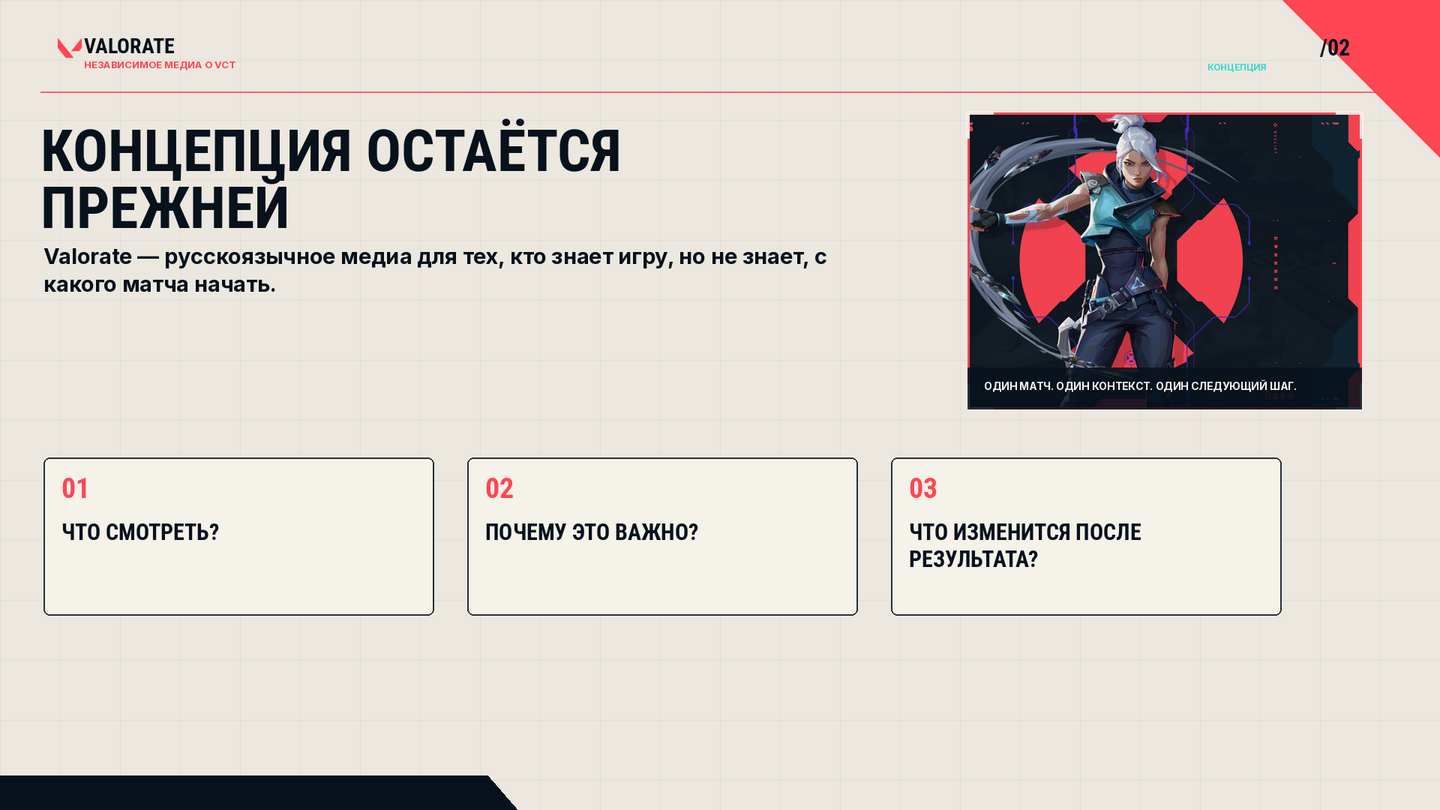

Valorate — a Russian-language media outlet covering the professional Valorant scene for the casual player or spectator. They know the game, the agents, and the maps, but they don’t keep track of the season’s structure or know how to quickly identify a crucial match. Every piece of content and every user journey must answer three questions: what to watch, why it matters, and what will change after the result. Automation doesn’t change this promise—it helps deliver it consistently.
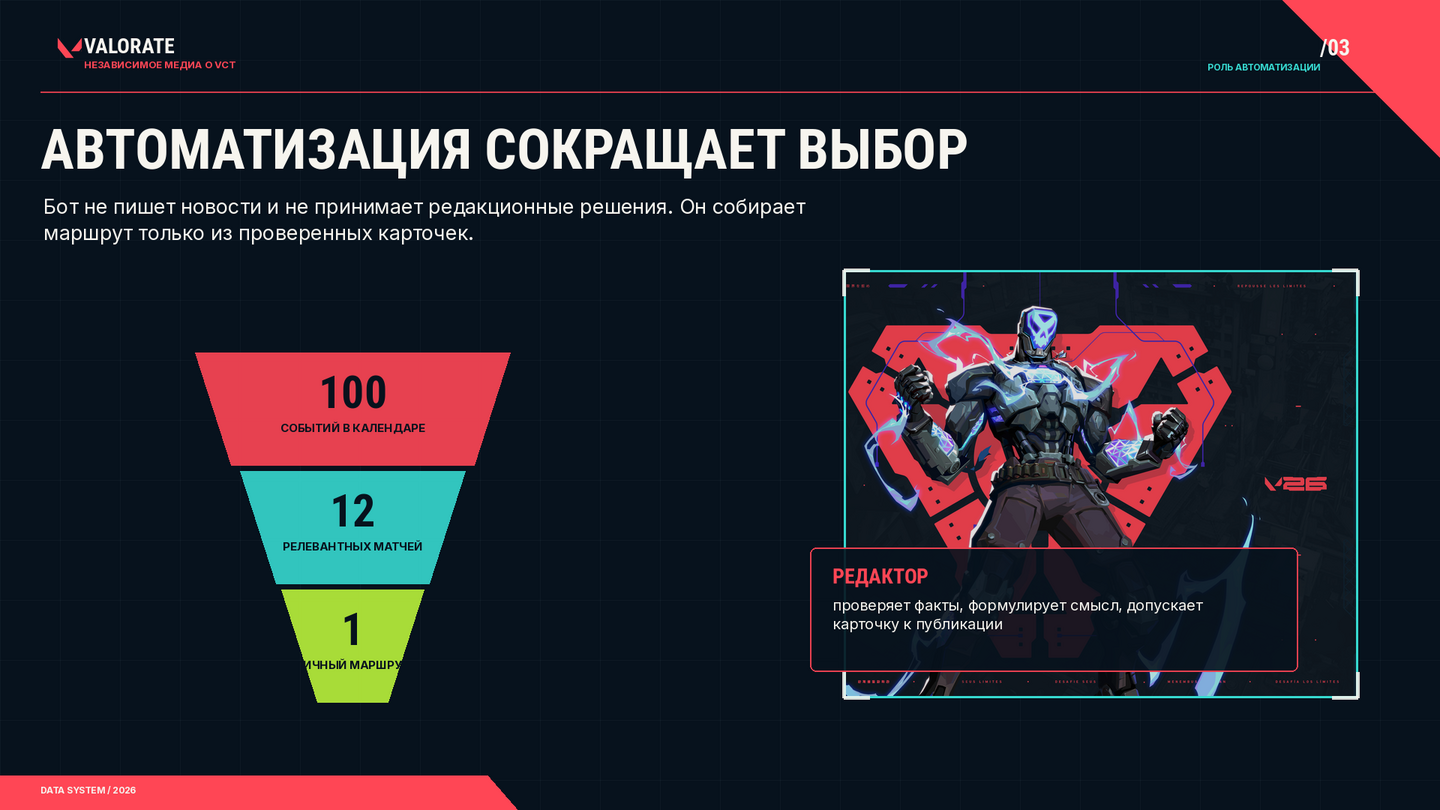
The comprehensive calendar presents both significant and routine events equally, meaning newcomers are faced not with a lack of information, but with an excess of options. The bot curates this selection. It does not invent news, rehash unverified rumors, or replace an editor. The service only receives vetted entries, matches them against the user’s interests, available time, and spoiler preference, and then compiles a personalized itinerary.

The primary source for schedules, stages, brackets, results, and series formats is the official VALORANT Esports platform. Official news from Riot Games and VCT is used for changes in season formats, rules, and tournament announcements. Official broadcasts and recordings confirm the actual start times, VOD availability, and highlights. Roster changes, transfers, and direct quotes are published only with a reference to the official statement from the team, player, or organizer.
The public match pages mentioned in the previous analysis can be used to verify statistics, match history, and facilitate navigation. Russian-language esports media and Telegram channels help locate themes and signals, but they do not constitute final proof. The editor always reverts to the original source material. If sources conflict, the primary official source takes precedence; otherwise, the card remains in review status. Unconfirmed information can only appear with the noticeable tag «rumor.»

The system consists of five layers. First, links and facts are saved from approved sources. Then, a machine layer normalizes dates, times, team names, and formats. After this, an editor verifies the facts and adds an explanation—the tournament stake, plot, complexity, and recommended viewing time. Only cards with the «approved» status are available to the route compiler. The final layer publishes the material on Telegram or VKontakte and returns an anonymized user reaction to the system.
The tournament stores the region, stage, and dates. The match connects teams, time, format, and status. The team and player entities are needed for personalized subscriptions and routes. The source contains the URL, type, publication date, and priority. The editorial card holds the answer to «why watch, ” the plot, difficulty level, and spoiler rules. The user profile is limited to interests, time budget, and spoiler mode. The route connects the card with the selected viewing format and reminder, and the action logs opening, saving, or rating.

The card is divided into two parts. The Machine part contains stable fields: team and tournament identifiers, Moscow time, stage, series format, status, and source links. The Human part explains the significance of these fields: why the match is worth the time, what is at stake, what plotline is important, who to follow, and what viewing commitment is appropriate for a newcomer. This separation prevents automatically generated text from overriding editorial judgment.
The machine performs repetitive operations: importing, normalizing spellings, time conversion, duplicate detection, filtering by interests, route assembly, and sending reminders. The editor selects permissible sources, resolves conflicts, verifies changes, formulates the contest bet, marks uncertainty, and controls spoilers. The machine is responsible for speed and consistency; the human is responsible for accuracy, meaning, and publication consequences.

Each entry progresses through defined statuses. Raw indicates that the data has only been received. Check means it is being verified. Draft indicates the editor is formulating the explanation. Approved means the card is cleared for use. Live means it has been published or issued by a bot. Review means the system has received feedback or detected a change. If verification fails, the card cannot advance to approved. Statuses make errors visible and allow reverting to a previous version.
The automated service operates only with approved cards. Each fact must include a source, source type, and the last verification time. Any discrepancy in the date, composition, stage, or result halts auto-publication and creates a task for the editor. The service does not supplement missing fields with plausible text. Recommendations, forecasts, and interpretations are marked as editorial opinion and are not mixed with verified data.

The service can suggest a match, select the material depth, choose an acceptable format, and send a reminder. It cannot independently publish a new fact, hide a source conflict, alter the meaning of a quote, or remove rumor labeling. The editor has the right to withdraw the card, make corrections, and revert to a previous version. All changes retain the author, time, and reason so that the error can not only be fixed but also analyzed.
In spoiler-free mode, the score and winner do not appear in headlines, previews, or notifications. The result is revealed only after explicit user action, and post-match materials receive a service spoiler flag. For personalization, name, phone number, age, or geolocation are not required. Selected teams, players, or regions, time budget, spoiler mode, and action history within the bot are sufficient. The user must have the ability to reset personalization and disable reminders.

The first version is limited to one major tournament, three route scenarios—first match, player tracking, and post-break return—and one pairing of a Telegram Channel with a bot. The database utilizes at least four data statuses: raw, draft, approved, and archived or review. An MVP is considered functional if the user can select a route, open the material in an appropriate scope, and provide a simple rating of «too difficult, ” „just right, ” or „I want more depth, ” and if the editor can trace the source of every generated card.
SOURCES
Official VALORANT Esports platform—schedules, results, events, and tournament news: https://valorantesports.com/
VALORANT Esports Match Page—schedules, stages, and series formats: https://valorantesports.com/en-US/matches
Official VALORANT / Riot Games website—news and announcements: https://playvalorant.com/
VALORANT Media—official Riot Games visual assets: https://playvalorant.com/en-us/media/