EDITORIAL DESIGN SHAPED BY CONTENT AND CONTEXTI’m Safiia Timofeeva, a graphic designer working across print, digital and visual identity. My practice combines research and editorial thinking to develop visual systems shaped by the content and context of each project.Open to commissions and collaborations with cultural institutions and independent publishers.
[1] Wim Crouwel and Jan van Toorn: Two Approaches to Design
In 1972, Wim Crouwel and Jan van Toorn engaged in a public debate about the role of the graphic designer and the purpose of visual communication. The publication explores their contrasting positions through a comparison of their work, using opposition as the central principle of its editorial structure.
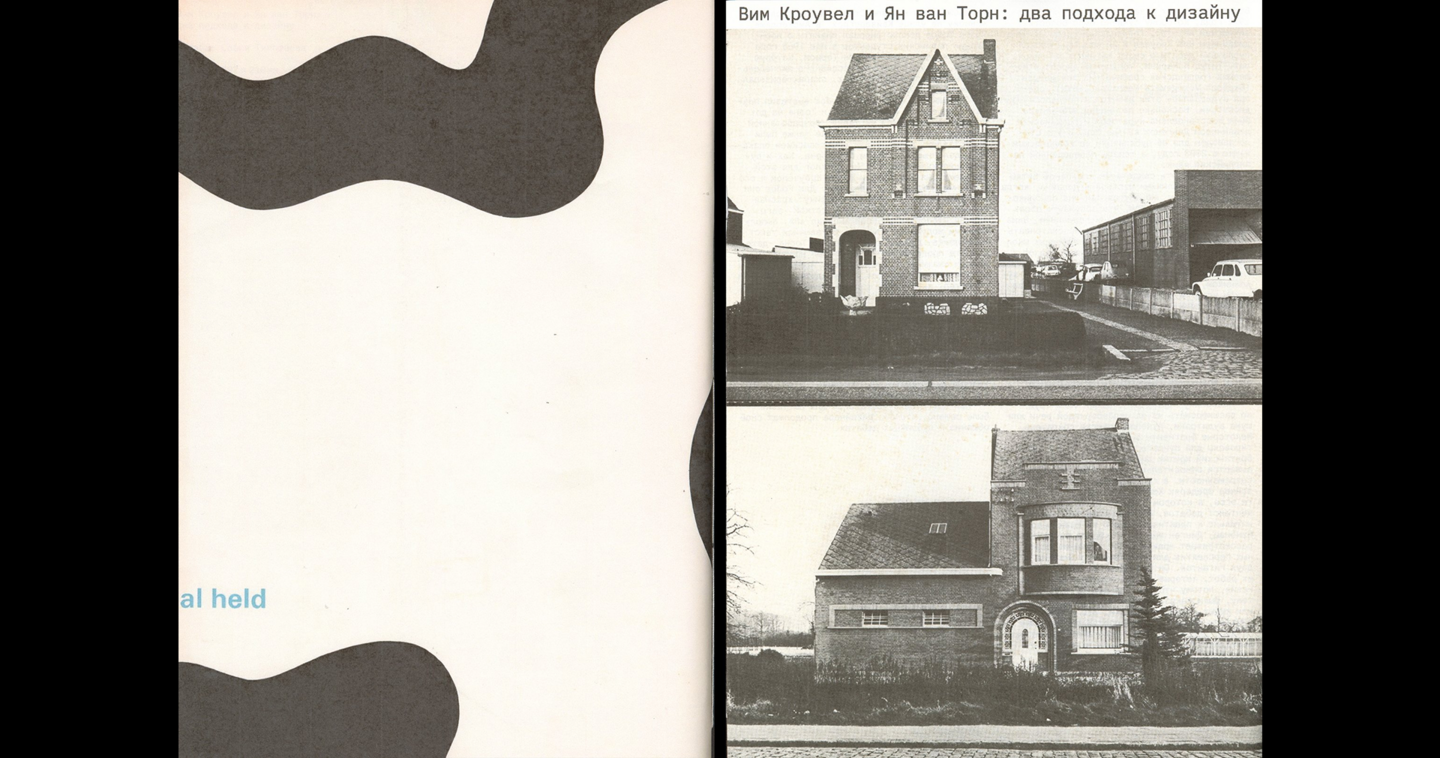
Approaches to Graphic Design: Wim Crouwel’s Universal, Systematic Approach and Jan van Toorn’s Contextual Approach The first part explores the contrasting approaches of the two designers: Crouwel’s pursuit of universal visual systems and Van Toorn’s emphasis on context. The section is structured around fold-out pages containing excerpts from their debate, which establish a theoretical framework for the visual material and connect each designer’s position with examples of their work.
Shared Strategies in Visual Communication The second part shifts the focus from theoretical differences to similarities in visual practice. Through the juxtaposition of selected works, the publication identifies shared strategies in visual communication, revealing points of intersection between the two designers despite their contrasting positions.
[2] Room 272
Room 272 is a workspace in which books, printed materials, tools and objects are constantly accumulated, rearranged and removed.The project documents the space as an open, changing system, focusing not only on its individual contents but also on the relationships between objects and their arrangement within the room.The project approaches documentation through two complementary methods: photography and scanning. Photography preserves the spatial relationships between objects, while scanning isolates individual elements from their original context.This distinction forms the basis of the editorial structure, allowing the same space to be examined both as a whole and through its individual components.
Room — Spatial Observation The first part documents the room through photography, capturing books, furniture, walls, plants and other elements of its everyday environment. The images preserve the spatial context of objects, revealing their arrangement, proximity and relationships within the room.
Objects — Extraction and Reorganisation The second part focuses on individual objects extracted from the same environment through scanning. Removed from their original context, they acquire a new visual presence as images and graphic elements. The publication brings these fragments together in a new sequence, establishing relationships beyond their original arrangement.
[3] non-place to place
non-place to place is a media project exploring how everyday environments acquire their distinct cultural identities.Through photography, video and visual observation, the project documents local phenomena, everyday practices and material traces that shape the character of a place. Its focus is on the subtle details of everyday life through which the identity of a place becomes visible.The project is based on direct observation of everyday environments, without staged scenes or predetermined subjects. Photography and video serve as tools for documenting local phenomena as they occur naturally.The collected material is organised through places and categories that emerge during observation. Accumulation, repetition and comparison make it possible to identify recurring patterns and differences between environments.
Digital — Web Archive
The web archive is designed as an open, non-linear structure. Materials are organised geographically, by countries and cities, with a system of tags that allows observations to be connected and compared across different locations.Rather than imposing a fixed viewing sequence, the interface encourages independent exploration. Relationships between materials emerge through accumulation, repetition and juxtaposition, allowing visitors to discover their own connections.
mobile
Print — Editorial Publication