Navigation
1. Introduction: The Development of Film Language
2. Space and Gaze: From Fixing Theatrical Action to Frame Dynamics
3. Time and Rhythm: The Birth of Parallel Montage
4. Psychology and Detail: The Evolution of the Close-Up
5. Conclusion: The Formation of the Classical Hollywood Paradigm
6. Filmography, Bibliography, and Sources
Research Concept
Early American cinema at the turn of the 19th and 20th centuries was akin to a carnival attraction, devoid of narrative grammar. Films produced by Thomas Edison’s studio and the early works of Edwin Porter captured reality in static frames, where the screen space was equivalent to the space of a theatrical stage. The audience came to the cinema not for a story, but for a spectacle—a moving picture, a demonstration of technical capability. However, by the 1910s, American cinema had transformed into a complex semiotic system capable of constructing multifaceted narratives. The hypothesis of this study is that the shift from the «attraction shot» to the «montage phrase» was not a singular invention but a sequential evolution of expressive means, during which cinema acquired new ways to organize space, time, and character psychology. American film scholar Charles Masher notes that the cinematographic effect only arises in the moment of juxtaposing one frame with another—that is, when a story emerges on screen [1]. In early cinema, where the camera was static and editing was absent, the narrative was replaced by demonstration.
This observation establishes the theoretical framework for the research: the transition to narrative is viewed not as a change in technique, but as the mastery of a new method of organizing screen material.
The object of this study is early American cinema at the turn of the 19th and 20th centuries, and the subject is the evolution of expressive means from the spectacle shot to the montage phrase. The analysis draws from films by William Hays, Edwin Porter, David Wark Griffith, and Louis Weber, which represent key stages in the transformation of cinematic language. The selection of these directors is based on the fact that each contributed fundamentally to the exploration of space, time, and character psychology.
The objective of this study is to analyze how American directors transformed film from a recorder of reality into an art of storytelling. The research goals are to examine Porter’s early films and identify the first signs of the montage phrase, to analyze Griffith’s narrative techniques—which include the close-up, cross-cutting, and multi-plane composition—and to explore the psychological depiction of space in Weber’s works.
The methodological foundation of this study combines film history and film studies analysis with Charles Masser’s theoretical concepts of cinematic effect. The visual structure of the work is organized into thematic blocks that demonstrate the evolution of cinematic language through the lens of space, time, and psychology. This approach allows one to trace how individual technical devices coalesce into a coherent sign system capable of constructing multifaceted narratives.
The selection of the chronological frame (1896–1916) is due to the fact that this period covers a key stage in the transformation of American cinema. The lower boundary (Edison Studio films) captures the state of the «cinema attraction, ” while the upper boundary (Griffith’s release of The Intolerable) marks the formation of a mature cinematic language. Analyzing this specific period allows us to isolate the process of visual narrative birth before the definitive establishment of the classical Hollywood paradigm in the 1920s.
Space and Gaze: From Fixing Theatrical Action to the Dynamics of the Frame
Still from the film «The Kiss» (directed by William Hays, Thomas Edison Studio, 1896)
Early American cinema at the turn of the 19th and 20th centuries operated on the logic of a fairground attraction. Edison Studio’s film «The Kiss» (1896) was a static capture of a theatrical mise-en-scène, where the camera functioned as a simple recorder of reality. The audience came to the cinema hall not for a story, but for the spectacle of moving images. Close-ups of characters' faces and the kiss itself were used not to reveal the characters' psychology, but as visual provocation. While editing grammar is absent in this frame, it clearly demonstrates the starting point from which the evolution of cinematic language toward complex narratives began.
The breakthrough occurs in Edwin Porter’s film The Great Train Robbery (1903). Although the camera remains predominantly static, Porter employs depth of field and introduces parallel editing, alternating between scenes of the robbery and the pursuit. The screen space ceases to be identical to the space of the theatrical stage—it begins to be segmented into distinct zones, allowing the viewer to construct causal relationships between spatially separated locations.
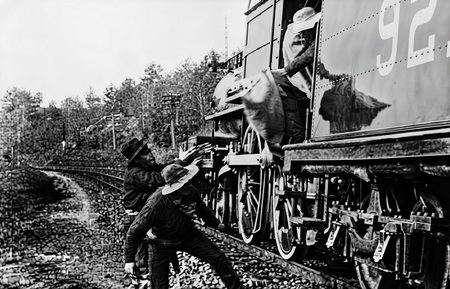
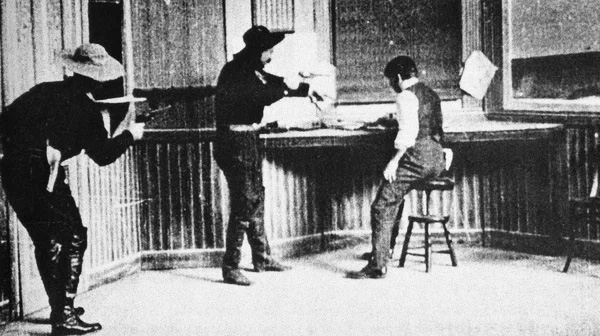
Stills from the film «The Great Train Robbery» (directed by Edwin Porter, 1903)
If Porter created dynamism in his earlier works by moving actors deeper into the frame and diagonally (tracks receding into the distance) in the film The Great Train Robbery, then in The New York Hat, Griffith places his emphasis on the camera. Although it remains static, the director actively employs shot changes—from wide to medium and close-up—to focus the viewer’s attention on the characters' facial expressions and the details that capture the viewer’s eye (the letter).
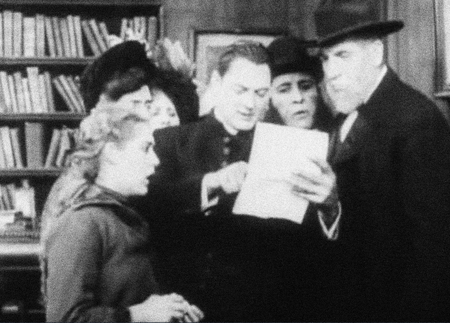
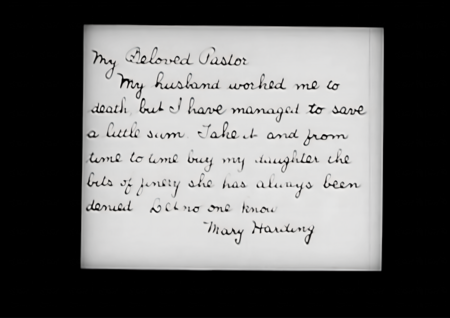
Stills from the film «The New York Hat» (Dir. David Ware Griffith, 1912)
D.W. Griffith actively utilizes camera movement, panoramas, and depth of field for complex staged mise-en-scènes in the film The Birth of a Nation (1915). The director abandons the static «frontal mise-en-scène.» The Ku Klux Klan chase scene demonstrates a new dynamic: the camera is no longer simply recording the action; it becomes an active participant in the narrative, setting the pace and directing the viewer’s gaze.
A still from the film «The Birth of a Nation» (dir. D. W. Griffith, 1915)
The apotheosis of cinematic dynamism is Griffith’s «Intolerance» (1916). In the Babylonian scenes, Griffith employs complex camera movements, including nascent crane shots—vertical camera movements achieved via specialized platforms. The camera literally «soars» over massive sets, demonstrating the scale of the space. This moves beyond mere scene documentation; it becomes an active manipulation of the viewer’s gaze, where the dynamism of the frame directly influences the dramaturgy and the perception of time.
The «Balthazar’s Feast» episode from the film Intolerance (dir. D.W. Griffith, 1916), where the camera moves across a vast expanse—descending or rising—to establish scale before approaching the characters.
Time and Rhythm: The Birth of Parallel Editing
The genesis of parallel editing can be found in Edwin Porter’s film, «The Great Train Robbery» (1903). By alternating scenes of the attack on the train with scenes in the saloon, Porter was the first to attempt to create the effect of two simultaneous actions. However, his editing remains mechanical—the viewer simply receives information about what is happening in different locations.
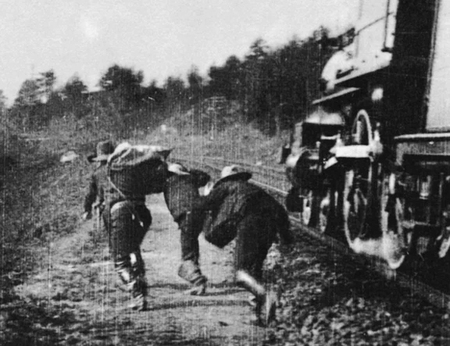
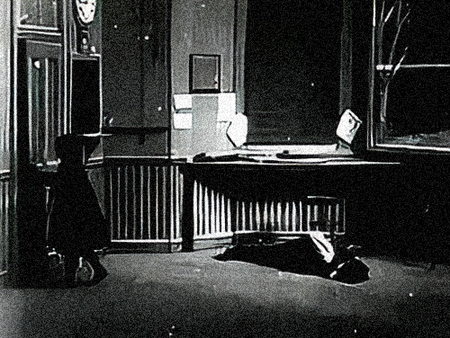
Stills from the film «The Great Train Robbery» (dir. Edwin Porter, 1903)
In the film «New York Hat, ” David WareGriffith utilizes close-ups and details to reveal character, moving beyond a simple documentation of action. The hat in the film functions as an object of desire. Ware becomes a key figure in transforming cinema into a complex semiotic system.
Still from the film «New York Hat» (directed by David Warck Griffith, 1912)
In Griffith’s «Birth of a Nation,» the technique of parallel editing reaches its classic form. Griffith constructs climactic scenes—such as the siege of a house or a final rescue—by constantly cutting between two or more locations. This creates a «last-minute rescue» effect, artificially compresses screen time, and forges a new rhythm of cinematic narrative that would become the foundation of Hollywood suspense.