Camera Obscura — an indie-pop group from Glasgow, founded in 1996. Their songs are arranged with influences tracing back to 1960s pop music, and their videos and album covers, for over two decades, reference the visual culture of previous decades: faded film, 1960s music television, 1970s tourism, and watercolor portraiture. None of the group members experienced any of these eras as adults. This study examines how this engagement with the past is structured and how it has evolved between 2001 and 2024.
Contents
[1] Concept
[2] Fabrication: television that never existed, and costume design
[3] Camera in the Frame: a group filming their own past
[4] From Here: an escape from Scotland on screen
[5] Envelope as a Family Album
[6] Fog
[7] Own Archive
[8] Conclusions
[1] Concept
In 2000s indie pop, retro became commonplace: vintage dresses, film filters, and «sixties-style» album covers appeared with dozens of bands. Simon Reynolds describes this decade as a time when pop culture began endlessly reissuing itself [4]. Against this backdrop, Camera Obscura stands out for its longevity—the band has been working with retro aesthetics for over two decades. Their debut album was released in 2001; the last one at the time of this research was in 2024. Over this period, the band has changed four labels (Andmoresound, Elefant Records, 4AD, Merge Records), survived the death of keyboardist Carey Lander, and returned after eleven years without a new album. This long span reveals what is subtle within a single record: how the band’s very attitude toward the past has evolved.

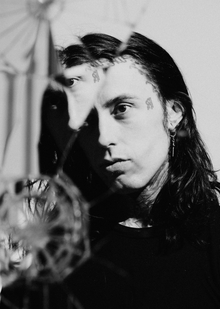
[1] Camera Obscura at a concert, photo by Andersju, 2005 [I-7]; [2] Fillmore, San Francisco, photo by Moses Namkung, 2009 [I-8]; [3] Fillmore, San Francisco, photo by Moses Namkung, 2009 [I-9]; [4] Spectator filming a concert, Doune the Rabbit Hole, photo by Conall, 2022 [I-10]
The research hypothesis consists of two propositions. The first: the retro aesthetic of Camera Obscura is not a stylization of a specific decade, but rather the fabrication of a family archive. The group assembles a visual image from the past that none of its members have witnessed firsthand: American diners from «Breakfast Club,» 1960s musical television shows, and low-budget 1980s British sci-fi. Yet, the fabrication is almost always evident—the pasted-on mustaches sit crookedly, and beneath frames from 2007, captions read «1966» and «1967.» This is close to what Svetlana Boym calls reflexive nostalgia: a nostalgia that yearns for the past yet knows returning there is impossible, allowing it the luxury of irony [2].
The second proposition concerns time: the longer the group exists, the less it requires an external archive. After 2013, the costumes and fake film disappear, and in 2024, the group’s own debut becomes the central quotation.
To test the hypothesis, three formats of visual communication are examined: fifteen official music videos from 2002–2024, the covers of all six studio albums and most singles, and the vocalist’s stage presence in concert photographs from 2005–2022. The images were sourced based on video descriptions, label news, and the Discogs database [9]. Music and lyrics are included only when they help explain the image.
The Clip — an homage that perfectly captures the atmosphere of 1960s mythical English, American, and European television shows through light and video effects.
The material is organized not by albums, but by the methods through which the group constructs the past. The first chapter is dedicated to forgery: fictional television and costumes. The second chapter focuses on the camera in the frame: participants film themselves on amateur film, and their portraits are drawn by hand. The third chapter is about escape: the desire to leave is constantly heard in the songs, and it examines how America and Europe are depicted on screen. The fourth chapter shows how the medium changes the past on covers, from staged photography to watercolor. Chapters five and six illustrate how fog and loss erase someone else’s past, making way for their own. Within the chapters, the material follows a chronology, so changes are visible within each theme.
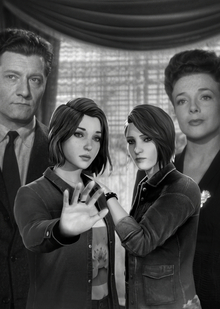
One image per chapter 2–7: [1] Tears for Affairs — Camera Obscura (Dir. Blair Young, 2007, 01:56); [2] Keep It Clean — Camera Obscura (2004, 00:46); [3] Let’s Get Out of This Country — Camera Obscura (Dir. Blair Young, 2006, 00:41); [4] Single cover for The Nights Are Cold (Julie Ennis, 2010); [5] Break It to You Gently — Camera Obscura (Dir. Joseph Mann, 2013, 02:56); [6] Mini-album cover for Lo
Camera obscura—a dark room or box with a small aperture. An image of the outside appears on the opposite wall: inverted, dim, and slightly blurred at the edges. This is not a recording, but a projection. The image exists only as long as the aperture is open, disappearing when the light fades.
The group’s name can be seen as a description of its method. The past in its music videos appears exactly like this: recognizable, yet inverted and subdued, as if viewed from a dark room.
[1] Portable camera obscura. Engraving from Johann Zahn’s treatise «Oculus artificialis teledioptricus, ” 1685 [I-1]. [2] Street camera obscura on Ramsay Lane in Edinburgh, photo marsupium photography, 2013 [I-2]
[2] Falsification: television that never existed, and costume design
The «Tears for Affairs» music video is edited as a compilation of archival television performances. In the lower corner of the frame, captions appear displaying the name of the show and the year, mimicking documentary films about music: A Whole Beat Happening (1966), Fünf Vier Drei… Beat! (1966), Bobbi Felix Uptown Hour (1967), Pop Goes the Country! (1968), Late Night Ranch Party (1967).
At least one of these captions is inaccurate: the group was filmed in 2007, not the sixties. The titles themselves were chosen to reflect typical formats of the era: a German beat club, an American variety hour, or a rural country show. The label Elefant Records described the video as a tribute to the «mythical» English, American, and European television shows of the 1960s [13]. The qualifier «mythical» points to the main idea: the video recreates not actual programs, but a collective perception of them.
Tears for Affairs — Camera Obscura (dir. Blair Young, 2007, 00:18–00:22)
Every «track» has its own light and color. A Whole Beat Happening features harsh black-and-white contrast. Fünf Vier Drei… Beat! is cool blue with double exposure. Pop Goes the Country! offers warm purple and a halo of light around the face. The Country Show features hay and a painted desert backdrop. The image is deliberately degraded: the frame edges are rounded like a CRT monitor, the color bleeds, and bright spots diffuse into halos. This simulation of technical malfunction serves as a signifier of authenticity.
The visual approach relates to the song’s content. In a 2009 interview, a journalist asked Campbell how deliberately the contradiction between the somber lyrics and the «lush» sixties pop sound was conceived. She replied that it was not planned—the songs sound gloomier on the demo recordings, and the band makes them cheerful [15]. The music video amplifies this contradiction: a song about infidelity is presented as a routine segment from a prosperous variety show.
Tears for Affairs — Camera Obscura (dir. Blair Young, 2007): [1] Fünf Vier Drei… Beat! (00:51); [2] Pop Goes the Country! (01:26); [3] Late Night Ranch Party (02:01); [4] Country Show (01:41)
In six years, admissions resume, but the era shifts. Troublemaker opens with a blue title sequence reminiscent of an old TV episode: «tribute video, Camera Obscura, Series 5 — chase scenes.» This series with a fifth season does not actually exist—the intro mimics the format rather than quoting a specific show.
Blair Young described the video as a tribute to older British sci-fi—“low-budget and futuristic, reminiscent of the 80s”—and hoped it would capture the feeling that made many fans of the genre as children [16]. Here, time is fabricated for the first time, reflecting the past the band members experienced as kids. The borrowed past begins to merge with their own.
Troublemaker — Camera Obscura (Dir. Blair Young, Gavin Dunbar, 2013, 00:00–00:04)
The genre tropes have been carefully assembled: a 4:3 format, video noise, sudden close-ups, a large brooch on a red cloak, and a man in a light jumpsuit running through a forest for no apparent reason. The narrative is almost indecipherable—and this, too, is part of the quote: Stereogum called the music video a tribute to the «low-budget and almost incomprehensible» British series of the 1980s [5]. It was filmed in Glasgow, and the city’s recognizable streets serve as a backdrop for someone else’s television.Stuart Murdoch, the frontman of Belle and Sebastian—a group from the same Glasgow indie-pop scene—shot the earliest of the considered music videos. The song is titled «Eighties Fan,» referencing an «80s fan, ” but the imagery points to an earlier era. Black-and-white film, white lab coats, and the protagonists holding a mid-century British illustrated weekly magazine evoke not the 1980s, which had become fashionable retro by 2002, but the British „kitchen realism“ of the late 1950s–1960s.
Troublemaker — Camera Obscura (Dir. Blair Young, Gavin Dunbar, 2013, 00:41, 00:56, 00:21)
Eighties Fan — Camera Obscura (Dir. Stuart Murdoch, 2002, 00:16, 01:01, 02:21)
In the Lloyd music video, «I’m Ready to Be Heartbroken, ” tropes from different decades are interwoven. The heroines, dressed in white golf attire and A-line dresses from the mid-sixties, walk across an artificial lawn set against the backdrop of Tokyo’s night neon. A wall of identical boxes labeled „Lloyd“ is reminiscent of Andy Warhol’s „Brillo Boxes.“
The set featuring umbrellas and raincoats is arranged according to the rules of a 1950s Hollywood musical: rain, a chorus in matching costumes, and a soloist in a bright cape. However, the scenery is artificial—a fence, a bush, and puddles on the studio floor—and the camera does not hide this fact.
Lloyd, I’m Ready to Be Heartbroken — Camera Obscura (Elephant Records, 2006, 02:05–02:09)
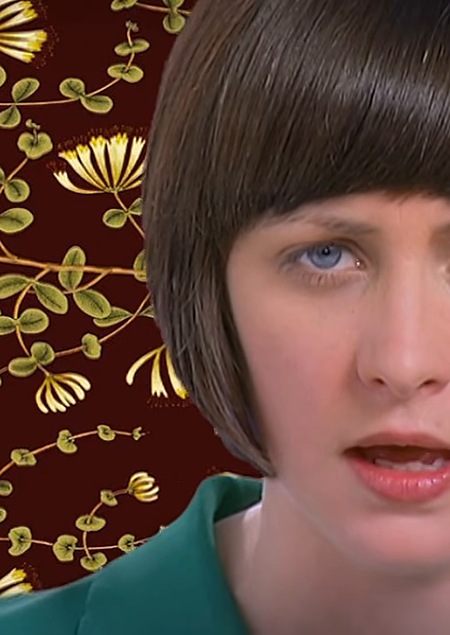
Against this backdrop, Tracy-Anne Campbell, wearing a green shirt, sings directly into the camera, barely moving. Only the backgrounds behind her change: patterns resembling textiles from the sixties and seventies cycle through one another, like samples in a wallpaper catalog. The surroundings stage the past, while the vocalist remains still within it, like a photograph in a frame.
Lloyd, I’m Ready to Be Heartbroken — Camera Obscura (Elefant Records, 2006, 00:41, 02:50, 01:05)
In the music video for «Teenager,» the decade is different: the seventies. Orange tents, denim overalls, a plaid blanket, bicycles on a dirt road, softcover books. The imagery is warm and nostalgic—like home movie footage from a family vacation, developed years later. The adult band members portray teenagers camping, a scene familiar to them more from family photographs than from their own experiences.
Teenager — Camera Obscura (Elefant Records, 2003, 00:11, 02:21, 00:51, 03:16; director not listed in public sources)