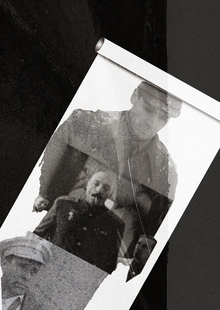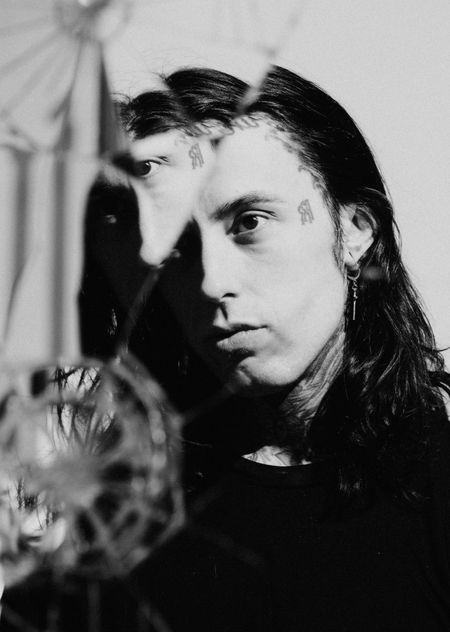
On the cover: Ronny Radke. Press portrait from the Coming Home period. 2017.
Concept
A musician’s public persona is constructed from repeated gestures, performance style, costume, and the manner in which they present themselves to the audience. These elements allow one to recognize the artist across different songs, on stage, and in music videos. Филип Auslander defines the musical persona as «a version of the musician designed for public performance» (Auslander, 2019, p. 91). The stability of this persona, however, is relative—a new creative period can alter the performer’s appearance and their relationship with the public. Ziggy Stardust, David Bowie’s alter ego, existed simultaneously as a character in the songs and as Bowie’s own stage identity (Auslander, 2019, p. 92). The shift in role, nevertheless, implies the possibility of recognizing the person performing it. Simon Frith compares the pop star to the film star, who, «while adopting numerous roles, retains an essential ‘self’» (Frith, 1996, p. 199). In a music video, this connection becomes particularly evident: a familiar face may belong to a fictional character, and the performing musician may participate in the action alongside them.
In the work of Falling In Reverse, this variability is a key dramatic device and the foundation of the band’s mythology. In this study, fracturing refers to the division of the recognizable image of the artist into several bodies, roles, or temporal states. These versions may appear in the same space, sequentially replace one another, or conflict through the return of an older image. The connection is maintained through the face, hairstyle, tattoo design, and costume. The function of this transformation is significant: the ability to take the place of one’s own judge, give body to internal contradiction, respond to a threat with superhuman power, or re-examine the past. Kai Arne Hansen views the pop persona as a collection of «symbolic fragments scattered across various media» (Hansen, 2019). The public history of Falling In Reverse is closely tied to the figure of the performer, Ronnie Radke: his accounts of addiction, conflict, and musical searches accompany the release of songs and offer the viewer a biographical framework. The study covers the entire creative trajectory of the band from 2011 to 2026. Three sections explore different possibilities of fracturing. «Fracturing in Space» tracks the coexistence of the artist’s versions within a single clip’s space, characterizing their interaction and coexistence. «Fracturing in Image» examines the shift in corporeality and the contradictory state of the hero, the presence of internal conflict within a single character. «Fracturing in Time» illustrates how new versions of early songs and the return of former looks transform the videography into material for reflection. Within these sections, episodes are organized by clips and associated series.
1. Spatial Decomposition
The shared space transforms diverse performer positions into participants on a single stage: they can judge one another, compete, or simply coexist.
Just Like You
Falling In Reverse. Just Like You. 2015. Directed by Zach Merck.
Falling In Reverse. Just Like You. 2015. Dir. Zach Merck.
Falling In Reverse. Just Like You. 2015. Director: Zach Merck.
Radka takes on the roles of host, contestant, and judge in the music competition. The song, «Just Like You, ” connects these roles—the assessor and the assessed turn out to be versions of the same artist.
Losing My Mind / Losing My Life / Drugs
These three clips are conceived as a series: the characters and spaces transition from one piece to the next, continuing the story of an internal struggle.
Falling In Reverse. Losing My Mind. 2018. Dir. Ethan Lader. | Falling In Reverse. Losing My Life. 2018. Dir. Ethan Lader.
In «Losing My Mind,» the protagonist is alone in a luminous room; in «Losing My Life,» the same space becomes the meeting place for two of his versions.
Falling In Reverse. Losing My Life. 2018. Dir. Ethan Lader.
Falling In Reverse. Losing My Life. 2018. Dir. Ethan Lader.
Falling In Reverse. Losing My Life. 2018. Directed by Ethan Lader.
Radke explained the doppelgängers as opposing forces: one strives to prove its validity, while the other impedes it. Furthermore, eliminating the adversary is impossible—each manifestation is reborn again and again, continuing the struggle.
Falling In Reverse. Drugs. 2019. Directed by Ethan Lader.
With each clip in the series, the confrontation intensifies, and in Drugs, the meeting with its own version turns into bloody violence.
Voices in My Head
Internal voices gain bodies. Each incarnation destroys the previous one and itself becomes the next target. Instead of a duel between two figures, there arises a continuous chain of confrontations with the self.
Falling In Reverse. Voices in My Head. 2022. Directed by Jensen Noen.
Falling In Reverse. Voices in My Head. 2022. Dir. Jensen Noen.
Falling In Reverse. Voices in My Head. 2022. Dir. Jensen Noen.
Falling In Reverse. Voices in My Head. 2022. Dir. Jensen Noen.
The number of iterations is growing: copies occupy shared space and continue a struggle from which it is impossible to maintain a single version of oneself.
Falling In Reverse. Voices in My Head. 2022. Directed by Jensen Noen.
All My Women
Falling In Reverse. All My Women. 2025. Dir. Jensen Noen.
Radke’s puppet version is an interesting example of constructing another split identity. It even has its own name—Donnie. The recognizable figure of the performer becomes an independent comedic character.