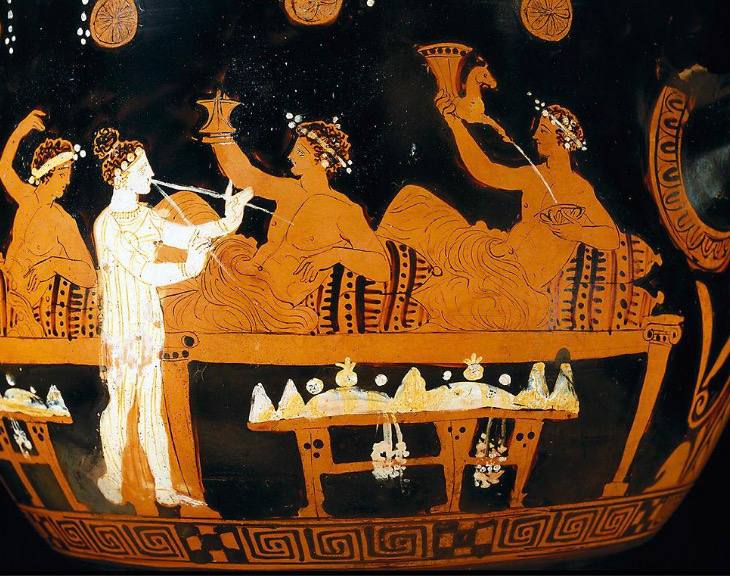
The visual motif of the research is ancient pottery featuring scenes of banquets, musicians, feasting men, and wine vessels.
Core Concept: A symposium in Ancient Greece was not merely a dinner party, but a specific cultural space where art, philosophy, music, ritual, and social life converged.
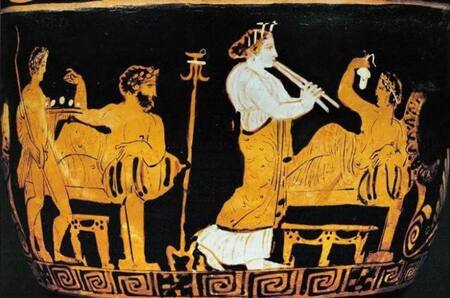
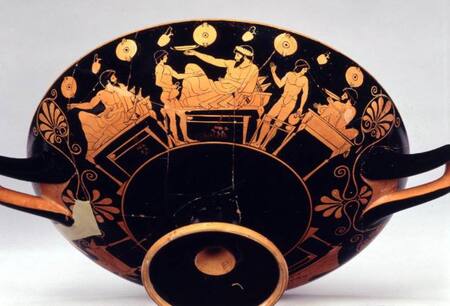
1. Attic red-figure kylix with a symposium scene. Late 6th — early 5th century BCE. Athens (Attica). Unknown artist. Pottery, red-figure technique. 2. Neapolitan vase painter. «Colonnaded krater with a symposium scene.» Circa 440 BCE. Athens. Terracotta, red-figure painting.
1. Concept
The choice of this topic stems from an interest in the daily life of the ancient Greeks and how ordinary social practices became integrated into artistic culture. Ancient Greece is primarily known for its architecture, sculpture, mythology, and philosophy; however, pottery is an equally compelling resource for understanding ancient society. It is on these vases that numerous depictions of daily life—festivals, musical performances, and social interactions—have been preserved. Among these, the symposium holds a special place—a traditional feast that was a vital part of the social and cultural life of free men, particularly those of the Athenian elite. The symposium was an organized gathering that typically took place after the main meal. Participants reclined on special couches—kline—drank diluted wine, conversed, listened to music, engaged in intellectual debates, recited poetry, and played games. A key feature of this event was its internal structure: there was a host—the symposiarch—who dictated the rules of the evening, the amount of wine to be consumed, and the sequence of entertainment. Thus, the symposium can be viewed simultaneously as a form of leisure, a social ritual, and a unique model of ancient society. The relevance of this study lies in the ability to examine ancient Greek culture not only through masterpieces of art but also through objects of everyday use. Ceramic vessels are interesting because they functioned both as utilitarian objects and as carriers of imagery. The cup from which a person drank wine might contain a scene of a feast, while the large vessel used for mixing wine and water might depict gods, satyrs, musicians, and banquet participants. As a result, the artistic imagery became an integral part of the ritual itself. The study pays particular attention to Attic vase painting from the 6th–5th centuries BCE. It was during this period that the black-figure and red-figure techniques for decorating ceramic pottery actively developed in Athens. Works from the collections of the Metropolitan Museum of Art in New York, the Vatican Museums, the Getty Museum, and other museum holdings were selected for analysis. The primary criteria for selection were not only the artistic expression of the objects but also their thematic connection to the symposium: the presence of depictions of diners, musical instruments, and vessels.
Navigator
- Concept
- Illustrative Sequence
- Conclusion
- Bibliography
2. Illustrative Series
Symposium Space: The Setup of an Ancient Banquet
Fresco, «Banquet Scene,» Tomb of the Diver, Pesutim, circa 480–470 BCE. Unknown author.
The fresco from the tomb of the Diver depicts one of the most famous images of an ancient symposium. The depiction helps to envision the atmosphere of the symposium: participants recline semi-reclining, converse, and spend time together. The symposium space was organized so that people could see each other and maintain conversation. The symposium usually took place in a dedicated room—the andron. Along the walls were couches where one or two participants could recline. The center of the room remained open for service and entertainment. This type of spatial organization emphasized the communal nature of the event.
Attic red-figure kylix depicting a symposium. Circa 480–470 BCE. Artist unknown; in the manner of Pistoksen. Metropolitan Museum of Art, New York.
The composition of the painting is particularly interesting: the figures dining are arranged along a continuous line of the couch. The artist creates the impression of a unified space where the participants are an integral part of the overall composition. Importantly, these types of images did not necessarily depict a specific historical banquet. Instead, they demonstrated a consistent artistic model of a symposium—a particular way of behaving, socializing, and spending leisure time. The visual image became a kind of idealized representation of the ancient feast.
The Vessel as Part of a Ritual
Attic krater depicting a symposium. Artist Doris, c. 500–470 BCE. Vatican Museums.
The exterior of the cup depicts men seated in boxes, singing, playing musical instruments, and participating in the cotab game. Here, one can also see a woman playing a double flute and a young servant attending to the diners. It is particularly interesting to consider the object not only as an image of a banquet but also as a direct participant in it. Since the kylix was used for drinking wine, the image inside the cup became visible precisely during the act of drinking.
Column crater depicting the return of Hephaestus to Olympus. Attributed to Lidus, circa 550 BCE. Terracotta, black-figure technique. The Metropolitan Museum of Art.
The Krater was one of the most important vessels at a symposium. Wine was mixed with water in it, and then the beverage was poured into individual cups. Consuming unmixed wine was considered inappropriate for a civilized feast. The vessel displays a mythological scene connected to Dionysus—the god of wine and festive revelry. This underscores the connection between the everyday ritual and the religious-mythological beliefs of the ancient Greeks. The symposium was not merely about drinking wine; it entailed adhering to rules, practicing moderation, and following a specific sequence of actions. Therefore, the vessels held simultaneous practical, aesthetic, and symbolic significance.
Symposium Participants: Social Roles and Relationships
Attic red-figure kylix. Attributed to Onisimos, c. 490 BCE. The Getty Museum.
The inside of the cup depicts a nude woman playing a kottab—a popular symposium activity. She attempts to toss the remaining wine from the cup into a specific target. This object allows us to examine the status of women in ancient culture. The symposium was primarily a male event, attended by free male citizens. However, hetairai—educated women who entertained guests with music, dance, and conversation—could be present at such gatherings. It is important to distinguish between women’s social standing: wives and daughters of citizens typically did not participate in these banquets, whereas the presence of ahetaira was part of a particular leisure culture. Therefore, the depiction of a woman on a vase does not always signify equal participation in the feast.
Attic kylix. Artist Doris, circa early 5th century BCE. Metropolitan Museum of Art, New York.
The bowl depicts a woman engaged in a daily activity—washing. This subject is interesting because the bowl was used at a men’s feast, yet its interior surface displayed a female image. The museum description draws attention to the duality of perceiving this image: it could have reminded the symposium participant of the women present at the feast, or of the women remaining at home. Thus, even the absence of a woman directly in the feasting space did not preclude her presence in the symposium’s visual culture.
Music and Entertainment
Attic red-figure kylix depicting a musician playing an aulos and a symposium participant. Attributed to the Kolmars artist, circa 500–480 BCE. Louvre.
Music was an essential component of ancient feasts. The image shows a woman playing the aulos—a wind instrument with two pipes. Musical accompaniment helped create a festive atmosphere and became part of the overall ritual. In addition to music, symposium participants engaged in poetry, singing, dancing, and intellectual games. Entertainment could be combined with philosophical discussions and debates on various issues.
Attic red-figure vase painting depicting the game of cotab. Circa the late 6th—early 5th century BCE. Artist unknown.
Kottab was a game where participants threw the remnants of wine from a cup toward a target. It required a certain degree of dexterity and was often accompanied by jokes and lively banter. Such entertainments demonstrate that the symposium was a space for informal interaction. Here, one could showcase not only wealth and social standing but also sense of humor, conversational skill, musical talent, and physical agility.