Research Concept
The theme «the artistic image of Hogwarts» allows for research centered on a single institution, but approached as a complex environment: its exterior appearance, public spaces, instructional areas, residential zones, and private sections. This provides sufficient scope without turning the work into a mere catalog of locations.Hogwarts has a well-documented production history. Stuart Craig served as the production designer for all eight films; he explained that the school’s image is based on Oxford, Cambridge, and European cathedrals, rather than a fairy-tale castle. Interviews are also available with Art Department researcher Celia Barnett, who collected historical and visual materials for the common rooms, tapestries, medieval mechanisms, and other elements of the environment.
Key Question and Hypothesis
How do the design, architecture, and thematic content of Hogwarts shape the image of the school as an old, authoritative, and living institution?
Working Hypothesis: The artistic image of Hogwarts is created through a combination of monumental, historic architecture, functional academic and living spaces, and an environmental setting that makes the school simultaneously recognizable, ceremonial, and adapted to the students' daily lives.
External appearance and overall composition
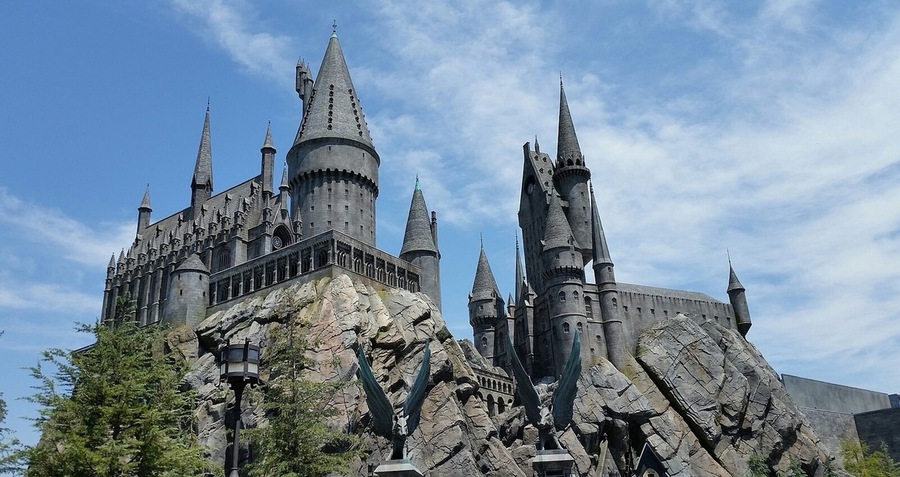
General view of Hogwarts in the first film
Hogwarts is perceived as a unified architectural complex, even though its screen image was formed over the course of eight films. The school’s exterior combines massive stone volumes, towers, roofs of varying heights, and numerous annexes. This composition creates the impression of a large, long-established institution rather than a single building. Stuart Craig noted that the image of Hogwarts drew inspiration from Oxford, Cambridge, and European cathedrals. Artists synthesized successful individual elements from various sources to establish a medieval Gothic aesthetic.
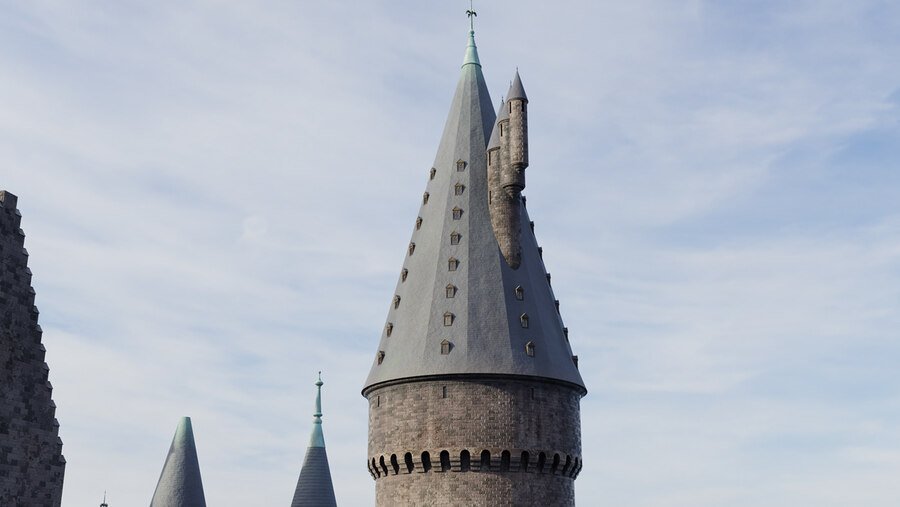
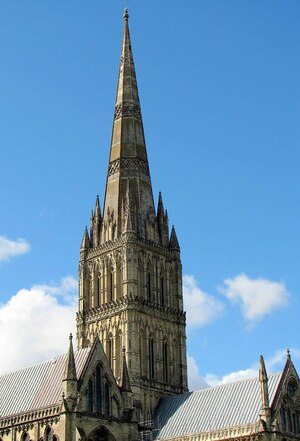
Left: Hogwarts with an emphasis on towers Right: Salisbury Cathedral
The vertical towers and spires are one of the most striking elements of the school’s exterior appearance. They enhance the sense of monumentality, making Hogwarts visually resemble a cathedral or an old university complex. Moreover, the towers do more than just create a «Gothic» impression. They help organize the castle’s silhouette: they define the central volumes, demarcate different sections of the school, and lend picturesque quality to the composition. In the frame, Hogwarts reads as a complex structure.
The school’s location in a remote area reinforces its image as a secluded institution. The hills, water, and distance from the city create a sense of a closed world, one where students only arrive at the beginning of the academic year. Hogwarts does not look like a typical city school. Its surroundings emphasize the scale, seniority, and unique status of the institution.
For the wide shots of Hogwarts, the Art Department created a detailed model of the castle. Each courtyard, tower, and turret of the model was shot individually, and the footage was later enhanced with digital effects. This illustrates that the school’s exterior appearance is not simply a recording of one real building; rather, it is a composite of model photography, digital additions, and discrete on-location shoots. Therefore, when analyzing its exterior, it is important to distinguish between the architectural vision and the technical method of its creation.
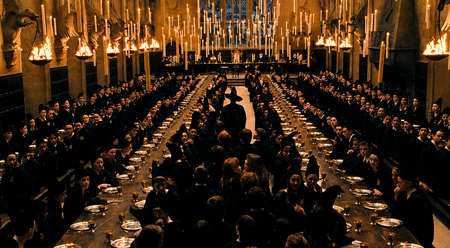
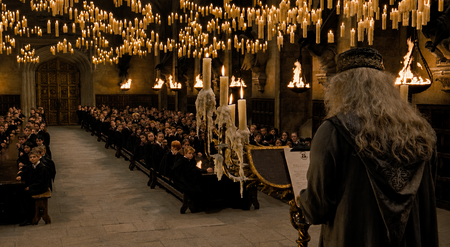
The Great Hall is Hogwarts' most recognizable communal space. It hosts general assemblies, first-year sorting ceremonies, mealtimes, and important school events. Therefore, its design must simultaneously support ceremonial grandeur and everyday use. The space is organized around long tables set parallel to one another. This arrangement allows for a large number of students to be accommodated while maintaining a visual connection between them, the faculty table, and the hall’s central area.
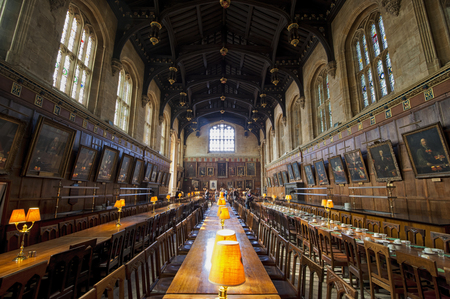
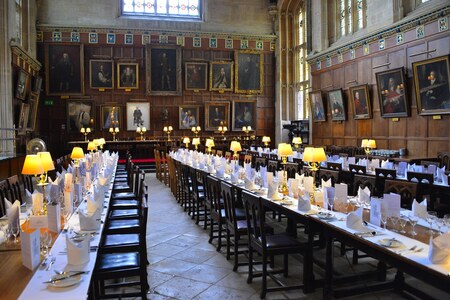
Photograph of the Christchurch Refectory in Oxford
The dining hall at Christ Church College in Oxford is often cited as a prototype for the Great Hall. The similarities are evident in the elongated floor plan, high ceilings, long tables, and distinctive lighting. However, the screen space is not an exact replica of the real interior. In the film, it is supplemented with set pieces, light fixtures, banners, and props necessary for the plot.
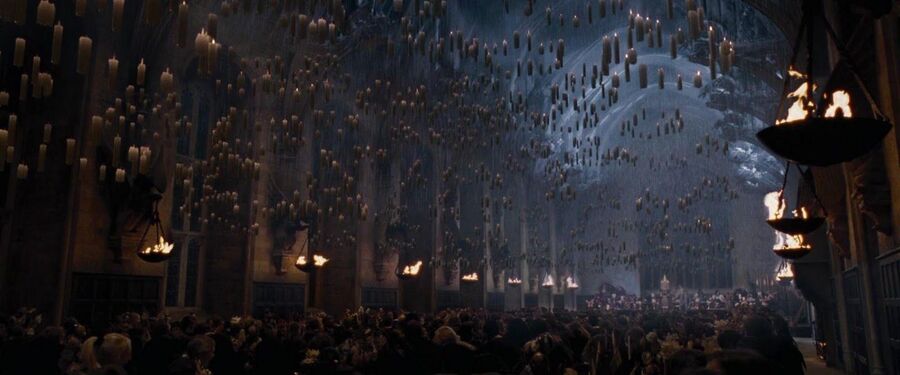
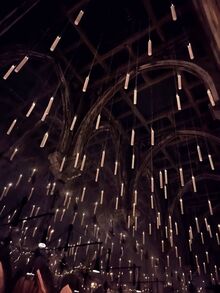
The high ceiling and lighting system lend a grand character to the Great Hall. Candles, dark surfaces, and the contrast between illuminated areas and semi-shadow create the atmosphere of an antique ceremonial space. Furthermore, the lighting does more than just decorate the interior—it helps highlight the central tables, delineate the area in front of the faculty desk, and support the sense of the hall’s scale.
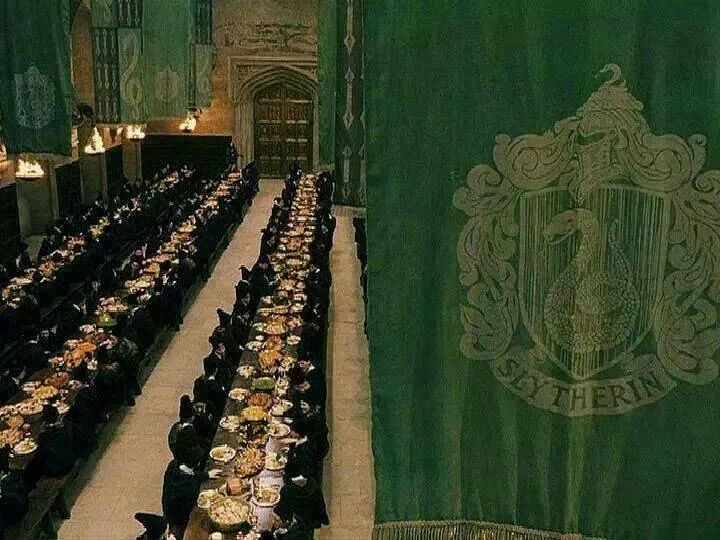
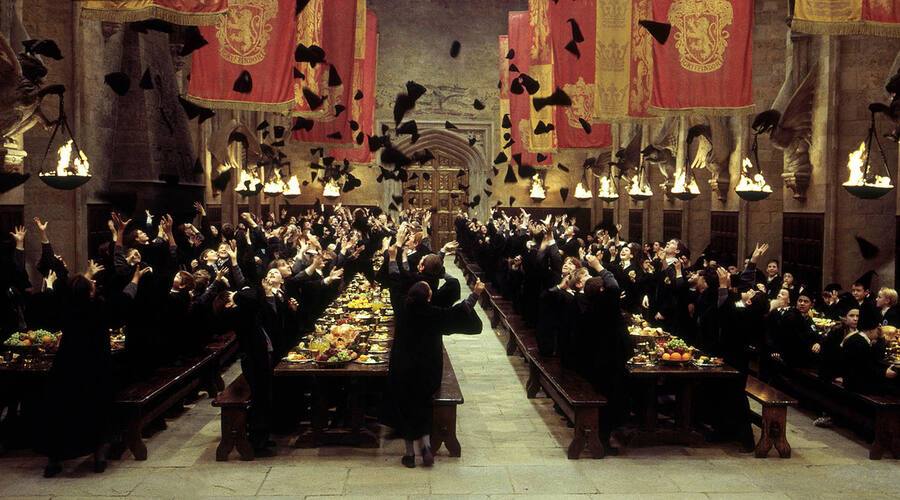
The faculty banners are an important element of the subject matter in the Grand Hall. They indicate which tables belong to different faculties and make the internal structure of the school visible. The symbolism is not limited to crests; the color of the banners, the arrangement of the tables, and decorative elements help convey the community’s structure. The Grand Hall thus functions as a space that clearly presents the order of school life.