A visual study, using works of feminist art as a case study, demonstrates how substituting the painting canvas with fabric and thread becomes a strategy for deconstructing «high» art, thereby redefining the very logic of museum representation.
Research Structure
1. Concept
2. Deconstructing «High» Art: Replacing Painting
3. Embroidery as Archive Rewriting: Corporeality and Voice
4. Redefining Museum Space: Tactility and Soft Sculpture
5. Conclusion
6. Bibliography
7. Image Sources
Justification for Topic Selection
For centuries, Western European art history maintained a rigid hierarchy of genres. Painting and sculpture established themselves as «high art”—creation primarily by men—while textiles, embroidery, and sewing were marginalized, categorized as decorative crafts and „women’s work.“ Museums, as key institutions of representation, long reinforced this gender hierarchy, excluding textiles from mainstream historical narratives. The selection of this topic is driven by the radical shift that occurred in the second half of the 20th century, influenced by feminist critique. Today, textiles in contemporary art function not as a decorative element but as a powerful tool for institutional critique. Female artists use fabric and threads to deconstruct the patriarchal canon, rewrite art history, and restore visibility to marginalized voices. Major global institutions (Tate, MoMA, Brooklyn Museum) are compelled to re-evaluate their collections, recognizing textiles as a full-fledged medium of contemporary art.
Material Selection Principle
— the use of «feminine» mediums (fabric, thread, embroidery) as the primary artistic language; — the presence of a critical statement regarding the traditional hierarchy of the arts or the institutional space of the museum; — high quality of visual material (including general shots of installations and exhibition photographs demonstrating the interaction of works with the museum space) necessary for deep visual analysis.
Rubrication Principle
The research is structured around three conceptual strategies that demonstrate the evolution of feminist critique through textiles: Deconstruction of «high» art (Ann Albers, Rosemary Trokel, Judy Chicago). Here, textiles substitute for painting, dismantling genre hierarchies and the myth of the «genius male artist.» Embroidery as Archival Rewriting (Ghada Amer, Tracey Emin, Louise Bourgeois). Fabric becomes a tool for reclaiming corporeality, intimacy, and the female voice in public space, deconstructing the male gaze. Redefining Museum Space (Sheila Hicks, Chiharu Shiota). Textiles transcend the plane, transforming into soft sculptures and immersive installations that alter the viewer’s physical experience.
Principles of Selecting and Analyzing Textual Sources
The theoretical framework is built upon texts regarding feminist art history and museum theory. Source selection is based on a combination of classic works—such as Linda Nochlin’s essay, «Why Have There Been No Great Women Artists? ,» which analyzes institutional barriers, and Rozzi Parker’s book, «Subversive Textile,» which justifies the political role of embroidery—and contemporary philosophical concepts, like Judith Butler’s theory of gender performativity. Additionally, exhibition catalogs and publications from major museums are analyzed to trace how these institutions integrate textile into their narratives.
Key Research Question and Hypothesis
Key Question: How are contemporary female artists utilizing textile and traditional «women’s crafts» to critique the patriarchal structures of the art world, deconstruct the museum canon, and re-envision art history? Hypothesis: In contemporary art, textile functions not as a decorative element, but as a tool for institutional critique. Through it, artists expose the mechanisms that exclude women from art history, deconstruct the male gaze, and propose new, tactile, and corporeal ways of interacting with museum memory, thereby challenging the hierarchy of materials.
Deconstruction of «High» Art
Feminist criticism of the traditional history of art revealed a strict hierarchy of genres cemented by institutional museum mechanisms. Painting and sculpture were established for decades as «high art, ” created by male geniuses, while knitting, sewing, and weaving were marginalized as „women’s crafts“ and relegated to archives or decorative arts sections. This section demonstrates a strategy through which female artists use textiles to directly deconstruct this hierarchy. By substituting the traditional canvas with a knitted cloth and the brush with yarn, they do not merely expand the medium’s boundaries—they expose the ideological underpinnings of the museum canon. Through the deliberate collision of „feminine“ craft with the canonical format of a panel painting or an institutional installation, they challenge the very myth of exceptional male genius.
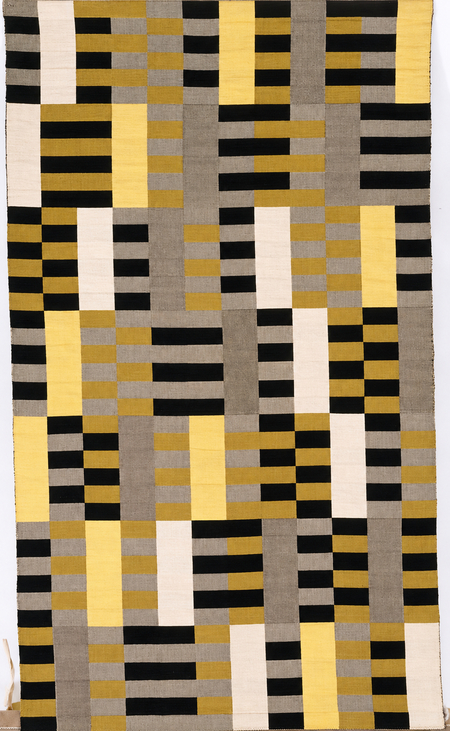
Annie Albert. Wall Hanging. 1926. Silk, cotton; weaving. Harvard University Museum.
Annie Albers: The Geometry of the Thread Versus the Painterly Canvas The precedent of systemic institutional discrimination was set within the walls of the Bauhaus, where women were forcibly channeled into the textile workshop, limiting their access to painting and architecture. Annie Albers transformed this limitation into a methodological weapon, creating textile panels whose compositional rigor, mathematical precision, and abstract expressiveness were on par with the works of her male contemporaries. · Visual Analysis: In the work Wall Hanging (1926/1964), the structure of the weave itself is paramount—the combination of silk and cotton threads creates a complex interplay of light and matte texture. Unlike the illusory depth of the painted canvas, Albers' textiles offer an immanent, physical depth derived from the material. The strict geometry of the pattern emphasizes that textiles are not merely «decoration, ” but independent architectural and intellectual constructs that dismantle the stereotype of female creativity as being overly emotional or incapable of abstraction.
Rosemary Trokel. Untitled (Woolmark). 1986. Wool; machine knitting. Hamburger Kunsthalle, Hamburg.
Rosemary Trokel: «Knitted Canvas» as a Critique of Minimalism In the 1980s, Rosemary Trokel turned to machine knitting, creating the Strickbilder («Knitted Pictures») series as a direct challenge to the male dominance in the art world. By stretching knitted wool fabric onto a traditional wooden frame, she completely reproduced the format of classical canvas painting, substituting only the medium. · Visual Analysis: In the Strickbild (1986), the wool and factory machine knitting conflict with minimalist aesthetics. Trokel incorporates industrial logos (such as the Woolmark quality sign), transforming the painting into an object of mass consumption. The tactile softness of the wool contrasts with aggressive graphics, and the very gesture of stretching the knitted fabric onto the stretcher deconstructs the aura of the «unique masterpiece.» The viewer encounters a typical museum display, but the material undermines the patriarchal myth of the male artist’s «genius gesture.»
Rosemary Trokel. Untitled (Hammer & Sickle) / Bez Nazvaniya (Hammer and Sickle). 1986. Wool; machine knitting. 129,5 × 149.9 cm. Hamburger Kunsthalle Collection, Hamburg.
Judy Chicago: «The Dinner Party» and the Monumentality of Women’s Labor The installation «The Dinner Party» (1974–1979) became a pivotal act of feminist institutional critique. For a long time, major museums refused to acquire the work, deeming it «too decorative» and «not sufficiently artistic.» Today, it stands as a central exhibit at the Brooklyn Museum. • Visual Analysis: The composition features an equilateral triangular table with 39 place settings, each dedicated to an outstanding woman. Ceramic plates featuring three-dimensional sculptural forms (symbols of female corporeality) are juxtaposed with exquisite embroidery on the table linens. This embroidery functions as a form of collective creation and the «invisible labor» that for centuries remained outside the scope of art history. The installation’s scale and its physical presence in the gallery compel the institution to acknowledge women’s contributions to culture through the media it previously ignored.
Judy Chicago. The Dinner Party. 1974–1979. Mixed media (ceramics, embroidery, fabric). Brooklyn Museum, New York.
Faye Ringgold: Quilting as an Alternative Historical Archive African American artist Faye Ringgold elevated the technique of quilting to the level of a conceptual statement by creating the «story quilt» format—a picture-quilt that merges painting, fabric, and handwritten text. · Visual Analysis: In her work *Who’s Afraid of Aunt Jemima? * (1983), Ringgold deconstructs the racist and sexist stereotype of «Aunt Jemima» from advertising. The fabric here becomes a carrier of collective memory and family folklore. The combination of painting on canvas, stitched patches, and embroidered text creates a polyphonic structure: the text and the ornamentation intertwine, preventing the viewer from perceiving the work as «mere decoration.» Ringgold’s quilt challenges the exclusively white and masculine canon, asserting the African American female experience as a complete historical and artistic value.
Faith Ringgold. Who’s Afraid of Aunt Jemima? (Кто боится тетушки Джемаймы?). 1983. Acrylic on canvas, patchwork (quilt). Private collection.
Embroidery as Archive Transcription: Embodiment and Voice
Textiles in the hands of the artists transform from mere materials into a way to bring back into the public sphere what has remained outside its boundaries for centuries—embodiment, desire, personal trauma, and memory. Embroidery, traditionally considered a «modest» domestic pastime, evolves into a tool that allows artists to literally «rewrite» the male gaze upon the female body and create their own archive, where the private becomes political.
Gada Amer. Encyclopedia of Pleasure. 2002. Fabric, embroidery, cardboard (installation).
Ghada Amer. Encyclopedia of Pleasure. 2002. Fabric, embroidery, cardboard (installation). Close-up.
Ghada Amer: Embroidery as a Deconstruction of the Male Gaze Egyptian artist Ghada Amer uses embroidery to challenge the traditions of abstract expressionism and the male gaze on female sexuality. In her works, she stitches erotic imagery lifted from pornographic magazines, transforming them into complex, almost abstract compositions.In her piece Encyclopedia of Pleasure (2002), Amer references a medieval Arabic treatise on sexuality. The female figures embroidered onto the canvas are wrapped in a dense network of threads that simultaneously conceals and accentuates their bodies. The viewer is forced to «untangle» the image through effort—thus, the artist compels them to abandon passive consumption and enter into an active dialogue. The slow, meditative process of embroidery stands in opposition to the aggressive gesture of the painter, and the textile itself becomes an instrument of reclaiming female subjectivity.
Tracy Emin. My Bed. 1998. Mattress, sheets, pillows, clothing, personal belongings (installation). Tate Gallery, London.