Navigator
I. Work Description
1. Topic
2. Object
3. Subject
4. Goal
5. Objectives
6. Chronology
7. Geography
8. List of Artifacts for Analysis
II. Research Concept
1. Rationale for Topic Selection
2. Material Selection Principle
3. Categorization Principle
4. Principle for Selecting and Analyzing Textual Sources
5. Key Question and Hypothesis
III. Visual Content Narrative
1. Image Background
2. Amulets and Charms
3. Comparative Material
4. Image Dynamics
IV. Conclusion
V. Bibliography
VI. Image Sources
I. Project Overview
1. Topic
The Bear Image in the Visual Culture of Eastern European Peoples: From Tabooed Name to Amulets and Talismans (4th Millennium BCE — 6th Century CE)
2. Subject Matter
The visual image of the bear in the culture of Eastern European peoples: amulets and talismans made from bear claws and teeth, figurines, wooden idols, and images on household items and ceramics.
3. Subject Matter
The relationship between the taboo animal name and its visual substitution: how the prohibition against uttering the bear’s true name generated material images (amulet, figurine, idol), what functions these images served, and what this reveals about the sacred and social structures of Eastern European peoples.
4. Objective
To identify and analyze how the image of the bear in the visual culture of Eastern European peoples replaced the forbidden name of the beast, and to demonstrate that this transformation reflects a shift from collective hunting magic to individual and domestic protective cults—and consequently, a change in the social structure of society.
5. Objectives
1. To define the visual forms of bear worship—amulets made from bear claws and teeth, figurines, and images on everyday objects and ceramics.
2. To trace the connection between the visual image and the tabooing of the animal’s name—showing how the linguistic prohibition against uttering the animal’s true name transitions into material culture.
3. To compare Early Slavic material with the cult of the bear among neighboring Finno-Ugric peoples and with the Perm animal style to identify similarities and differences.
4. To incorporate Paleolithic and Neolithic material as the backstory of the image, in order to demonstrate the continuity and transformation of the bear cult.
5. To create a table charting the evolution of the image alongside the parallel evolution of the social structure—from a hunting group to a settled community.
6. Chronology
1. Image Prehistory (Context): Paleolithic and Mesolithic–Neolithic eras—used as a background to illustrate the deep roots of bear worship.
2. Main Period: 1st–6th centuries CE—the time when early Slavic antiquities were forming (from cultures associated with Proto-Slavs to early Slavic cultures of the 5th–6th centuries).
3. Upper Limit: 6th century CE—the time of the first written records of the Slavs (Eusebius, Procopius of Caesarea).
4. Comparative Material: Mid-1st millennium CE—the Permian animal style among Finno-Ugric peoples.
7. Geography
1. Primary Area: The forest and forest-steppe zone of Eastern Europe—the Dnieper Basin, Polissia, Volhynia, and Dniester region (the territory of early Slavic cultures).
2. Comparative Material: Finno-Ugric cultures of the Kama and Urals (Perm Animal Style), Karelia (Olenestrovskiy Burial Site—Mesolithic), as well as selected European Paleolithic monuments (as a precursor to the image).
8. Artifact List for Analysis
II. Research Concept
1. Rationale for Topic Selection
Today, the bear is associated by most people with strength and grandeur. For example, in the Russian Federation, where it has become an almost state symbol. But it wasn’t always like that. For ancient societies in forested regions, the bear was less a symbol of power and more a sacred being, standing on the border between human and animal, the world of the living and the dead—so significant that it could not even be named. I was drawn to a rare instance where a linguistic fact directly testifies to the animal’s sacred status. The word «bear» in Slavic languages is an euphemism: it literally means «honey-eating,» or «one who eats honey.» The true, «forbidden» name of the beast, tracing back to the Proto-Indo-European root *h₂ŕ̥tḱos, disappeared entirely from Slavic languages. Only a remnant remains in the word «den» (berloga), meaning «the lair of the bear.» Language rarely discards a word for such an ordinary yet vital creature without reason—the reason is taboo. Neighboring traditions speak to the same phenomenon: the English word «bear» means «brown,» while the Lithuanian lokys and Latvian lācis mean «licking (its paw).» Several peoples independently «forgot» the same name—this indicates mass taboos rather than a random coincidence. The choice of Eastern Europe as a region is not arbitrary. The bear cult here was not exclusive to one people; it was shared by early Slavs, Balts, and Finno-Ugric peoples of the forest zone. The Slavic taboo on the name provides a linguistic key to the problem, while the visual material allows us to see how the same sacred image circulated among different peoples throughout millennia. This makes the research analytical: by comparing traditions, one can identify the universal and the specific, rather than describing one people in isolation.
2. Material Selection Principle
- Chronological Principle. The main period of study spans the 1st–6th centuries AD: from cultures associated with the Proto-Slavs (the Zurubinets culture) to the Early Slavic cultures of the 5th–6th centuries, known through written sources (Jordan, Procopius of Caesarea). The Neolithic and Mesolithic periods are included as historical background. They demonstrate the origin of the visual tradition but are not attributed to the Slavs. Comparative material (Perm animal style, Baltic finds) dates back to the mid-1st millennium BC.
- Geographical Principle. The primary material focuses on the forest and forest-steppe zone of Eastern Europe: the Dnieper region, Polissia, Volhynia, Dnipro region, and the Volga region. The comparative array includes Karelia, the Kama and Ural regions, and the Baltic countries. This constitutes a unified landscape and cultural context where the bear was a real and significant creature.
- Formal Principle. Various visual forms were selected for the sample to trace the transformation of the image: three-dimensional figurines (wood, flint, amber), pendants and amulets made from claws and fangs, bronze amulets of the Perm style, and depictions on everyday objects. This illustrates how the image transitions from the sphere of collective ritual to that of personal protection.
- Source Reliability Principle. Priority was given to items from museum collections with published images and verified dating, as well as finds detailed in scholarly publications. This allows for reliance on established attribution rather than mere conjecture.
- Comparability Principle. Artifacts are compared based on the same criteria: material, form, discovery context (burial, dwelling, sanctuary), and function. This ensures the validity of the comparison.
3. The Principle of Categorization
- Section 1. Background of the Image: The Bear in the Visual Culture of the Stone Age. This section examines Neolithic and Mesolithic figurines and pendants from the forest zone of Eastern Europe: voluminous depictions of the bear (wood, flint, amber) and pendants made of fangs. The section addresses the question of where the visual tradition originated and how the bear first became a subject of depiction. It is important to note that this material is clearly designated as a background study—it shows the origins of the image but is not attributed to the Slavs.
- Section 2. Amulets and Talismans of the Early Slavs and Proto-Slavs. This is the central section of the work. It includes talismans made from the claws and fangs of the bear, pendants, and associated images from cultures dating from the 1st century BCE to the 6th century CE (Zrubinets culture, Dyakovskaya line). Here, the key hypothesis is tested: the amulet as a material «substitution» for a forbidden name and a personal protector.
- Section 3. Comparative Material: Balts and Finno-Ugrics. The bear cult was not exclusive to the Slavs; therefore, a separate section is dedicated to neighboring traditions of the forest zone: Baltic finds and the Perm Animal Style with its bronze pendants featuring the bear’s head. Comparison allows for the identification of commonalities and specific characteristics in the development of the image, demonstrating that the Slavs were integrated into a broader East European tradition.
- Section 4. From Collective Cult to Personal Amulet: The Dynamics of the Image. The compiled material is compared in a table here: form, function, context of discovery, and social organization of society. The section shows how the image transitions from collective hunting magic to individual and domestic protective cults.
- Section 5. Conclusions. The findings are formulated: what the bear image signified at each stage, why it was created, and what it reveals about the sacred and social structure of the society. The structure is organized chronologically, but thematically within the sections: artifacts are compared based on the same criteria (material, form, context, function). This dual principle allows one to trace the image’s evolution over time while correctly comparing the objects against each other.
4. Principles of Selecting and Analyzing Textual Sources
- Linguistic Sources. The Etymological Dictionary of M. Fasmer (the article «bear») is a key source for substantiating the taboos surrounding the name: it shows that the Slavic word is a euphemism («mead-knowing»), and the ancient root survives only in the relic «den.» Linguistic data (parallels in Baltic, Germanic, and other Indo-European languages) are used as independent evidence of the widespread taboo against the animal’s name.
- Archaeological Literature. Works on Slavic antiquities and forest-zone cultures (V. V. Sedov et al.), publications concerning sanctuaries and idols (I. P. Rusanova, B. A. Timoshchuk), and articles detailing specific finds—amulets, figurines, pendants. These sources provide dating, material, context of discovery, and attribution of artifacts—that is, the factual foundation without which analysis is impossible.
- Theoretical Literature. Michel Pastoureau’s work, «The Bear: History of a Fallen King, ” is used as theoretical scaffolding: it examines the transformation of the bear image in European culture and allows specific artifacts to be integrated into a broader narrative, rather than being described in isolation.
- Documentary Sources of the Era. Texts by Jordanes and Procopius of Caesarea (6th century CE) are utilized to characterize early Slavic societies (their daily life, beliefs, and social organization) and establish the upper boundary of the research.
- Museum Catalogs and Digital Collections. Museum pages (the Karelian National Museum, the Perm Regional Museum of Local Lore, the State Historical Museum, the Moscow Museum, etc.) are used to attribute specific exhibits, verify dating, and obtain imagery.
5. Key Question and Hypothesis
- Key Question: How did the bear image in early Slavic culture replace the taboo name of the beast, what visual forms did it take, and what does this reveal about the sacred and social structure of early Slavic society?
- Research Hypothesis: The taboo on naming fostered a stable visual representation of the animal (amulets made from claws and tusks, volumetric figurines, images on everyday objects) that served a protective function and substituted for the forbidden name. The transformation of these forms—from Neolithic figurines to early Slavic talismans—reflects a shift from collective hunting magic to individual and domestic protective cults, and consequently, a change in social structure: from a group of hunter-gatherers to a settled community of farmers and herders.
III. Visual Content Description
Section 1. The Origin of the Image
No. 1. Bear Fang Pendant The bear fang is the earliest visual representation of animal interaction in my material, originating from one of the largest Mesolithic burial grounds in Northern Europe—the Olenyeostrovskoye site, located on the South Bear Island of Lake Onega. The monument was discovered in the 1930s during limestone quarrying, and during excavations in 1933–1935, under the direction of V. I. Ravdonikas, 177 burials were unearthed. Male interments were accompanied by hunting equipment, while female burials contained household items and jewelry. The fang shown in the image was part of a necklace worn by a tall, robust man. His burial was distinguished by its richness: a quiver filled with arrows tipped with stone and bone, a bone dagger with a blade made of flint blades, and clothing embroidered with elk antler pieces and beaver-bone plaques. Both the burial rite and the inventory composition suggest that this individual was prominent among his peers—likely a chief or elder. Two elements are crucial to my research. First, in the Stone Age, a part of an animal’s body transforms into a personal amulet: the strength of the beast seems to be transferred to the person who wears its fang. Second, such an amulet belonged not to just any member of the group, but to someone of higher standing: the sacred connection to the bear marked social status from the outset.
Fig. 1. Pendant made from a bear fang. Bone, 7,4 × 2,2 × 1.3 cm. Southern Olonets Island, Onega Lake, Karelia. Mesolithic (7th–6th millennium BCE). National Museum of the Republic of Karelia, KGM-11071/3
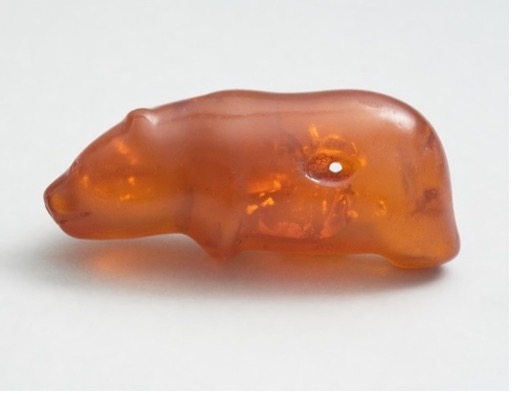
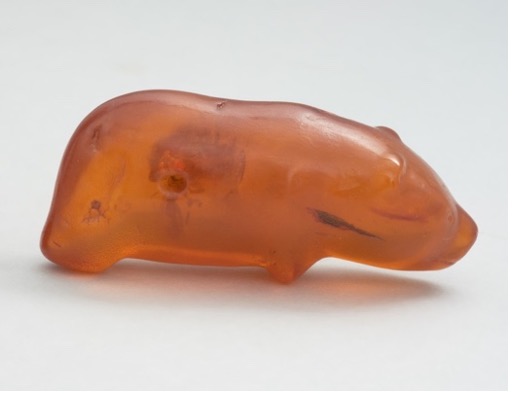
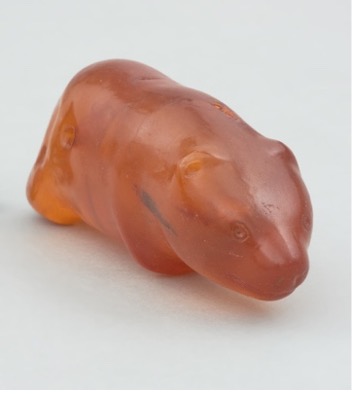
No. 2. Amber Bear Figurine If the fang from Oleneostrov is an amulet that is part of the beast itself, then the amber bear cub from Slupsk is already a complete representation—a three-dimensional figurine carved from a solid piece of amber. This find was made in peat near Slupsk, in the Western Pomerania (Poland), and dates back to the Stone Age. It is one of the earliest examples of how a person did not just wear a part of the bear, but reproduced its image in a material form. The figurine is small—10.2 × 4,2 × 3.5 cm—and, judging by its shape, likely served as a pendant: such volumetric depictions of animals were worn on the body as amulets. The Szczecin Museum directly links similar figurines to the totem animal and patron spirit: a person who wore the bear’s image would enter into a sacred bond with it, taking its power under protection. What is important here is the material—amber. It is not a part of the beast, but a «foreign, ” mineral substance, and yet it is in it that the person chooses to capture the bear, meaning the image is already separated from the animal itself and begins to live an independent life. For my research, this figurine is an intermediary link between two poles that I will examine further. On one hand, it is still a „prehistory”—the monument is not connected to the Slavs and belongs to pre-agricultural populations of the forest zone. On the other hand, the same mechanism that operates in Slavic charms is already at play here: the image of the animal substitutes for the animal itself, becoming its material „name“ that can be carried with you. From the fang—a body part—to the figurine—an image—and then to the charm: this outlines the very trajectory that my entire material will follow.