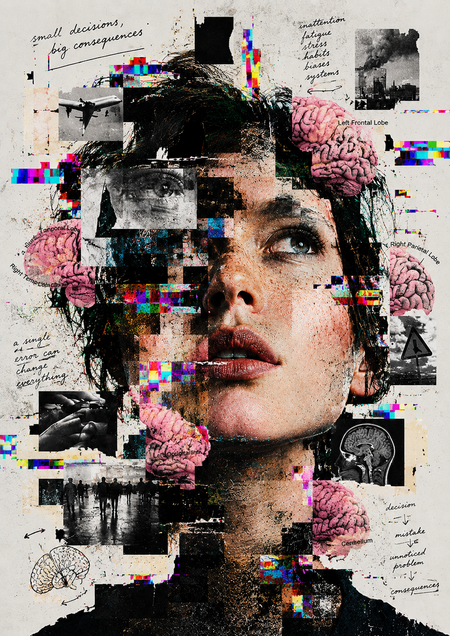
INACCURATE — a media exploration of human errors and their ramifications. How the slightest misstep by an individual or a corporation influences the historical process and shapes a new reality.
Media that explores how human errors, incorrect decisions, and small oversights lead to unexpected consequences—from humorous everyday incidents to major accidents, corporate failures, and engineering disasters.The core principle of this media is not «who is to blame?» but «how did this become possible?»The media does not ridicule the person who made a mistake; instead, it deconstructs the chain of decisions that led to the resulting outcome.
Problem
Audiences regularly encounter stories of human errors, failures, accidents, and poor decisions, yet they often receive information about what happened rather than why it happened. Causes are frequently reduced to a single mistake or a specific culprit, when in reality, an entire chain of decisions and circumstances may be behind the event.Furthermore, audiences are interested in real stories with unexpected twists, paradoxes, and a clear connection to everyday life. They need content that blends education with entertainment, allowing them to dissect complex situations without feeling like they are attending an academic lecture.
Objective
Media that examines human error through real-life stories, showing them not as isolated failures, but as the result of the interplay between people, systems, and circumstances. The focus is on how the error occurs, why it seems logical, and how it leads to consequences.
The media should transform complex cause-and-effect relationships into accessible, visual, and engaging content, enabling the audience not just to learn about unusual failures, but to learn how to see the mechanisms underlying them.
Themes
Focus: human error and its consequences.Specific Theme: real-life narratives where incorrect decisions, chance, or unnoticed mistakes lead to unforeseen outcomes.The core theme of the media is human error and the unexpected consequences of decisions. The project examines error not as an isolated slip-up by an individual, but as a process that can arise from inattention, misjudgment of a situation, lack of information, cognitive biases, or systemic imperfection.The media draws together stories from diverse fields: daily life, psychology, design, technology, business, science, engineering, and history. This allows us to show that the mechanism of error operates regardless of scale—one poorly selected button can cause a domestic problem, while a small calculation error can lead to a major accident.Key Publication Themes:1. Micro-Errors — a small action or decision that yields an unexpected result. 2. Systemic Failures — chains of decisions and conditions that result in a serious breakdown. 3. Design Flaws — how the characteristics of interfaces, objects, and environments cause people to err. 4. Business Mistakes — flawed corporate decisions, unsuccessful products, and projects. 5. Human Factors — cognitive biases, inattention, fatigue, and other causes of error. 6. Catastrophic Consequences — accident and incident narratives analyzed through the sequence of decisions, rather than solely through the final event.
Competitors
Key Competition Criteria1. Thematic Scope: What types of errors are covered: personal, engineering, business, design, technology, disasters 2. Format and Platforms: YouTube, Telegram, website, Instagram*, TikTok, podcasts, etc. 3. Story Packaging: Title, cover art, opening hook, dramaturgy, material length 4. Visual Language: Photography, archival materials, infographics, maps, schematics, 2D/3D animation, motion 5. Tone of Voice: Academic, documentary, unsettling, ironic, conversational, sensational 6. Audience Engagement: Shorts/Reels, Stories, polls, comments, quizzes, collections, saves, discussions
Direct Competitors— projects that already offer audiences narratives of errors, failures, accidents, and their consequences.
Indirect competitors don’t necessarily focus on human error, but they compete for the same need: to watch a compelling documentary story about how something went wrong.
Potential Competitors—these are projects currently occupying an adjacent thematic niche, but which could easily begin competing directly for our audience if the topic broadens.Among these are PostNauka, Secret of the Firm, and other science-popular and documentary media that may regularly engage with the theme of human factors, failures, and poor decisions:PostNauka—a science-popular media outlet that could compete for an audience interested in psychology, cognitive biases, human behavior, and the scientific explanation of errors.T—ZH—a potential competitor in the realm of real people’s stories, financial decisions, setbacks, and life experiences. Its strength lies in recognizable situations and conversational delivery.Secret of the Firm—a potential competitor focused on business failures, corporate mistakes, and unsuccessful strategic decisions. Its content may overlap with «INCORRECT» when the cause of failure is a flawed management decision or a misjudgment of the situation.
Conclusions and Insights1. Most competitors focus on disasters, failures, or isolated domains, rather than the core mechanism of the error itself.2. Stories become particularly engaging when there is an unexpected contrast between the cause and the effect—a small mistake leading to a massive consequence.3. Ideas for inspiration include: a documentary approach, authentic archival material, event visualization, diagrams, timelines, and short narratives.4. Ways to differentiate yourself: center the error itself as the primary subject of study, regardless of the context—from mundane daily situations to massive engineering failures.5. For every piece of content, it is crucial to answer four questions: What happened? Why did the solution seem correct? Why was the error overlooked? What were the consequences?
Distribution Channel
Main Channel: YouTube. Suitable for detailed breakdowns of real-life stories lasting 8–20 minutes, where one can sequentially reconstruct the chain of events, use archival materials, diagrams, animation, and visual explanations.Additional Channels: Telegram, VK Clips / Shorts, Instagram*.Telegram is used as a platform for supplementary content and continuous engagement with the audience. Here, short versions of stories, unexpected facts, archival materials, diagrams, and visual analyses can be published. Telegram is also suited for interactive formats: «Spot the Mistake, ” polls, quizzes, and discussions, where the user first attempts to determine the cause of the problem independently and then receives an explanation.Short video formats—VK Clips, YouTube Shorts, and Reels—are used to attract a new audience. Unlike the main release, the story here must stand alone and be built around one strong fact or question: „How one mistake destroyed a project? , ” „Why did no one notice this error? , ” „Would you have done it too?“. At the end of the short video, the user can be directed to the full analysis.The adaptation of one piece of content might look like this: full mistake analysis on YouTube → short video „One mistake that led to…“ → cards detailing the sequence of events → poll „Would you have noticed the mistake?“ → a short post summarizing the story’s takeaway.
Target Audience
Segment 1 — «Why Did This Happen?» Context: The person is interested in unusual stories and wants to understand their causes. JTBD: «When I learn about a strange event or failure, I want to understand how it all came to be so I can grasp the reason.» Problem: Information often stops at the event itself. Media Value: A clear analysis of the cause-and-effect chain.Segment 2 — «The Curious Observer» Context: Loves unusual facts, documentary stories, science popularization, and internet content. JTBD: «When I want to learn something unexpected, I want a story that is both surprising and educational.» Problem: Entertainment content is often superficial, while educational content is too academic. Media Value: Complex topics presented in the form of short, visual, and engaging stories.Segment 3 — «Spot the Mistake» Context: Enjoys interactive tasks, puzzles, and situations where they can test their own attention to detail. JTBD: «When I see a situation with a potential error, I want to find the problem myself and compare my solution to the analysis.» Problem: Most media provide a ready-made answer and do not involve the audience in the analysis process. Media Value: Interactive formats, visual tasks, and error analyses.
UVP
USP 1 — Error as the central subject of inquiry. Media doesn’t just report on disasters and failures; it investigates the error mechanism itself—from the initial decision to the final consequence.USP 2 — From decision to outcome. Each story traces a sequence of events: why the decision seemed logical $\rightarrow$ where the failure occurred $\rightarrow$ why it went unnoticed $\rightarrow$ what happened next.USP 3 — Errors across various fields. A single concept unites the everyday, psychology, design, business, technology, science, and history. Therefore, the subject of study can range from an incorrect interface button to an error that led to a major accident.All USPs are based on analyzing direct competitors