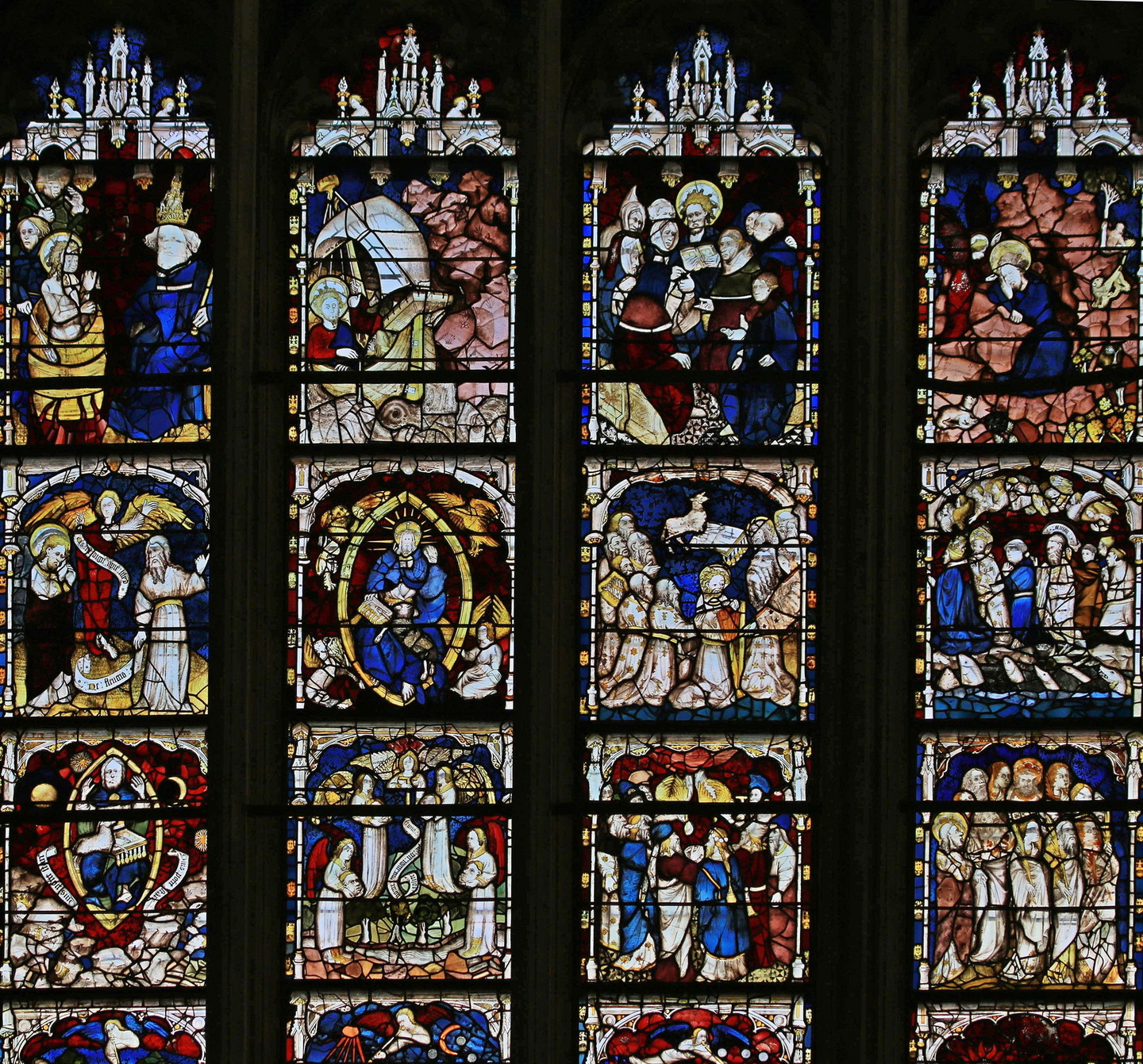
We are accustomed to viewing medieval stained glass as a «Bible for the illiterate”—a solemn narrative about Christ and the saints. But if we look down to the very base of the Gothic window, the sacred story ends, and the world of manual labor, grotesque imagery, and domestic satire begins.
Navigator
1. Rationale for Topic Selection;
2. Material Selection Principle;
3. Categorization Principle;
4. Principle for Selecting and Analyzing Textual Sources;
5. Key Question and Hypothesis;
6. Part I («The World at the Feet of the Saints»);
7. Part II («The Underside of Order»);
8. Part III («The Liberation of the Periphery»);
9. Part IV («The Fading of Glass»);
11. Conclusion;
12. Image Sources;
13. Bibliography
Justification for Theme Selection
In traditional art history, medieval and Renaissance stained glass has customarily been viewed as a «Bible for the illiterate”—an instrument of sacred propaganda and theological exegesis. However, the peripheral zones of stained glass compositions—lower registers, borders, and ornate tracery—and subsequently, small-scale secular stained glass forms, conceal a vast stratum of visual culture encompassing everyday life, grotesque imagery, and social satire. The selection of this topic is driven by the need to shift focus from the canonical center to the marginal periphery. Studying how images of earthly labor, parodic animals, and domestic scenes coexisted with the sacred, and later supplanted them in secular interiors, allows one to trace the process of the secularization of European consciousness through the material of decorative and applied arts.
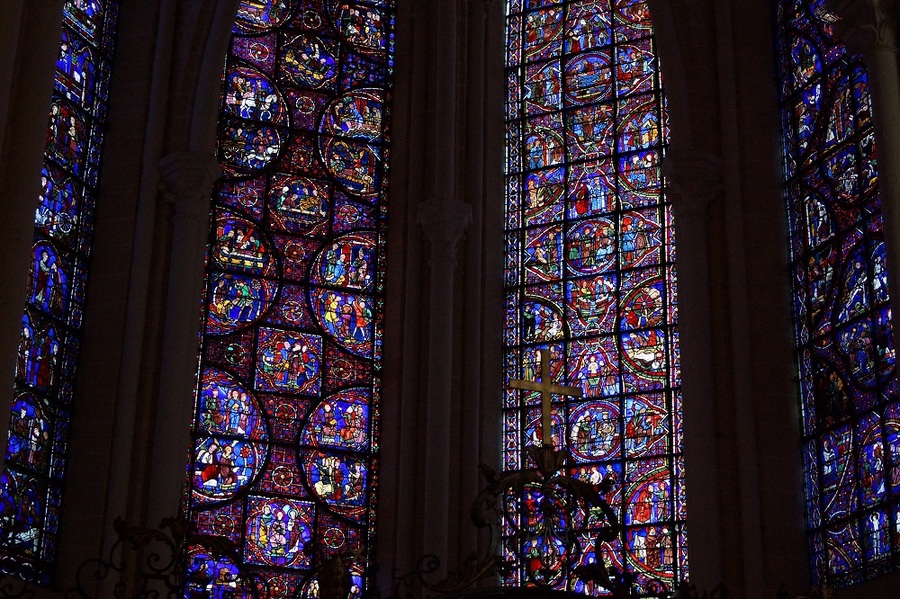
Chartres Workshop. Stained glass ensemble of the upper choir tier. 1210–1225. Colored glass, schwarzlot painting, lead cames. Notre Dame Cathedral (Chartres Cathedral), Chartres, France.
Material Selection Principle
For this study, monuments of stained glass art from Western and Central Europe (France, England, Switzerland, Netherlands, Germany) from the 13th to 17th centuries have been selected. These works feature non-religious, everyday, satirical, or grotesque motifs. The main selection criterion was the visual representation of the transition from a «peripheral» subject to a «central» one.
The sample includes three groups of objects: • Monumental church stained glass windows from the 13th–14th centuries featuring donor «craftsman» signatures and marginal borders (Chartres Cathedral, York Minster); • Secular, small-scale cabinet windows (Kabinettscheiben) and 16th-century Dutch roundels created for town halls, guild houses, and bourgeois residences; • Late painted glass and printed graphic works from the same period, which allow for the documentation of the fading of this tradition in glass.
Unknown master (York Workshop). Scene «The Monkey Doctor Examining a Flask» (a fragment of the lower border of the «Pilgrims' Window»). c. 1312–1330. Stained glass, painted with black glaze, leaded frame. St. Peter’s Cathedral (York Minster), York, United Kingdom
The Principle of Tabulation
The research is structured according to a chronological-thematic principle, reflecting the dramaturgy of image transformation (inciting incident—development—climax—resolution).
The work is divided into four main thematic sections: • Section I («The World at the Feet of the Saints») fixes the spatial hierarchy of the Gothic window and the emergence of artisanal life within it; • Section II («The Reverse Side of Order») analyzes the grotesque, the bestiary, and the motif of «the inverted world» in church borders; • Section III («The Liberation of the Periphery») is dedicated to the flourishing of secular cabinet stained glass, where daily life and moral satire occupy the center of the composition; • Section IV («The Fading of Glass») examines the migration of satirical subjects into printmaking.
Each section utilizes a method of correlating a «master plan» (architectural context) with a «detailed plan» (detail cutout), as well as creating visual echoes with adjacent media (such as a book miniature or engraving).
Unknown Master (Chartres Workshop). Stained Glass Rose of the South Transept («Christ in Glory»). c. 1221–1230. Colored glass, schwarzlot, lead framework. Chartres Cathedral, France
Principles of Selecting and Analyzing Textual Sources
The theoretical foundation of the research was built upon works concerning the iconography of medieval marginalia and visual culture (M. Maisulz, L. Randall), as well as catalogs and studies of stained-glass museum collections (Corpus Vitrearum, research from specialists at the Pushkin State Museum of Fine Arts and the State Hermitage Museum). Textual sources are employed not to recount the historical narrative, but rather for the semantic deciphering of visual codes: defining the meanings of medieval proverbs, guild symbols, bestiary allegories, and the social functions of the patrons.
Unknown Master (Chartres Workshop). Stained-glass rose window of the North transept («The Glorification of the Virgin Mary» / «The Rose of France»). c. 1230–1235. Colored glass, black enamel painting, lead cames. Notre-Dame Cathedral (Chartres Cathedral), Chartres, France.
Key Research Question and Hypothesis
• Key question: How, and under the influence of what sociocultural and technological factors, did «low» motifs (craft labor, grotesque, everyday satire) evolve from subordinate elements on the borders of church windows into independent narratives within European stained glass? • Hypothesis: Margins in medieval stained glass were not a random expression of workshop license, but rather served a function of visual contrast, separating the sinful or transient earthly world from the celestial realm. As the economic influence of the bourgeoisie grew, as culture secularized, and as the technique shifted from mosaic leadwork to painted glass (silver stain, enameling), peripheral narratives detached from the sacred context, moved to the level of the viewer’s eye in private interiors, and transformed into an independent genre of secular moralizing miniature.
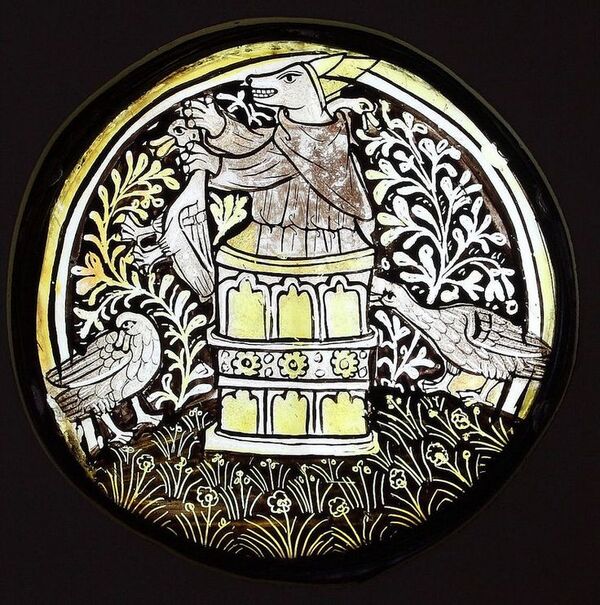
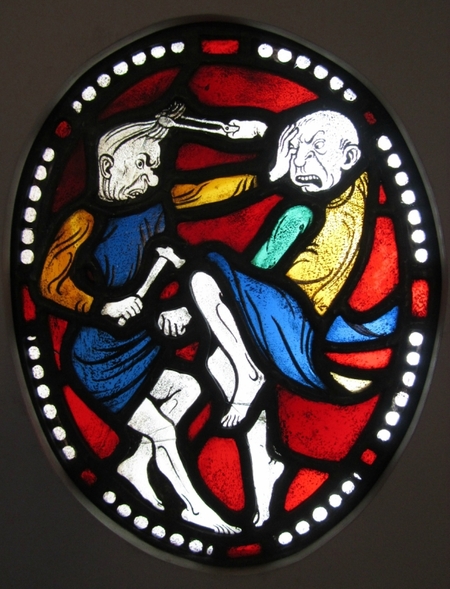
• Unknown master. Medallion «The Fox Preaching to the Geese.» Early 15th century. Glass, painted, silver stain. Museum of Stained Glass, Ely, UK • Carl Parsons. Panel «Hammer and Tongs.» c. 1920. Glass, painted, silver stain. Museum of Stained Glass, Ely, UK
Section I («The World at the Feet of the Saints») (13th–14th Centuries)
In a classic Gothic window, a strict vertical hierarchy of space is maintained. The upper and central registers belong to sacred history—Christ, the Virgin Mary, and the lives of the saints. However, at the very bottom, near the stonework and closest to the eye level of the parishioner, a zone of the earthly world emerges.
The 13th-century Chartres Cathedral features over a hundred such «craftsman signatures.» Bakers placing bread in the oven and merchants measuring fabric act here as collective donors who paid for the window. Their labor is not yet an independent narrative, but it is the first instance where everyday life is legitimized within the sacred space.
Unknown Master (Chartres Workshop). Fragment of the stained glass window «The Story of Noah.» c. 1210. Colored glass, black paint, lead cames. Notre Dame Cathedral, Chartres, France
In the 13th century, the construction of Gothic cathedrals was funded not only by kings and bishops but also by municipal craft guilds. In exchange for their donations, the workshops received the right to display their collective image in the lower section of the stained glass.
Section II («The Inside of Order»): Grotesque and bestiaries at the frame’s edge (14th–15th centuries)
In the 14th century, the periphery of stained glass comes alive and becomes audacious. Monsters, hybrids, and animals parodizing human vices appear along the side borders and in the filigree finials of the windows.
What are these ridiculous monsters, this astonishing ugly beauty and magnificent ugliness, before the eyes of the reading brethren in the monasteries? Why are there dirty monkeys here?