Череп как знак смертности в искусстве XVI–XVII веков
Визуальное исследование по истории искусства
Contents
I. The Skull in the Space of Reflection
II. Addressing the Viewer
III. Man Disappears, Things Remain
IV. The Return of the Face
10 works, 1514–1651.
Research Question
How do the position, scale, and lighting of a skull—its relationship with human gesture and surrounding objects—alter the perception of memento mori?
Object: Western European graphics and painting of the 16th–17th centuries.
Working Hypothesis
The compositional role of the skull determines how the viewer interprets the symbol. In interior design, it accompanies contemplation; next to a face, it creates contrast; in an anamorphic piece, it demands discovery; and in a still life, it connects the meanings of objects.
Theme SelectionThe skull is recognized as a symbol of mortality, yet its meaning within a painting depends entirely on the composition. It may appear on the periphery, coexist with a figure’s face, or become an optical enigma. This study compares the ways artists render the concept of life’s finiteness and guide the viewer’s focus.The selection of the theme stems from an interest in visual communication. For a designer, it is crucial to understand how the placement of a single element alters the reading of the entire image. A recurring motif allows for a comparison of scale, light, gesture, and the surrounding context of objects. The focus is on the organization of the image, not the artist’s biography.MaterialsThe materials comprise ten works of graphic and painting from 1514–1651. The majority of these are rooted in Northern Europe. A painting by Georges de La Tour supplements the selection with a French example. The study includes works by Hieronymus, a double portrait, a figure of a youth, Magdalen, and vanitas still lifes.The pieces are selected based on the thematic role of the skull and the opportunity to compare specific visual devices. Authorship and dates are verified using museum records. Two works by Dürer and two still lifes by Claes are needed to compare solutions within a single artistic problem. The selection does not represent all European traditions.Structure and InquiryThe structure follows the operational methods of the motif. The first section addresses contemplation, the second addresses the viewer, and the third examines the material connections in still life. The final section explores the convergence of portraiture and objects.The key question is: how do the placement, scale, and light—as well as the skull’s relationship to gesture and surrounding objects—change the perception of mortality? The hypothesis posits that the compositional role dictates the symbol’s function: it either accompanies contemplation, demands discovery, establishes an address, or connects the meanings of objects.
Hypothesis: The compositional role determines the action of the symbol: it accompanies contemplation, requires discovery, creates an appeal, or connects the meanings of things.
Method and Sources The method is based on comparing the whole and the detail. The overall view preserves the relationships between elements, while the fragment highlights a specific technique. Paired comparisons are constructed based on a single attribute: distance, gesture, light, or object proximity. The scale of the reproductions in the mockup is conventional and does not reflect the physical dimensions of the originals.The textual foundation includes museum cards, the National Gallery catalog on «The Emissaries, ” a Metropolitan Museum of Art article on still life, and materials from De Lakenhal on Bayi. The cards clarify the attributions, and the research helps establish the context. Historical fact is separated from the proposed visual interpretation.Hypothesis TestingThe hypothesis is also tested through cases that complicate it. In „The Emissaries, ” the skull is visible as a form but is not immediately recognizable. In the works of Bayi, figures, portraits, and objects coexist. Therefore, the absence of a face is not considered the inevitable outcome of artistic development, nor does the appearance of a skull automatically explain all neighboring objects.The result is a typology of visual strategies for the selected works. It illustrates the difference between contemplation, engagement, discovery, and reading the connections between objects. The conclusions apply only to the specific sample studied; they do not replace the study of other cultures, periods, or modes of depicting death.
A space for contemplation
A skull can be placed near a person without disrupting the scene’s tranquility.
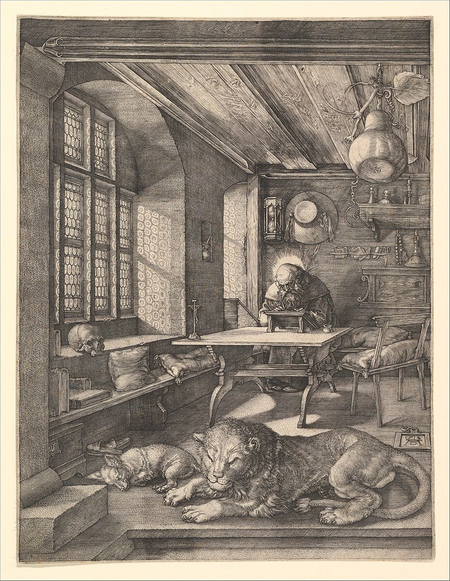
Jerome in his CellAlbrecht Dürer. Saint Jerome in His Cell 1514. Metropolitan Museum of Art, New YorkDürer places a skull on the windowsill. It belongs to the interior setting while Jerome continues his work. Mortality is present in the scene alongside the reading, the light, and everyday objects.
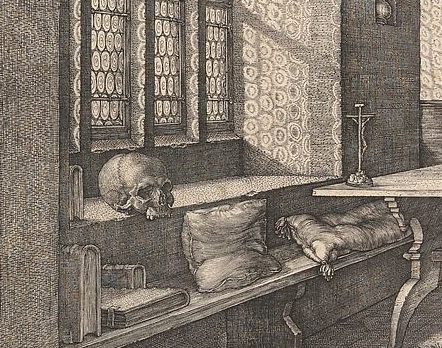
Skull on the PeripheryThe skull is located on the left, away from the desk. It must be discovered amidst the room’s details. In this composition, the memento mori does not become a spectacle.
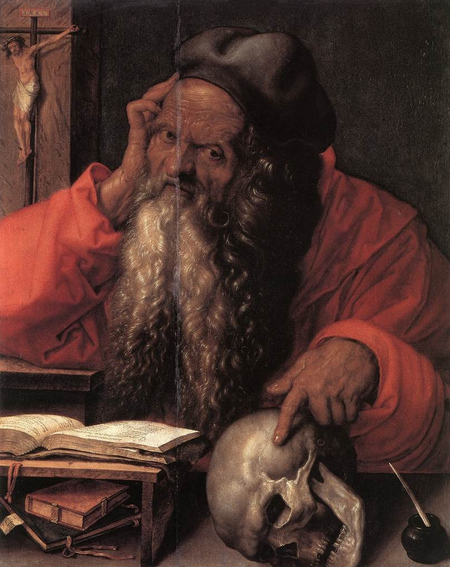
Hieronym Facing the ViewerAlbrecht Durer. Saint Jerome 1521. National Museum of Ancient Art, LisbonIn this 1521 painting, the figure is brought closer to the viewer. The skull dominates the foreground, and Jerome’s finger points toward it. The visual connection between the person and the symbol becomes more explicit.
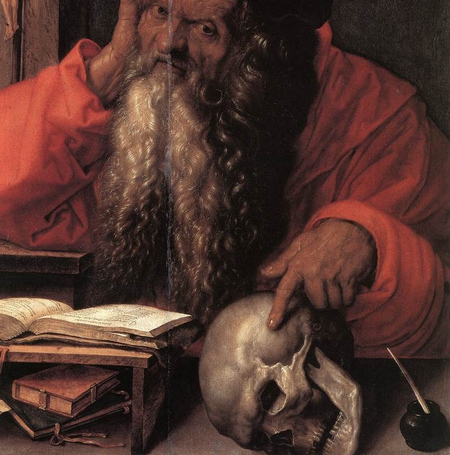
Face, hand, skull
Hieronym’s gaze and pointing gesture connect the viewer to the object on the table. The skull’s position shifts: from a detail within the room, it transforms into a focal point.
Two Solutions to One Scene
In 1514, the distance within the room was important. In 1521, the closeness of the figure and the gesture made the depiction more pointed.
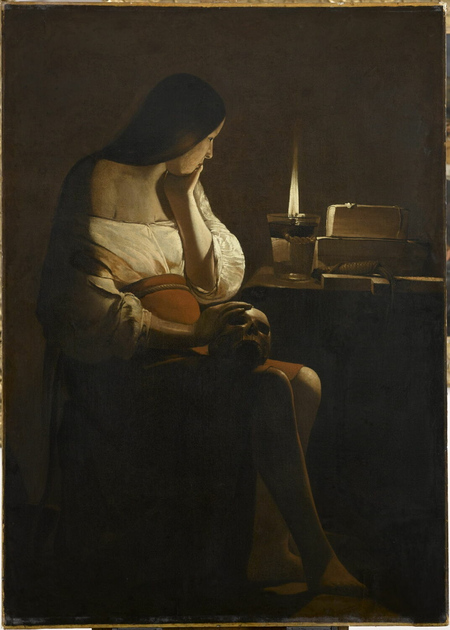
Magdalene with a NightlightGeorges de La Tour. Magdalene with a Nightlight c. 1642–1644. Louvre, Paris © GrandPalaisRmn (musée du Louvre) / Franck RauxMagdalene holds her hands over a skull and gazes toward the fire. The dark space emphasizes the illuminated forms. The gesture can be read as prolonged, quiet contemplation on the finitude of life.
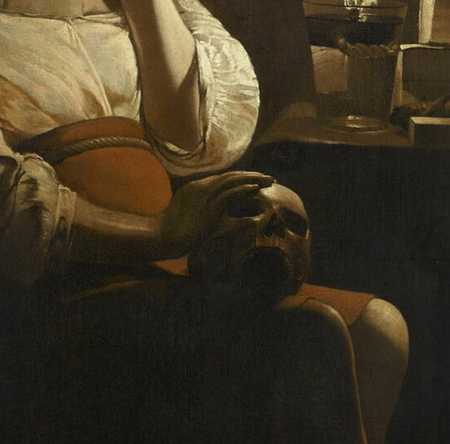
Contact with the BodyThe skull rests on the knees, near the hands. Its presence is not external to the figure. The visual intimacy makes the theme of mortality an inherent part of the contemplative pose.
Conclusion: Distance and Contact
In three works, the skull is associated with the human in different ways. Dürer first depicts it in an interior setting, then in the foreground. Latour incorporates it into a static gesture. This compositional proximity shifts the nature of the contemplation.
II
Addressing the Viewer
A reminder of mortality may depend on the viewer’s perspective or the gesture of the depicted figure.

AmbassadorsHans Holbein the Younger. Ambassadors 1533. National Gallery, London Holbein depicts Jean de Dentesville and George de Selve alongside objects of scholarship and status. The elongated form in the foreground disrupts the spatial clarity of the double portrait.
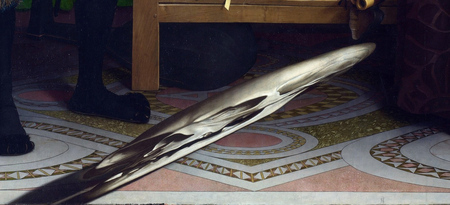
AnamorphosisHans Holbein the Younger. Ambassadors 1533. National Gallery, London · FragmentWhen viewed from a specific angle, the elongated form reads as a skull. Here, the reminder of death is linked to the act of viewing itself: the viewer must change their perspective.
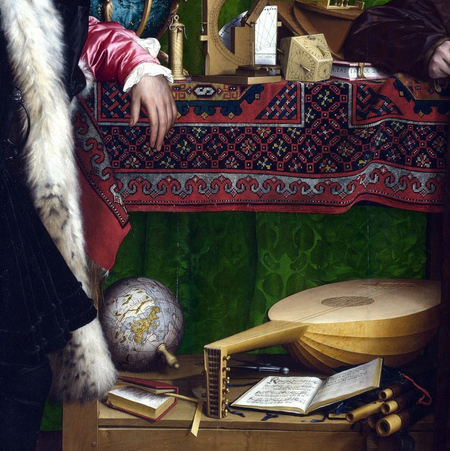
The World of Things and the Hidden SignBooks, tools, and globes are gathered on the shelves. Their detail contrasts with the distorted form below. The painting also has a religious context: in the upper left corner, a crucifixion is partially hidden.
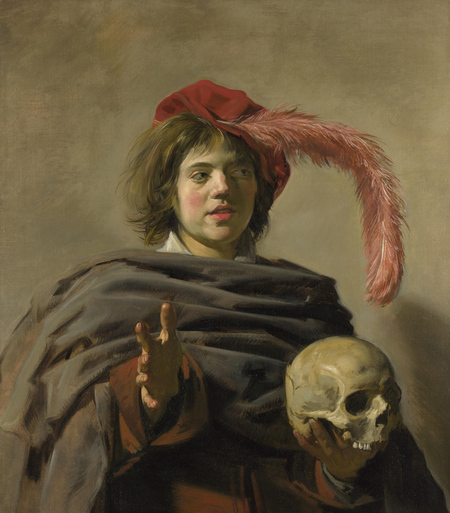
Youth with SkullFrans Hals. Youth with Skull (Vanitas) 1626–1628. National Gallery, LondonHals depicts a youth holding a skull and gesturing expressively with a free hand. The museum attributes the subject matter to vanitas. There is no reliable confirmation identifying the character as Hamlet.
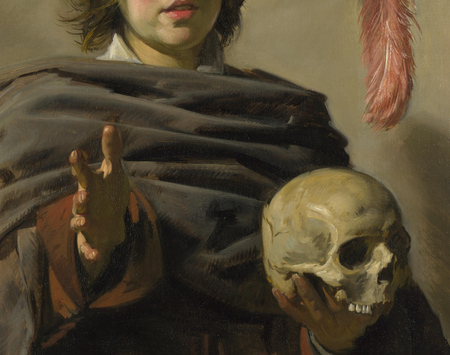
Gesture and StillnessThe hand is directed into the space before the painting. The skull remains a static object. The contrast between movement and stillness transforms the symbol into a part of the address to the viewer.
Discovery and Approach
For Holbein, meaning is revealed through a shift in perspective. For Hals, the gesture directs attention. The same motif demands different ways of looking.
Conclusion: The Role of the Viewer
Reminders of mortality can be integrated into the very process of perception. Anamorphosis delays recognition. A gesture creates a feeling of direct address. The viewer participates in shaping meaning.
III
Man vanishes, objects remain
In a vanitas still life, human themes can be expressed through objects.
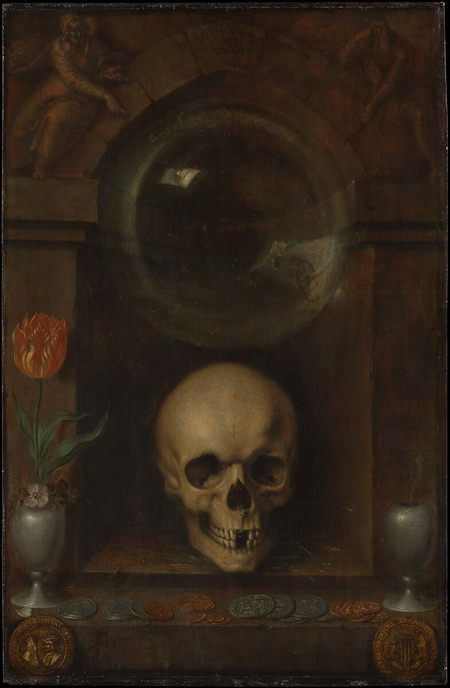
Skull in the CenterJacob de Gheyn II. Vanitas Still Life 1603. Metropolitan Museum of Art, New YorkDe Gheyn places the skull in a niche beneath a large bubble. Flowers and other objects reinforce the theme of the brevity of life. The Metropolitan Museum of Art regards this work as one of the early independent vanitas still lifes.
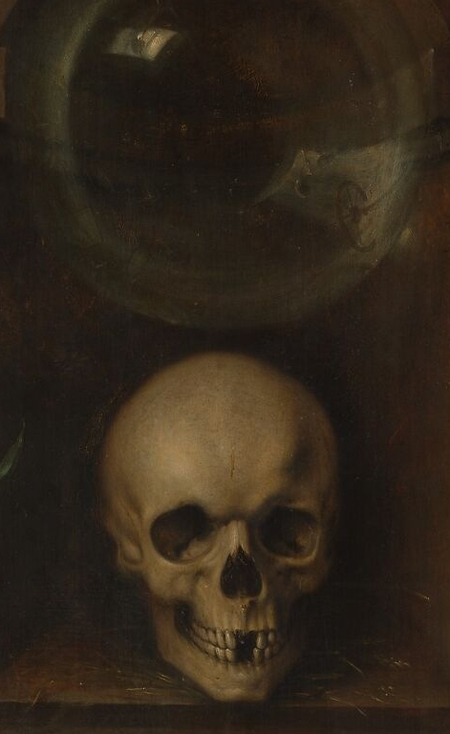
Vertical AxisThe bubble and skull are positioned one above the other. The central axis unifies the composition. The fragile shell and the hard bone demonstrate the endpoint of existence in different ways.
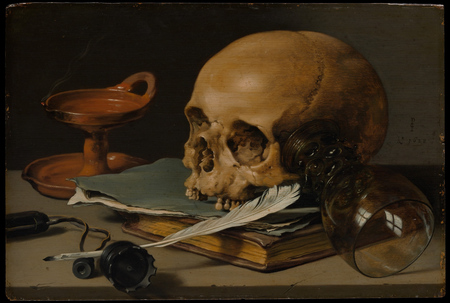
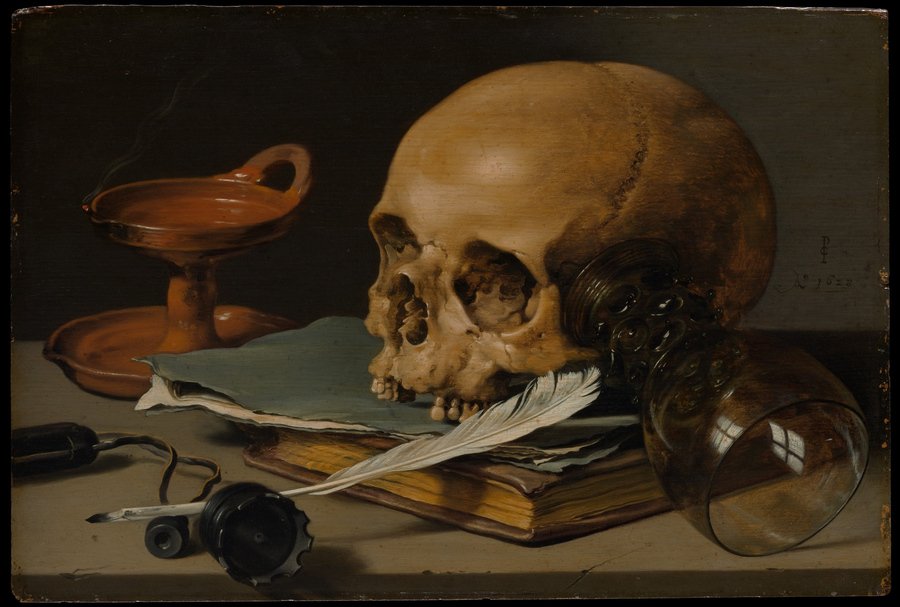
Objects on the Stone LedgePeter Claesz. Still Life with Skull and Goose Feather 1628. Metropolitan Museum of Art, New YorkThe composition brings the objects close to the edge of the frame. The skull sits next to the feather, a book, an overturned glass, and a lamp. A restricted palette unites the various surfaces.
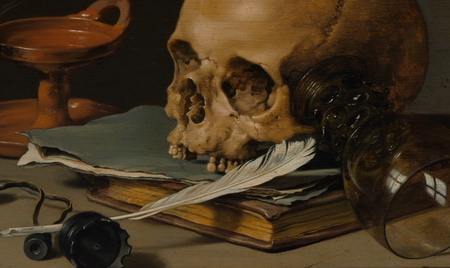
Material ProximityThe feather, the sheets, and the bone are meticulously rendered. The stone edge separates the image from the viewer’s space while simultaneously bringing them closer. Abstract thought assumes the form of tangible objects.
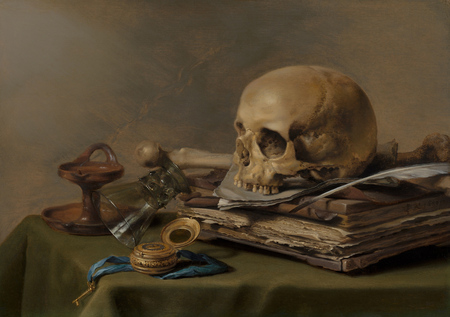
Objects of TimePeter Claesz. Vanitas Still Life 1630. Mauritshuis, The Hague Mauritshuis, The HagueThe 1630 still life features a skull alongside a clock, an empty goblet, and an extinguished lamp. The Mauritshuis interprets this grouping as a reminder of mortality.