Медиа
автоматизация
Media Concept
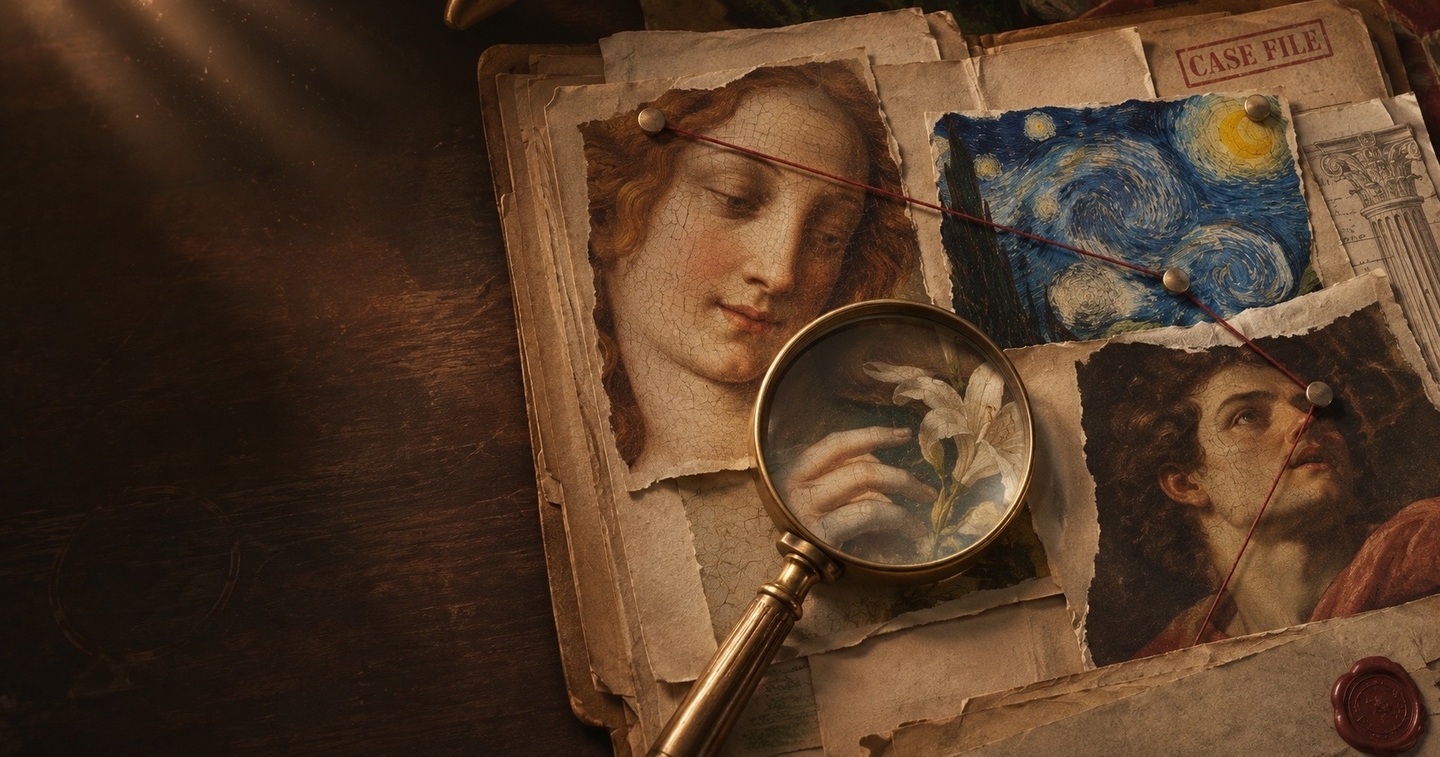
The «Key to the Secret» media series consists of short, vertical videos where a familiar classical painting is transformed into a detective mystery. The viewer receives three or four «clues"—hidden symbols—and an unexpected resolution that allows them to see what they missed for years. The essence of the project is to deliver a sense of intellectual discovery in just 40 seconds and provide a reason to share it with friends. This project exists because the niche of «art as a mystery» is currently represented only by text-based channels and long lectures; there is no short, detective-style video with this structure. We are filling that gap using museum archives and an automated production pipeline.
Data Sources
Main image source
Gallerix Role: High-resolution image database for video.Why it is suitable: — Large reproductions (often 2000–5000 px on the longest side), sufficient for zooming, cropping, and macro detail. — Easy navigation through museums, artists, and eras. — Option to download images without watermarks.
Museum Archives (Open Data)
Key Museums: — Louvre, — Prado, — National Gallery, — Tretyakov Gallery, — Russian Museum, — MoMA, — National Museum of Norway, — The State Hermitage Museum.What to look for: • Catalog data: title, artist, date, medium, size, provenance (the painting’s «biography»). • Scholarly descriptions of symbols and iconography (often found in the «Explore the collection» section). • High-resolution images.Why this is important for the USP: only museum archives provide us with «credibility» and «protection against AI sludge.» In a Telegram post, you can link directly to the catalog entry—the viewer can see that the fact is verified.
Wikipedia
Role: A quick start for gathering foundational facts and navigating a topic.
How to use: · Establish the general framework: dates, key symbols, and historical context. · Always verify every fact against a museum catalog or a scholarly article. · In the narrative, never cite Wikipedia as a final source—only museums or peer-reviewed research.
Why it’s not a final source: Wikipedia can contain inaccuracies, outdated attributions, and popular interpretations. For a detective format, an error equals a loss of credibility.
Art Historical Articles and Scholarly Publications
Role: Depth, unexpected discoveries, and facts not found in popular sources.Where to look:· Google Scholar — academic articles on art history, restoration, and technical analysis of paintings. · JSTOR — archive of academic journals (some are open access). · ScienceDirect / Springer — articles on technical analysis (X-ray, IR reflectography, layer amplification). · PubMed / Scientific Reports — research on art perception (e.g., experiments with the smile of the Mona Lisa). · Museum websites — the «Research» / «Conservation» sections: these publish reports on restoration and technical investigations (e.g., the report on the inscription on Munch’s «The Scream"—The National Museum of Norway, 2021).Rule: for every piece—at least one scientific or museum source must confirm the key «clue» or «discovery.»
Additional resources (for context and verification)
· Google Arts & Culture — an aggregator of museum collections, useful for quick searching and comparison. · Auction houses (Christie’s, Sotheby’s) — provenance, history of ownership, and attribution. · Exhibition catalogs (online) — often contain fresh research and details not found in general articles. · Conservation databases — such as technical research reports from the Louvre, Prado, or Tretyakov Gallery.
The separation of human and machine processing
Machine Processing
Selecting 10 artworks per month based on recognizability and potential; Parsing trends and sourcing candidate artworks based on audience queries; Writing a script using detective terminology; Initial fact-gathering (dates, artist, museum, key symbols) and searching museum catalogs and academic articles; Generating 5–7 «hook» variations for the first 3 seconds and tailoring captions for specific audience segments; Generating prompts and creating frames with analytical overlays (borders, grids, captions); Final voiceover; Cross-posting on TikTok, Instagram Reels, Shorts, and VK Clips with adapted hashtags and CTAs; Monitoring comments (draft responses); Collecting metrics (% view-through, shares, Telegram traffic) and identifying patterns for reporting.
(recognized as an extremist organization and banned in the Russian Federation)
Human Processing
Downloading high-resolution images from primary sources (Gallerix.ru, museum archives); Fact-checking—cross-referencing every «clue» and «solution» with the museum catalog or a scholarly article, filtering out «folk interpretations» from Wikipedia (zone of trust); Final editorial review and approval of the tone of voice; Authenticity check of the visuals (artwork is not a redraw, overlays do not distort the original); Timeliness verification; Assembly, color grading, and final grade; Publishing the post on Telegram with the «complete case» and links to sources; Interpreting analytics and adjusting the content plan.
Guidelines for Automated Services
- Permissible Tasks for Automation
- Gathering raw facts, sourcing material, and parsing trends.
- Generating options for titles, captions, and image prompts.
- Providing narration for timing, cross-posting, and analytics gathering.
- Creating analytical overlays (frames, grids, labels) on top of original images.
- Prohibited Actions
- Do not redraw or regenerate the «artwork”—only overlays on the original are permitted.
- Do not fabricate facts or use Wikipedia as the final source.
- Do not publish content without human fact-checking and tone-of-voice approval.
- Do not use images without citing the source (Gallerix.ru, museum archive).
- Source Requirements
- Images must come exclusively from Gallerix.ru or open museum archives.
- Facts must be verified against a museum catalog or scholarly article (Google Scholar, JSTOR, museum websites).
- A mandatory source link must be included in the Telegram post.
- Format and Style
- Video Aspect Ratio: 9:16; Duration: 40–50 seconds; Structure: „hook → 3 clues → resolution.“
- Overlays: Red borders/dots, white labels, maintaining the integrity of the original image.
- Tone of Voice: Detective-oriented („clue, ” „suspect, ” „resolution“), but without distorting facts.
- Mandatory Human Validation
- Fact-checking every clue and resolution.
- Approval of the script and final voiceover.
- Verification of visual authenticity (the painting must not be redrawn).
- Publication on Telegram with cited sources.
- Transparency and Logging
- Every automated step must leave a trace: the fact source, the image link, and the prompt version.
- In case of error, rollback to the previous step must involve human intervention.