Today’s academic journal is no longer just a print publication or a PDF released several times a year. It exists simultaneously across various mediums—in print, on the internet, and on social media—and editorial teams must find new tools both for engaging with readers and for presenting scholarly knowledge.
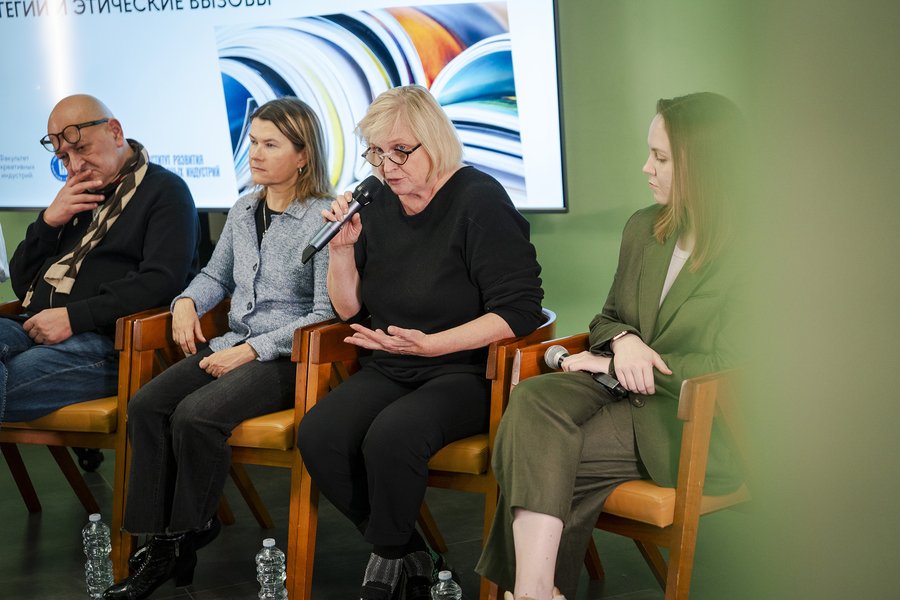
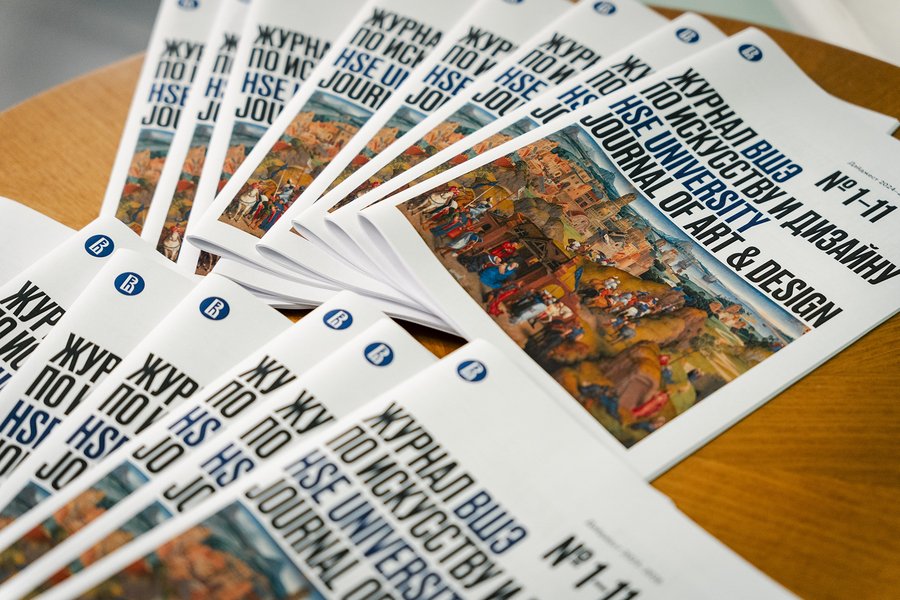
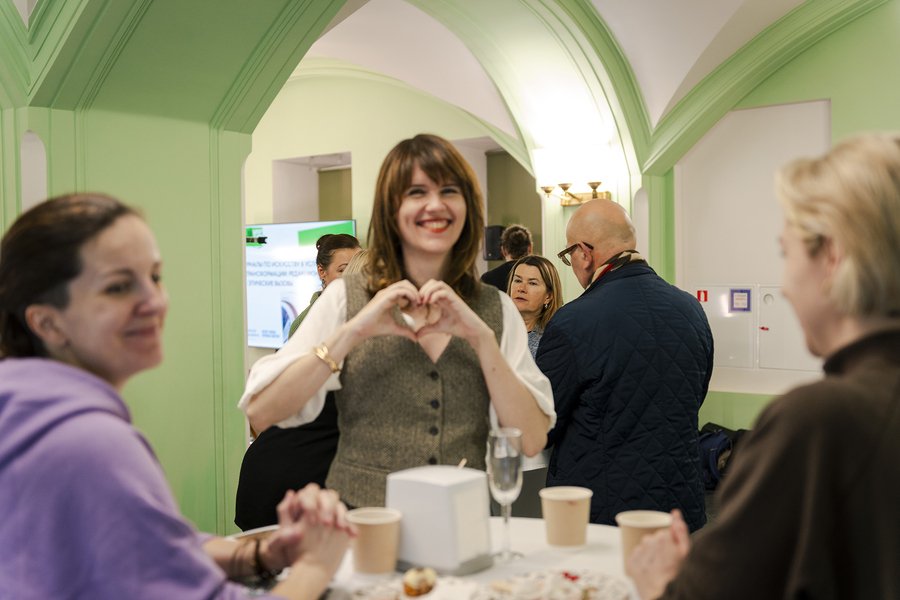
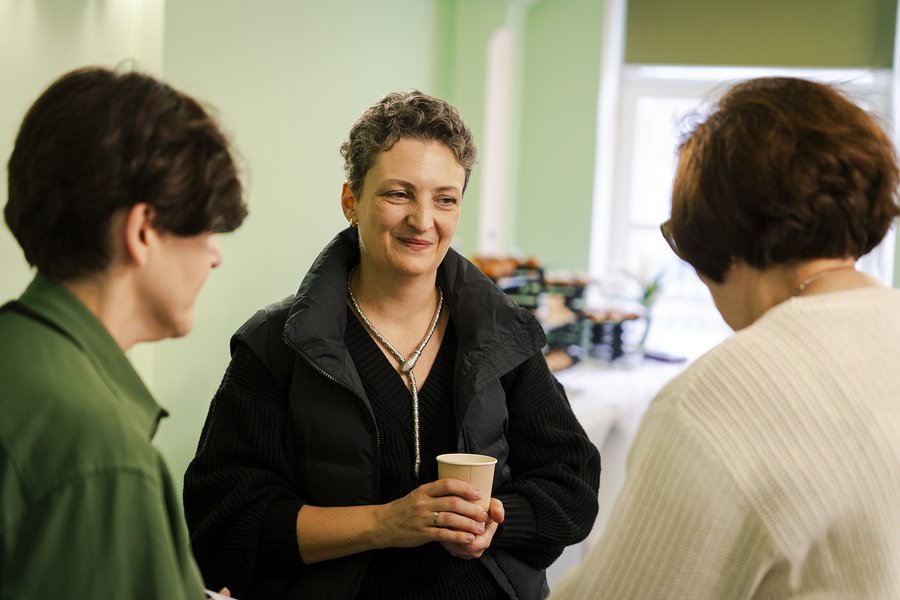
October 17 at the HSE Professor’s Club held the Design School Round Table: The Future of Academic Journals in the Age of AI.Here is a brief summary of the event.
How is the work of academic journals changing amid digitalization, scientometrics, and the spread of artificial intelligence? During the meeting, editors and researchers discussed what determines the quality of a scientific publication today, how journals establish relationships with authors, and why technology does not negate the most crucial elements—expert review, accountability, and the human voice.
The Journal as an Authorial Stance
Opening the discussion, Lyudmila Alyabyeva, Academic Director of the Postgraduate School of Arts and Design at HSE University, Head of the «Curation and Fashion Criticism» Master’s Track at the HSE Art and Design School, and Chief Editor of the journal «Fashion Theory: Clothing, Body, Culture, ” Associate Professor and Candidate of Philological Sciences, suggested that a scholarly journal should be viewed not only as a platform for publishing research findings but also as a space where professional perspectives and understandings of significant themes are formed.In the digital environment, editorial teams must simultaneously navigate academic requirements, new material distribution formats, and evolving audience expectations.
However, digitalization does not make the editorial process instantaneous. A scholarly publication undergoes expert peer review, editorial preparation, and author approval. The duration of this process is particularly noticeable for postgraduate students and young researchers who must account for certification deadlines. According to Lyabeva, the speed of digital dissemination does not mean that a high-quality scholarly article can be prepared just as quickly.
It is important not only the speed of publication but also the kind of research work the journal helps preserve and make visible.
Natalia Sipovskaya: Independence and Editorial Choice
Natalia Sipovskaya, Doctor of Art History, Director of the State Institute of Art Studies, and Chief Editor of the almanac «Pinakotheca, ” discussed the experience of publishing a journal founded in 1996. In her presentation, editorial independence was presented as a prerequisite for the publication’s substantive integrity: the journal must maintain its own interests and not reduce its editorial policy to meeting formal metrics.
Working with art historical materials presents practical challenges. Publications often require illustrations, and obtaining rights for image use and reproduction can be costly. Institutional requirements and the need to support a print edition also influence editorial decisions. Yet, as Sipovskaya emphasized, the journal must retain its own substantive logic even under these conditions.
If the journal interests its editor-in-chief, it interests everyone.
Nikolai Molokov: research is more important than a formula
Nikolai Molok, candidate of art history, editor-in-chief of the journal «Iskusstvoznanie» of the State Institute of Art Studies and senior research fellow at the Sector of New and Contemporary Art of the State Institute of Art Studies of the Ministry of Culture of the Russian Federation, spoke about the relationship between scientific criteria and the actual research value of a text.A formally correct article does not automatically become significant: editorial staff requires independent research, substantiated conclusions, and material that expands the understanding of the subject, rather than simply reproducing the conventional structure of a scholarly publication.
Molok drew attention to the longevity of scholarly texts. As an example, he mentioned Raphael Samoilovich Kaufman’s work, «Soviet Thematic Painting,» published in 1940. Older articles can be reintroduced into scientific circulation and serve as sources for new research. Therefore, it is important for the journal to maintain an archive and ensure the ability to locate materials published decades ago. In the same context, the systematic index of the «Art Studies» journal for over half a century was discussed.
One specific example involved the use of artificial intelligence and online sources. Molok discussed editorial corrections where an incorrect dating of the Venus de Milo was added to the material, based on information from Wikipedia. This case served as a reminder: automated searching can speed up the work, but it does not replace fact-checking or professional responsibility.
A scholarly article must contribute new knowledge, not merely satisfy the formal requirements of publication.
Alexandra Persheeva: Digital Format and Visual Argumentation
Irina Sakho: editorial responsibility and fact-checking
Irina Sakhno, Doctor of Philological Sciences and Professor at the HSE Art and Design School, Editor-in-Chief of the HSE Journal of Art and Design, and Academic Advisor for the Master’s Program in «Contemporary Art Practices,» discussed how young academic journals can become visible and how to build relationships with authors. Clear publication guidelines, trust in experts, and consistent editorial work remain crucial.
Discussing artificial intelligence, Sakhn noted that while it can be useful for finding and preliminarily processing information, the results must be verified. She gave an example where a neural network suggested a selection of twelve photographers, including an American celebrity from the entertainment industry. This case illustrates why it is crucial for researchers to independently verify sources and avoid integrating machine-generated answers into scholarly text without critical evaluation.
In editorial practice, expert review holds crucial importance: if two reviews are negative, the material will not receive a recommendation for publication. Sakhnо also mentioned a new tool designed to detect possible AI usage. However, such signals are viewed cautiously and do not replace the professional judgment of the editorial board.
«Any information obtained using an AI model must be verified.»
Alexandra Persheeva, Candidate of Art History, Academic Director of the «Contemporary Art» Program at the HSE Art and Design School, Head of the Department of Art and Design History and Theory at the HSE Art and Design School, member of the editorial board of the publication ART, researcher, film director, and video artist, spoke about the format of a scientific journal that operates at the intersection of research, design, and visual culture. A digital publication allows for the construction of extensive materials, the inclusion of imagery, and the creation of supplementary ways to navigate complex content. Print formats, meanwhile, can supplement the online platform rather than compete with it.
As an example, Persheeva mentioned Sergey Kavtaradze’s material on the decorative elements of the «Ploshchad Revolyutsii» metro station. Such publications demonstrate that visual material in art history is not mere «decoration,» but an integral part of the argumentation. It aids in examining the subject, comparing details, and making the researcher’s findings more accessible to the reader.
Discussing AI, Persheeva suggested that neural networks can assist in the early stages—for example, structuring a draft or outlining a plan. However, the development of research and writing cannot be reduced to simply editing generated text. Furthermore, the proliferation of erroneous material online creates a risk of that material reappearing in the models’ training data; consequently, inaccuracies can be replicated and solidified.
The tool can help structure the text, but it does not perform the research work for the author.
Ekaterina Salnikova: The Value of the Human Voice
Ekaterina Salnikova, Doctor of Cultural Studies and Candidate of Art History, Editor-in-Chief of the academic journal «Artistic Culture» and Head of the Sector of Artistic Problems in Mass Media at the State Institute of Art Studies, emphasized that the interest of a scholarly publication often stems from an unusual subject and a unique authorial perspective. Among the examples she cited were rock music in silent film, plastic architecture, and the depiction of mosques in European painting. Such topics demand not only mastery of methodology but also meticulous engagement with the material.
Salnikova described editorial work as a dialogue with the author. The final text is not the only thing that matters; the process—during which the editor helps refine the argumentation, find the precise phrasing, and preserve the researcher’s individual voice—is equally important. Yet, academic journals often encourage an impersonal style, demand excessive citations, and restrict the author’s personal voice, even though it is the author’s observations and digressions that sometimes lend substantive vitality to the article.