Concept
The visual study is dedicated to the history of three non-digital games that have ceased to exist as living practices: the Tsarist Game Ura, Egyptian Senet, and Scandinavian Hnefatafl. The games are examined as three different scenarios of disappearance: loss of rules, loss of meaning, and displacement by another game.
The choice of topic stems from the fact that defunct games are seldom viewed as worthy of serious study. We tend to treat games as mere entertainment, yet their fate illustrates how culture preserves and loses knowledge. The research aims to demonstrate that a game can vanish in three distinct ways, and that each time, it is the researcher—not collective memory—who brings it back. This is crucial for understanding how we reconstruct pre-digital games and to gauge the reliability of those reconstructions.
The focus is on what remains from each game (boards, placards, murals, sagas), who reconstructed it and how (Irving Finkel, Peter Piccione, Harold Murray), and what remains unknown.
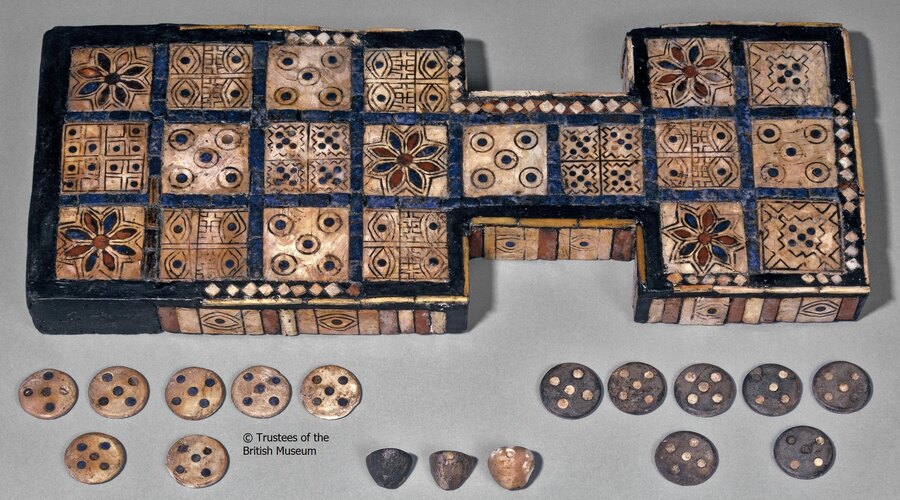
Game board from the Tsarist Cemetery in Ure. Circa 2600–2400 BCE. British Museum, No. 1928,1009.378.
The analysis examines the material traces of the games, the principles of rule reconstruction, and the boundaries of reliability: what is known from sources and what constitutes the researcher’s hypothesis. The religious significance of the senate is examined separately, where the game transforms into an image of the soul’s journey, as well as the transition of the tafl into the Sami game tablut.
The research incorporated works on the history of board games (Murray, Parlett, Bell), articles by Finkel on Ura rules, studies by Picchione and Crist on Senet, as well as theoretical works by Huizinga and Kaiou. Materials were selected based on the principle of scholarly verifiability, prioritizing museum catalogs, academic publications, and primary sources.
Senet game set from Tutankhamun’s tomb. Cairo Museum.
Research Question
How did three board games (Tsarskaya Игра Ura, Senet, and Hnefatafl) cease to exist as a living practice, what survived from them, and through what methods were researchers able to partially restore their rules and meaning?
Game board from Ballinderry, Ireland. National Museum of Ireland.
A game can disappear in three ways: losing its rules (Ur), losing its meaning (Senet), or yielding to another game (Hnefatafl).
Each of these three games has a scholar who brought it back to life: Finkel, Picchione, and Murray.
1. A Game That Is No Longer Played
Why study something that no one plays, and how a game actually dies.
Games do not leave behind ruins. Pieces are lost, boards burn, and the rules everyone knew by heart were never written down. Therefore, a vanished game is like an object without instructions: we see the board, but we do not know how it was played. The history of such games is the story of how scholars meticulously reconstruct what was once common knowledge.
Three games, three destinies, three researchers.
We will examine three games that disappeared for different reasons. The Tsarist game Ura retained its boards but lost its rules almost four millennia ago. Senet preserved both its boards and its imagery but lost the most important thing: the meaning that made it a game for both the living and the dead. Khnefatafl was once a favorite game in Scandinavia, but it was superseded by chess, leaving behind traces in sagas and one surviving Sámi game. Each case illustrates its own mechanism of oblivion.
2. Ur: A game that lost its rules
Between 1922 and 1934, British archaeologist Leonard Woolley excavated the Royal Necropolis in Ur, located in southern modern-day Iraq. Among the findings were five game boards. One of these, housed in the British Museum (inventory no. 1928,1009.378), dates to approximately 2600–2400 BCE and is considered one of the oldest game boards in the world. The game received its name from its place of discovery.
It is also known as the «twenty-cell game.»
British Museum, online collection; Finkel 2007; Parlett 1999
When the tablets were discovered, no one knew how to play them. Irving Finkel, an Assyriologist and curator at the British Museum, found the answer. In the 1980s, he translated a clay tablet dating to 177 BCE, written by the Babylonian scribe Itti-Marduk-balatu. The tablet was found in the ruins of Babylon in 1880 and sold to the British Museum (BM 33333 B). In addition to this, Finkel used photographs of the second tablet, which contained the rules, from the private collection of Count Emar de Lidekerke-Boffor. Based on the descriptions and the form of the tablet, he reconstructed the core rules.
Royal Game of Ur, c. 2600–2400 BCE, via the British Museum
The Game That Was Returned
Regarding the reconstruction of Finkel, Ur is a race between two players, each with seven tokens. Moves are determined by four tetrahedral dice (coins will also suffice). These rules are considered standard today. However, the plaque was written more than two thousand years after the board was placed in the tomb. In such a timeframe, the rules could very well have changed, and different games may have been played on a single board. Therefore, the reconstruction should rightly be called the most plausible, not the definitive.
Ur demonstrates the first way to vanish: the material traces remain, but the knowledge of how to play has disappeared. One person revived the game by deciphering the placard. After that, the game left the museum. Finkel played a demonstration game, the recording of which became very popular, and Ur found a new audience online and at home. Thus, the researcher turned into a «reviver» of the game.
A still from the British Museum’s video for International Board Game Day 2017, where curator Irving Finkel challenged Tom Scott to play Tsar’s Game Ura. World History Encyclopedia (September 19, 2017)
3. Senet: A Game That Lost Its Meaning
Ur was not alone. A game similar in design to the twenty-square game was also known in Egypt. From the 17th to the 19th Dynasty, Senet was often played on two-sided game boards: one side featured the Senet board, and the other displayed twenty squares. But Senet’s fate was different.
With Ur, we lost the rules, and with Senet, we lost the meaning—we stopped understanding the game that served as both recreation and the soul’s journey through the realm of the dead.
The Afterlife Path Map
The game’s name originates from the ancient Egyptian znt, meaning «passage.» The board consists of 30 squares («houses») arranged in three rows of 10. The pieces followed a winding path, starting from the upper left corner. Moves were determined by throwing sticks or small animal bones. The boards were made of wood, ivory, or faience, and whether belonging to nobility or commoners, they shared the same three-row format. Among the most famous discoveries is the set found in Tutankhamun’s tomb: three boards were found in an annex to the burial chamber, and one is housed in the Cairo Museum.