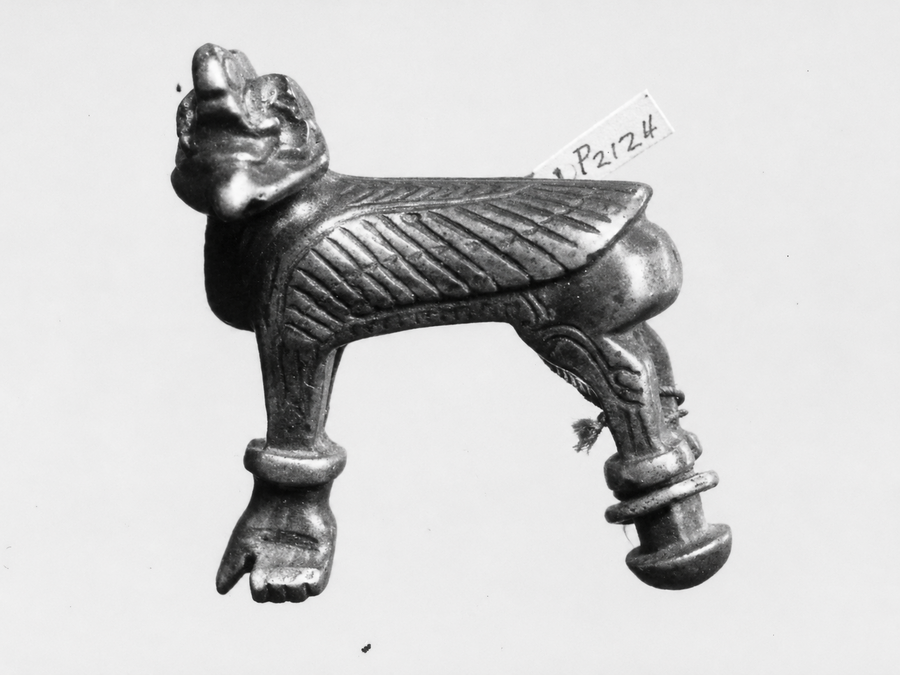
Fibula in the form of a griffin. Urartu. Casting, bronze. 8th–7th century BCE.
Concept
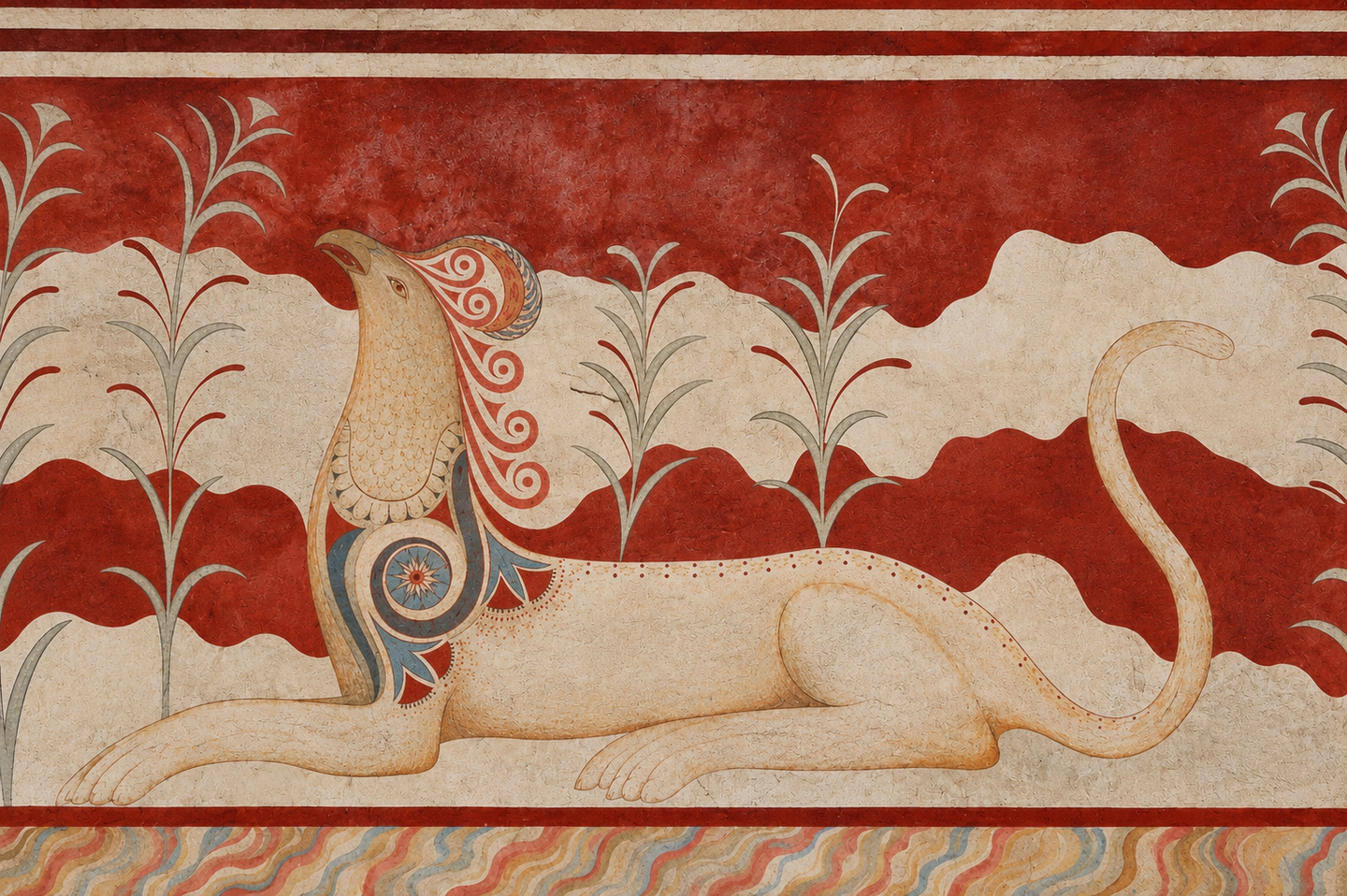
The topic was chosen due to an interest in hybrid animals, which have been widely prevalent in the art of the ancient world. Fantastical creatures possess striking, recognizable features that could evolve as the image migrated, taking on diverse forms depending on the region and time period. The griffin is a captivating and one of the most recognizable examples of such creatures. Although the griffin lacks a canonical or immutable appearance, it remains immediately identifiable. Proportions of the body, head shape, wing style, plumage, and the recognizability of specific animals within the depiction could vary across different cultures. This diversity of variants intrigued me and led to the selection of this subject. I am interested in how the visual scheme of the griffin is constructed in the art of the Ancient East, which elements remain recognizable, and what distinctive features these various artistic interpretations acquire. I approach the griffin not as a single canonical image, but as a collection of visual variants that may have developed in parallel and become established in different regions at different times. Differences between depictions might be linked to local artistic traditions, materials, and the function of the object, as well as cultural contacts. However, the contacts themselves do not fully explain the unique character of each image.
Research Question and Hypothesis
How is the visual scheme of the griffin structured in Ancient Eastern art?
Despite having consistent features that allow for the identification of the griffin, its visual representation was not uniform. It shifted depending on artistic traditions, material, execution technique, and the object’s intended purpose. Several variations existed, evolving in parallel and becoming established in certain regions at different times. The motif was passed down to artisans through trade and cultural exchange, yet they cannot fully account for the specific appearance of the griffin in any given region.
Method and Visual Definition
Gryphon—a mythological creature that combines the traits of several animals: typically the body of a lion and the head, beak, and wings of a bird of prey. Some depictions include additional features: ears, horns, crests, feathers, and decorative elements.
Despite a stable core concept, griffins lack a single canonical appearance. Their visual representation has shifted according to cultural milieu, historical period, and artistic traditions. For example, some depictions emphasize the leonine features—powerful body, paws, and tail—while others highlight the avian traits: beak, wings, and plumage. In the museum passport, the griffin is considered a winged creature with a bird’s head, which defines the subject. A leonine body is not present in all artifacts and is analyzed only where it is preserved. The study also examines the artistic imagery, which can take on various forms while maintaining the recognizable combination of animal parts.The objective of this work is to describe how the visual appearance of the griffin evolved in Near Eastern art between the 5th and 1st millennia BCE. The research method is based on a comparative formal analysis of the imagery.
The Gryphon in Urartian Art
Urartu was a state centered around Lake Van, with Tušpa on its eastern shore serving as the capital. The oldest known written document, a rock inscription in Van, names the king Sarduri (c. 840–830 BCE) and the god Haldi, the supreme deity throughout Urartian history.
Griffins and winged deities are widely featured in Urartian art. Scholars suggest that the appearance of such creatures, particularly in Urartian culture, is linked to the transition from zoomorphic divine imagery to anthropomorphic forms. Griffins, which combine features of different animals, may reflect one stage of this process. The combination of human and animal attributes was also present in the depictions of gods within the Urartian pantheon, many of whom were frequently shown with wings or accompanied by animal symbols. According to the Berlin State Museum, the griffin with a bird’s head and wings was often depicted in Urartian art, yet its specific role in mythology and cult remains unknown. This study does not discuss the religious significance of the image; it examines its depiction only.
The Griffin occupied a notable place among such imagery. Its depiction appeared on bronze objects, decorative belts, parts of horse tack, metal ornaments, and pieces of courtly furnishings. Images of winged hybrid creatures were particularly characteristic on bronze ware.
The proliferation of such motifs is linked to the specific characteristics of Urartian artistic production. Artisans actively employed casting, repoussé, and engraving, which allowed them to convey plumage, scales, musculature, and individual details of fantastical animals.
The Griffin could be shown as a standalone figure or incorporated into more complex decorative compositions. For instance, on bronze belts, fantastic creatures might be arranged in repeating rows and combined with depictions of other animals and ornamental elements.
Fibula in the shape of a griffin. Urartu. Bronze casting. 8th–7th centuries BCE.
Griffin statuette. Rusakhinili (Toprakkale). Bronze with gold traces. 8th century BCE.
The statue and fibula share a set of common characteristics: a bent beak, large eye sockets, a flat wing with barring, and a static posture. However, there are also differences. The griffin statuette stands on straight legs, its wing is raised and decorated with barring, and the surface is covered in a dense pattern, beneath which, according to the museum’s records, there was gold foil. On the fibula, the wing is pressed against the back and decorated with a «Christmas tree» pattern, and the head is turned to the side. Some of the differences are related to the objects' function: the size (21.2 and 3.5 cm) and the body structure of the fibula are determined by its clasp, while the statuette has a standalone decorative function. The position of the wing on Urartian awls and fibulae changes regardless of the intended use.
In Urartian depictions, there is no striving for an accurate reproduction of real animal anatomy in the griffin. The proportions of the body and wings are conventionalized, and individual details are either simplified or emphasized with decorative elements. The wings might be small relative to the body, and the feathers are rendered through graphic hatch marks. The creature’s form is built not upon anatomical fidelity, but upon a combination of recognizable avian and leonine characteristics. Therefore, the main significance lies not in the realism of the image, but in preserving the griffin’s characteristic hybrid structure.
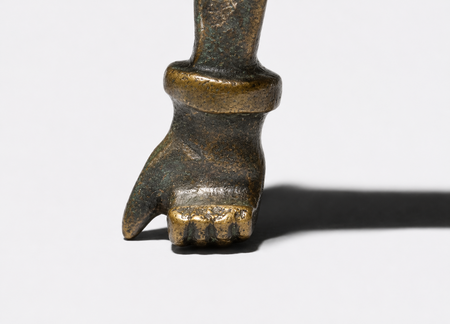
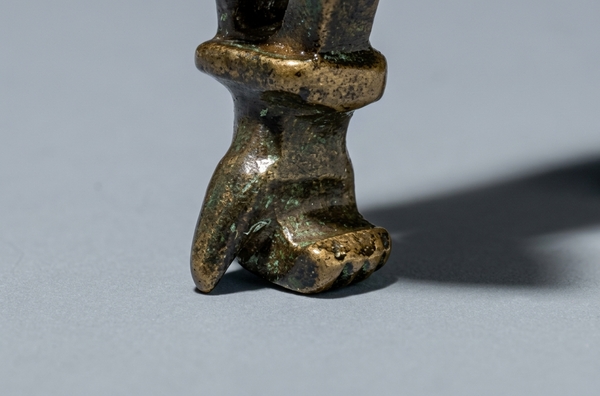
Phalangeal segment shaped like a griffin. Resemblance to the human hand.
The clasp pin is lost. Where the pin should have been, the griffin’s forelegs merge and transition into a human hand, emphasizing the creature’s composite, hybrid nature. Presumably, the bronze fibula was a prestigious piece of adornment.
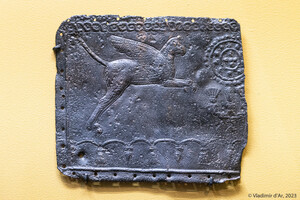
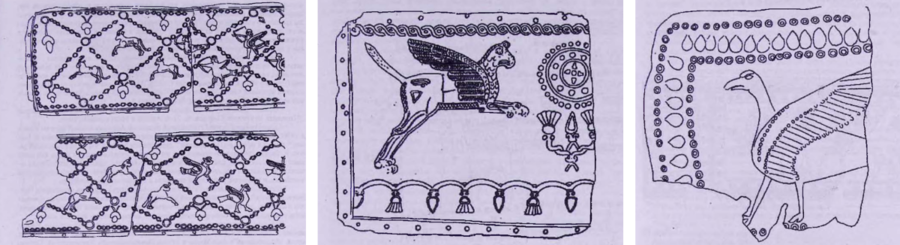
Urartian Bronze Belts of Shirak.
In the leftmost segment, there is a stylized image of a griffin—a winged lion with a fish tail and a bird’s head.
Thus, the Shirak belt belongs to the group of belts featuring cultic scenes. The central part of the fragment depicts a running griffin, in the form of a winged lion with the head of a bird of prey. The feathers of the wings and the front and hind paws, as well as the protruding tail, are meticulously rendered. The neck and chest are particularly well-defined, where fine stippling emphasizes small downy feathers. The round eye and the large curved beak are clearly marked. In front of the griffin is an image of a tree branch topped with a sun disc containing an inscribed cross.
Rendering of the Griffin from the Urartian Belt. Karimir-Blur. Armenian Museum of History, Yerevan.
The creature is depicted in profile, facing right. The head, featuring a massive beak, is adorned with a spiral curl and a small feathered projection. The neck is covered in a scaly pattern, while the torso and tail are feathered. The hind leg is bent, and the legs rest upon a palmette.
Conclusion
The reviewed artifacts show that Urartian art featured a recognizable visual schema of the griffin, built upon the combination of a bird’s head, a lion’s body, and wings. Despite these common traits, the depictions are not entirely identical: the position of the head and wings, the plasticity of the body, the degree of detail, and the nature of the ornamental design all vary.Thus, the Urartian griffin does not represent a strictly fixed image type. While maintaining its fundamental anatomical features, its external appearance allowed for variations in plasticity, composition, and decorative treatment.
In Urartian art, the griffin appeared in several artistic forms: as an element within ornamental compositions and as a freestanding, volumetric figure. The combination of fantastical anatomy with geometricized surface ornamentation became one of the distinctive features of its visual representation. These examples allow us to view the griffin not as an isolated motif, but as part of a broader Urartian artistic tradition.
Gryphon Beyond Urartu: A Comparison
Saddle blanket. Altai Mountains. Felt, horsehair. V century BCE.
A snippet featuring a scene of a griffin attacking a mountain goat.