Navigation Menu
- Introduction to Visual Research
- Geometric Period
- Archaic Period
- Classical Period
- Hellenistic Period
- Conclusion
- Bibliography
Introduction
From ancient times, humanity has sought to comprehend death, understand what happens after earthly life concludes, and find ways to preserve the memory of the departed. These contemplations were reflected in funerary rites, objects interred in graves, and monuments erected in honor of the deceased. The tombstone gradually transformed from merely indicating a burial site into a means of narrating the person—their societal standing, achievements during life, and relationships with loved ones. A particularly fascinating example of these shifts is the art of Ancient Greece, where the forms, materials, and artistic representations of death evolved over several centuries.Through this study, I intend to examine what factors influenced the changing appearance and artistic content of tombstones. Funerary art was shaped by religious beliefs, social structure, views on the afterlife, advancements in sculptural techniques, and evolving concepts of human beauty. The deceased’s social status and their family’s material means also played a crucial role. All of this was mirrored in the choice of material, the monument’s size, its decorative scheme, and the scenes depicted. For instance, across different periods, the ideal commemorative monument changed: some emphasized the individual’s social status and merits, while others focused on family ties, personal qualities, and memories of daily life. Comparing tombstones from different eras will allow us to understand why certain artistic choices eventually faded while others gained increasing popularity.
My research covers the period from the 10th to the 1st century BCE. The selection of these specific timeframes is linked to the ability to trace the development of ancient Greek burial culture from early geometric forms to the complex funerary compositions of the Hellenistic era. During this time, funerary monuments underwent a significant transformation: from large ceramic vessels adorned with geometric ornaments and schematic depictions of funerary scenes to monumental sculptures, relief stelae, and elaborately decorated grave markers.
The study of ancient Greek tombstones is fascinating not only from the perspective of art history but also as an opportunity to understand the daily and spiritual lives of people from the past. Such monuments allow us to see what was deemed worthy of remembrance, what human qualities were valued by society, and how the living sought to maintain a connection with the deceased. Furthermore, they provide insight into the evolution of artistic techniques, changing tastes, and attitudes toward the human body across different historical periods.
Despite the fact that more than two thousand years have passed since these works were created, the themes of memory, loss, and human legacy remain timely today. The ways in which the dead are commemorated change along with society, yet the desire to preserve the memory of a person remains constant. This is precisely why studying the evolution of ancient Greek tombstones allows us to view art not merely as a sequence of styles and forms, but as a reflection of a changing worldview, social relationships, and humanity’s conception of its own life and death. Through the examination of funerary monuments, I aim to illustrate how the Ancient Greeks' attitude toward remembering the deceased evolved and how these changes were embodied in their material culture.
The primary objective of this research is to trace the evolution of ancient Greek tombstones from the 10th to the 1st century BCE, identify the major changes in their form, materials, composition, and artistic design, and determine how religious beliefs, social structure, and changing attitudes toward death and the memory of the deceased influenced the development of funerary monuments.
Geometric Period
During the Geometric Period, grave markers had not yet taken the sculptural stela form familiar to us. Large ceramic vessels were used to denote burials; these vessels participated in funerary rituals and served as grave markers simultaneously. Their surfaces were decorated with repeating geometric ornaments: meanders, zigzags, triangles, circles, and parallel lines.
Human and animal figures gradually began to be incorporated into the ornamental system. Scenes of prothesis—the ritual display of a deceased body before burial—are particularly indicative. The figures were depicted schematically: heads were circular, torsos were triangular, and limbs consisted of simple lines. Furthermore, the compositions were organized into horizontal bands, which emphasized the rhythm and decorative quality of the images.
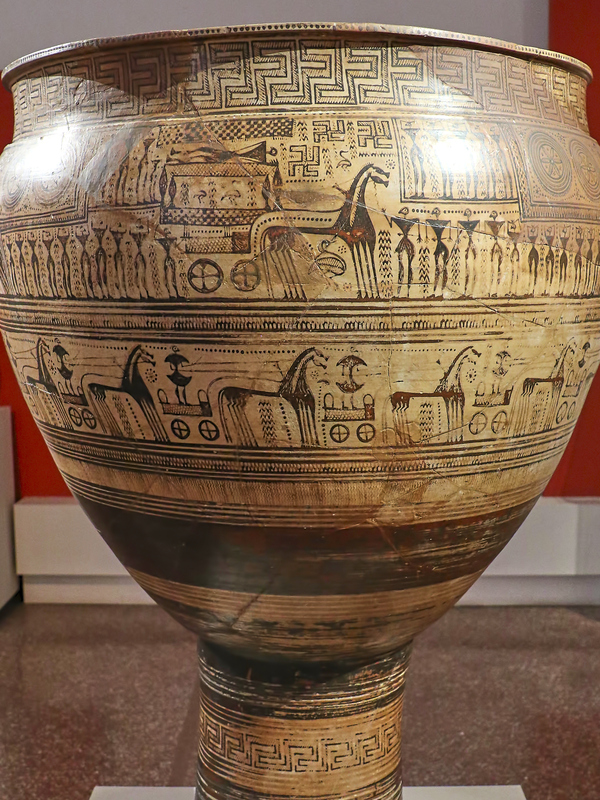
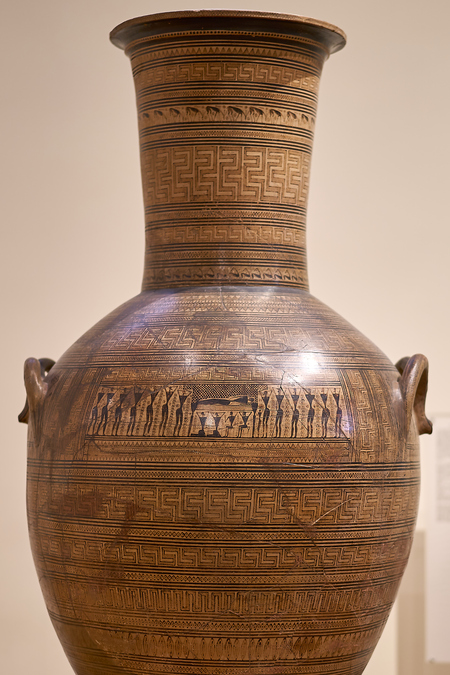
Attic Geometric Krater (750–735 BCE) and Dipylon Amphora (760–750 BCE)
The Dipylon Amphora is a large ceramic vessel discovered in the Athenian necropolis of Dipylon. It dates to the Late Geometric period and served as a funerary marker. The most significant part of its decoration is the scene of the prothesis.
In the center of the composition, a body is depicted lying on a funerary couch. Flanking it are figures of mourners. Some characters have raised their hands to their heads—this gesture is associated with expressing grief and ritual lamentation. The figures are stylized: their bodies are composed of simple geometric shapes, and their faces and details are barely rendered. The artist does not aim to portray the individual features of each participant but rather to convey the action itself and its ritual significance.
The composition adheres to a strict rhythm: the figures are arranged in a line and are repeated, forming an almost ornamental band. The human silhouettes become part of the vessel’s overall decorative system. This is a characteristic feature of geometric art: the depiction simultaneously recounts an event and serves as ornamentation for the object.
The Dipylon Amphora illustrates an early stage in the development of Greek funerary art, where the main content of the image was the collective funerary rite. The deceased is not yet presented as a distinct individual with individual features; the focus is on the ritual and the community that is accompanying them.
Reasons for the formation of such an artistic language
- A strong connection between funerary art, rituals, and religious beliefs.
- The geometric style was a characteristic artistic trend of the era.
- Images served not so much as portraits of the deceased, but as indicators of the burial rite and social status.
- Large vessels allowed them to fulfill both practical and commemorative functions simultaneously.
Archaic Period
In the Archaic period, funerary art begins to take on a more monumental character. Large stone sculptures replace ceramic tomb markers. One of the most recognizable types becomes the kouros—nude youths with a frontal posture, arms held down along the body, and one leg slightly extended forward. The female counterpart was the kore, depicted wearing long robes and adorned with decorative details.
Kuros from Anavissos (circa 530 BCE)
These sculptures were not always tombstones; they were also used as votive offerings to the gods. However, some kouri were indeed placed on graves. A prime example is the Kouros of Croesus from Anavyssos. Over time, relief stelae developed, depicting the deceased in profile or full length. Unlike early pottery, these showed a growing desire to represent not only the funerary rites but also the individual person.
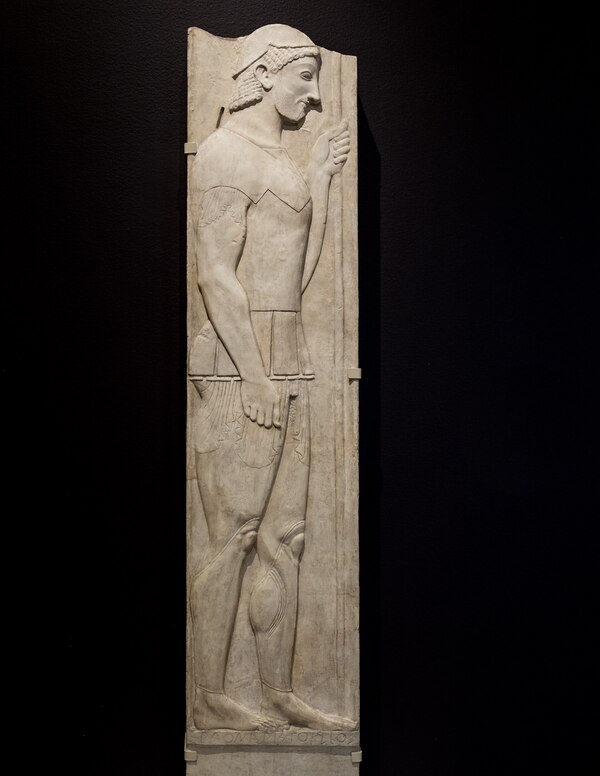
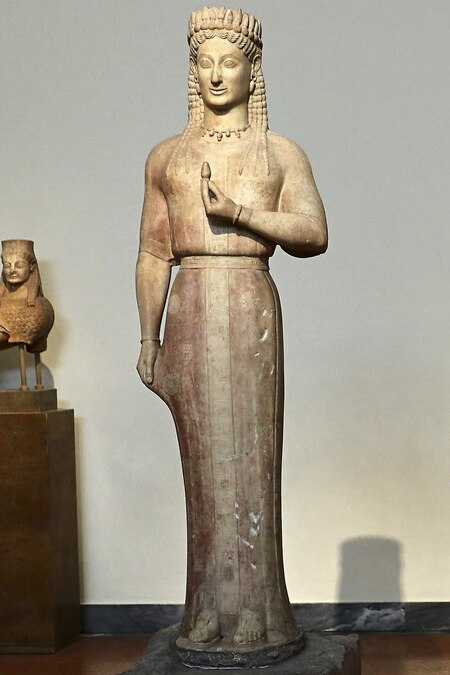
Stela of Aristion (510–520 BCE) and Kore of Phaskyleia (550–540 BCE)
Kouros of Kroisos is a marble statue of a young man discovered in the Anavyssos region of Attica. It was placed on the tomb of a young man named Kroisos, who died in battle. It is one of the most famous examples of archaic funerary sculpture. The statue is housed in the National Archaeological Museum of Athens.
The figure is depicted nude, standing in full height and facing strictly frontal. The arms hang by the sides of the body, the palms are clenched, and the left leg is slightly advanced. This pose is characteristic of kouroi—a type of statue of a youth that gained popularity in Archaic Greece. While the external appearance resembles Egyptian sculpture, Greek masters gradually developed their own understanding of the human body and its depiction.
Kreusa Base (530 BCE)
The inscription on the base of the statue holds particular significance. It states that Croesus died in battle and urges passersby to stop and mourn him. Thus, the sculpture does more than merely mark a grave; it creates an image of the deceased who continues to exist within the space of the living. Furthermore, the statue is not a realistic portrait in the modern sense—it depicts the youth through the idealized image of a physically perfect man.
Croesus’s statue demonstrates an important evolution in funerary art. While the Geometric period primarily focused on depicting burial rituals, in the Archaic period, the monument increasingly becomes an image of the deceased person himself. There emerges a desire to preserve not only the memory of the death event but also a representation of the individual’s virtues—his youth, beauty, and heroic demise.
Reasons for the formation of this artistic language
- The development of stone sculpture and the adoption of new marble-working techniques.
- The increased significance of an individual’s social status and societal standing.
- The influence of monumental sculpture from Egypt and the Near East on early Greek plasticity.
- The spread of the concept of physical beauty and the perfection of the human form as a vital artistic value.
Classical Period
The Classical period becomes one of the most significant stages in the development of ancient Greek funerary monuments. Whereas during the Archaic era the idealized body and monumentalism of the figure held great importance, attention gradually shifts now toward conveying human relationships and individual experiences.
Stele of Hegeso (c. 400 BCE)