Concept
Chinoiserie is one of the most paradoxical phenomena in art history. For centuries, Europe created an image of China that did not actually exist: pagodas, dragons, porcelain emperors, and girls in robes under willow trees. All of this was a beautiful fiction, a backdrop for aristocratic pleasures. And I have always been fascinated by this ability of artists to invent entire countries.
But the longer I looked at these pastoral scenes with Chinese umbrellas and Meissen teapots, the more I became interested in another question: what did the Chinese themselves think about this? How did they perceive this European obsession with the «Oriental»? And what happens when they themselves begin to use the very same techniques — but no longer to admire, but to criticize?
How has the visual image of China in European Chinoiserie been transformed throughout the 18th–21st centuries, and in what way have Chinese artists of different eras responded to this tradition — from imitation to decolonial deconstruction?
These questions became the starting point for me. My research is dedicated to the evolution of Chinoiserie from the 18th century to the present day, but not as a mere history of style, but as a dialogue. Europeans constructed a myth of «Chineseness»; the Chinese at first played along in export paintings, and then, especially in the 21st century, reclaimed this language and subverted it.
My hypothesis is that Chinoiserie has traveled a path from the naive exoticism of the 18th century and the Orientalist cliché of the 19th century to a modernist synthesis in the 20th century, where Chinese artists reimagined the Western gaze to search for their own identity. In the 21st century, they move towards conscious deconstruction, transforming Chinoiserie from a European fantasy into a tool for decolonial critique and an ironic analysis of global culture.
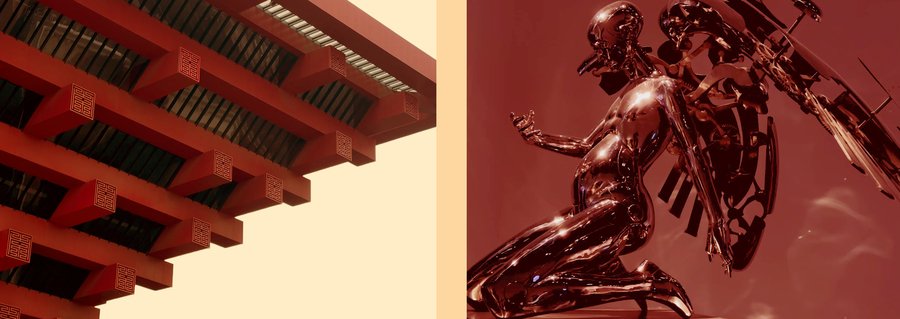
China Art Museum, Shanghai, personal archive
In selecting materials, I was guided by clear criteria. The research includes only those works that contain direct visual markers of Chinoiserie: pagodas, dragons, screens, «Sinicized» figures, porcelain with relevant scenes, willow and flower patterns, and more. I deliberately exclude general Orientalism (Middle Eastern or Japanese motifs), as well as traditional Chinese painting that has not entered into a dialogue with the European style. The genres I ultimately selected are: painting, graphics, furniture, architecture, porcelain, as well as photographs of installations and video art.
A unique feature of my approach is the parallel presentation of both sides: the European myth-makers and the Chinese artists who responded to this myth at different stages. For the 18th–19th centuries, these are masters of export art and the «counter-style» (occidenterie). For the 20th century, I chose Chinese artists who studied in Europe and synthesized traditions with modernism. For the 21st century, the focus is on authors working with installations and media, for whom Chinoiserie becomes a method of decolonial revision.
Art Zone 798, Beijing, personal archive
To understand what materials I needed for my research, I first traveled to see them in person. I visited the China Art Museum in Shanghai and then went to the 798 Art Zone in Beijing, whose website I also used to collect contemporary art materials. Additionally, I worked with the online collections of major museums (the Louvre, the Freer Gallery of Art), websites of contemporary galleries (Long March, Ullens Center), and catalogs of recent exhibitions. The theoretical framework is based on studies of Chinoiserie history, Edward Said’s works on Orientalism, and articles and interviews with contemporary artists.
Structure:
Chapter 1. Constructing the Myth: European Chinoiserie and the Chinese «Headwind» (18th–19th centuries)
Chapter 2. The Turning Point. The 20th Century: Transformation of Tradition in the Mirror of Western Modernism
Chapter 3. «The Other’s Response»: Decolonial Revision of Chinoiserie (21st century)
The principle of categorization is based on a chronological method combined with a cross-analysis of European and Chinese visual lines. The research traces the path from the formation of the myth (18th century) through its modernist transformation (20th century) to a conscious postmodern revision (21st century). Each chapter is built on the principle of dialogue: from the Western impulse to the responsive gesture of Chinese culture, allowing us to see art history not as a one-sided influence, but as a complex process of mutual reflection.
Chapter 1. Constructing the Myth
18th-century «China» in Europe was a beautiful fairy tale that aristocrats told one another. One of the main storytellers was François Boucher, the first painter to King Louis XV. In 1742, he created a series of canvases for the Beauvais tapestry manufactory that shaped the visual language of the era.
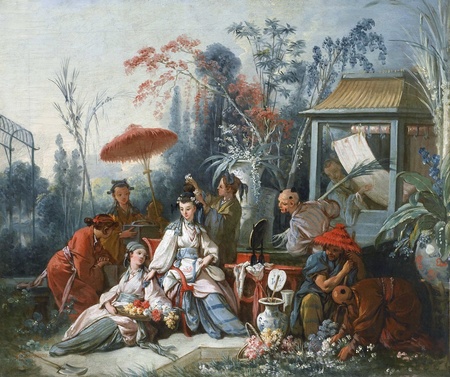
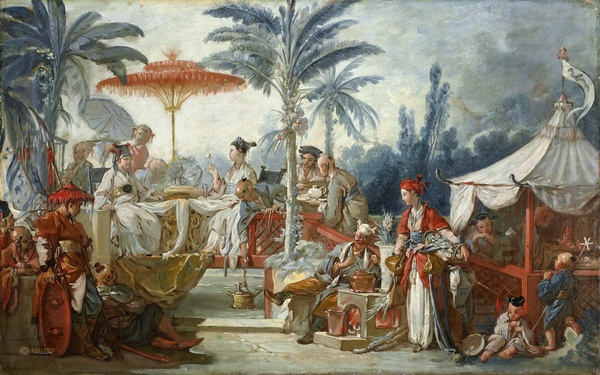
François Boucher, «The Chinese Garden» / «The Chinese Emperor’s Court,» 1742
In «The Chinese Garden,» we see an ideal, almost toy-like country, invented for the delight of the eye. The Chinese figures here are extras in whimsical costumes, resembling porcelain figurines come to life. The trees are too elegant, the pagodas unnaturally curved — it is all a mirage, behind which the real China is invisible, but the Rococo aesthetic is clearly seen. Even the porcelain vase in the foreground is not an everyday object, but a sign of «Chineseness» that a European was meant to recognize and appreciate immediately.In the pendant painting «The Chinese Emperor’s Court,» the story is less important than the decorative rhythm. The viewer’s gaze slides over bright spots — orange, blue, red — against a background of silvery-bluish foliage. This is no longer so much an image of China as it is a pattern ready to be transformed into a tapestry or a screen. The painting features plants not typical of China (for example, palm trees). This adds exoticism to the scene and creates a decorative effect.
If Boucher’s paintings are a theater where the illusion of depth and volume reigns, his younger contemporary Jean-Baptiste Pillement (1728–1808) turned that theater into an ornamental pattern suitable for mass production.
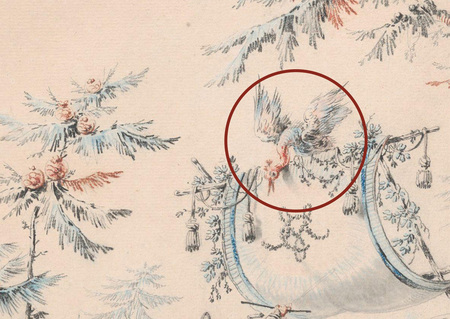
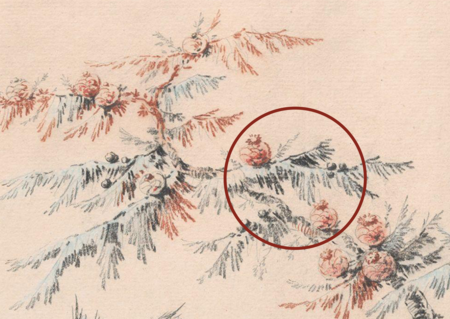
[1] — example of Pillement’s fantastic birds; [2] — example of Pillement’s exotic plants
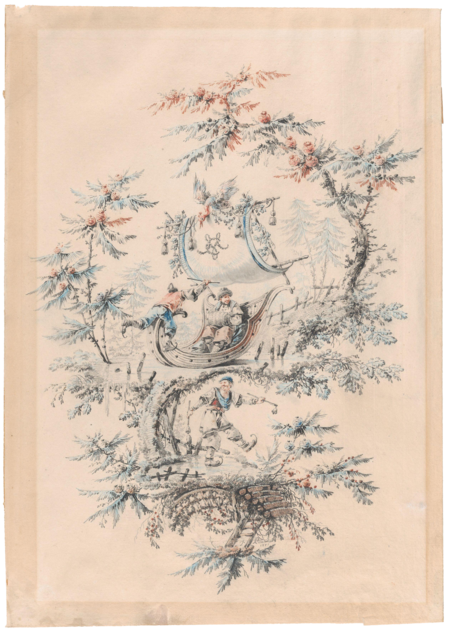
In his famous albums, such as «Cahier de Balançoires Chinoises,» he populates his compositions with incredible birds, dragons, and exotic beasts. The whimsical creatures, pagodas floating in the air, and idyllic scenes of his works are no longer just an applied pattern, but a kind of «Chinese utopia» transferred to paper.
Jean-Baptiste Pillement, «Cahier de Balançoires Chinoises,» 1770.
Jean-Baptiste Pillement, «Chinoiserie Ornament» series, one of the works, 1760-1785
The etching «Chinoiserie Ornament» is a perfect example of how Pillement uses a new visual vocabulary. There are no complex characters like Boucher’s, but there are unusual, intertwined lines and patterns that do not depict anything specific yet create a sense of «Oriental» complexity and ornamentality. There are also elements of rocaille, which create an effect of lightness and airiness.
Pillement’s work clearly reflects the commercialization of «Chinese» motifs during the Enlightenment. Among the surviving objects of that era is an elegant fan painted after Pillement’s designs. Its mother-of-pearl base and delicate watercolor tones emphasize that the Chinoiserie aesthetic permeated not only painting and tapestries but also fashion and personal accessories.
French fan based on designs by Jean-Baptiste Pillement, 1760–1770
Looking at Pillement’s «Chinoiserie Ornament» etching again, one might wonder: these fantastic birds, swirls, flowers… what do they have in common with the real China? The answer is simple: they are a pure product of European fantasy. Moreover, Pillement himself was not a pioneer. He drew on the tradition of French grotesques, reimagined by Antoine Watteau, merely adapting it to Eastern themes. Thus, a chain of borrowings was established: Watteau — Pillement — all of Europe.
And now, this ornamental wave reaches London, where Thomas Chippendale is at work.
Thomas Chippendale, design for «Chinese chairs,» 1754
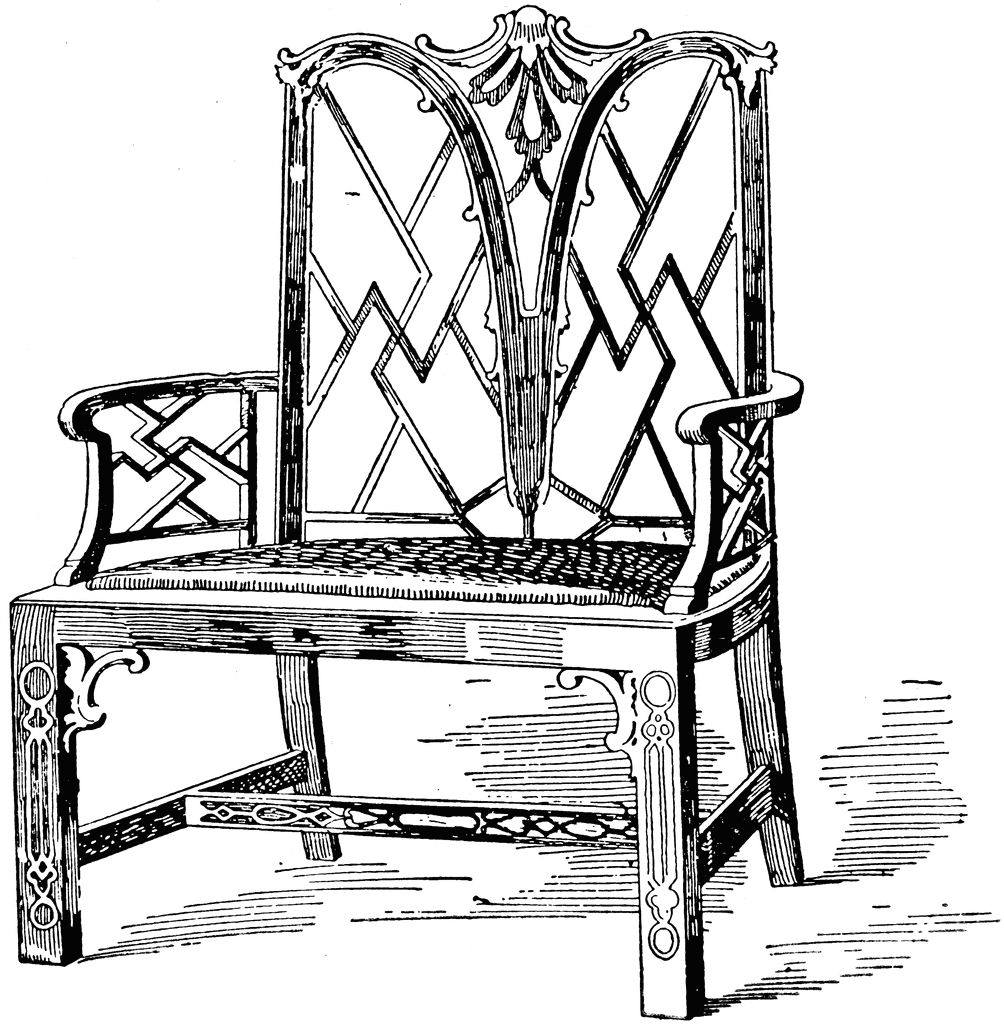
Comparing Chippendale’s sketches with Pillement’s etchings reveals an interesting distinction. Pillement emphasized illustrativeness, depicting animals and fantastic plants. Chippendale, however, brought a different kind of Eastern inspiration. Both masters had never been to China, but their interpretations of Chinese motifs differed greatly.Chippendale’s chairs, though called «Chinese,» did not copy actual Chinese furniture. Authentic Chinese pieces are massive, made of hardwoods, and minimally decorated. Chippendale’s chairs are a stereotypical embodiment of the English fantasy of the East. The English saw lightness, fretwork, and a certain exoticism in China, even though they actually knew very little about it.
Chippendale’s stereotypical visions of China represent one path. Another, opposite path was chosen by Sir William Chambers (1723–1796), an architect who actually traveled to China and even wrote a treatise on the architecture of the Celestial Empire.
Sir William Chambers, The Great Pagoda at the Royal Botanic Gardens, Kew, 1762, London, UK
His Great Pagoda in Kew Gardens (1762) is striking in its specificity—the structure truly resembles Chinese prototypes.