Navigator
1. Concept2. Architectural Ruins: Order and Decay3. The Ruin in Artistic Imagination4. Abandoned Space: Memory and Disappearance5. Conclusion
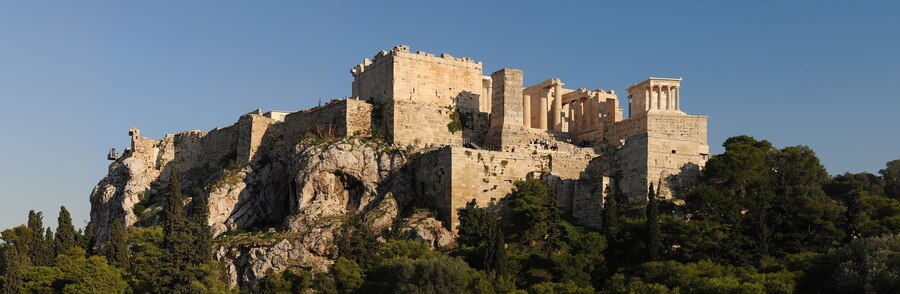
The Athenian Acropolis. Panoramic view from the Areopagus hill, date of construction: 5th century BCE.
Context and Relevance
Ruins connect loss and preservation. They bear witness to the disappearance of former function and human presence, yet they continue to speak to the scale and culture of their time. Therefore, an abandoned space is perceived not only as a historical trace but also as an expressive artistic image.
This research focuses on the perception of ruined and abandoned spaces. Ruin is examined as a state of architectural form: a structure has lost its integrity and function, yet it retains fragments that allow one to imagine its former appearance.
Research Problem
Why can ruined architecture be perceived not just as a loss, but as a source of aesthetic experience? What spatial qualities evoke a sense of the sublime, and which ones create a tragic impression? This study examines the role of scale, form preservation, the nature of decay, material texture, and the interaction between architecture and nature.
Core Hypothesis
The research hypothesis posits that the aesthetic experience of the sublime and the tragic arises from the combination of two factors: the preservation of recognizable traces of the original architectural order and the simultaneous presence of visible signs of its decay. Furthermore, the nature of this experience depends on the scale of the object, the degree of formal preservation, the surrounding landscape, and the historical context.
The theoretical foundation of this research draws upon the ideas of Immanuel Kant and Friedrich Nietzsche. In Kantian aesthetics, the category of the sublime is linked to the experience of scale and power that surpasses the capabilities of immediate sensory perception. This allows ruins to be viewed as objects where the human confronts the magnitude of time, nature, and decay. Nietzsche’s philosophy, particularly the contrast between the Apollonian and the Dionysian, helps illuminate the dual nature of the ruin: on one hand, it preserves traces of harmonious order and architectural structure; on the other, it demonstrates the breakdown of form, instability, and the destructive force of life. The concept of the tragic allows these oppositions to be linked within a unified aesthetic experience.
The primary sites selected are the Parthenon in Athens, the ancient city of Ephesus, and the island of Hashima in Japan. The Parthenon allows for an exploration of the decay of an architectural structure that retains a recognizable form. Ephesus presents the ruin as a fragment of a cohesive urban system, where individual buildings and streets continue to convey the structure of the vanished city. Hashima, a former industrial island with dense residential and industrial development, showcases a different type of abandoned space—the result of the cessation of human activity and the gradual decay of the modern architectural environment. Its history also necessitates considering the fates of the people connected to the island’s industrial past, including the issue of forced labor during World War II.
The goal of this study is to determine how architectural ruins and abandoned spaces shape the aesthetic experience of the sublime and the tragic. To achieve this, the historical and spatial characteristics of the selected sites are examined, their visual qualities are analyzed, signs of Apollonian and Dionysian principles are identified, and different types of ruined environments are compared.
The methodology encompasses visual-formal analysis of architectural objects, historical and cultural analysis, a comparative method, and interpretation through the philosophical categories of Kant and Nietzsche. The work is structured in stages: first, the theoretical foundations of ruin aesthetics are examined; then, ancient architectural and urban spaces are analyzed; subsequently, the abandoned industrial environment is explored. In the final stage, the results are compared, and the initial hypothesis is tested based on the material gathered.
Architectural Ruins: Order and Decay
The Parthenon. Athenian Acropolis. Photograph by George E. Koronaios, 2022
The Parthenon is an ancient Greek temple located on the Athenian Acropolis. Built in the 5th century BCE, it was dedicated to the goddess Athena. Today, the structure stands as one of the most recognizable monuments of ancient architecture, while simultaneously serving as an example of an architectural work that has survived significant destruction.
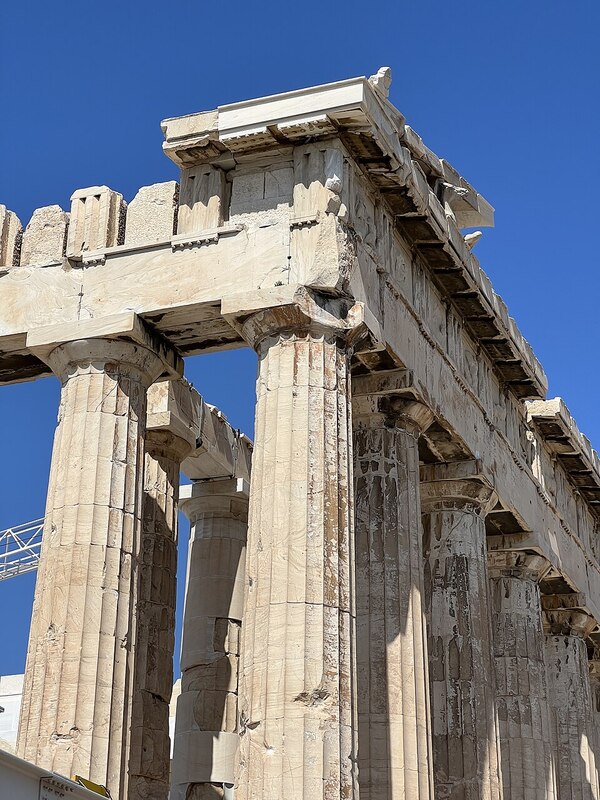
The Parthenon. Colonnade. Photograph by Sharon Mollerus, 2013
The initial appearance of the Parthenon was based on a clear geometric organization. The Doric colonnade, the horizontal lines of the entablature, and the facade’s symmetry created a sense of stability and balance.
The architecture was perceived as an integrated system, in which every part adhered to the overall compositional design.
The Parthenon’s colonnade establishes the building’s rhythm and defines its visual structure. The repetition of vertical supports creates a sense of order and continuity.
Even in its ruined state, the columns retain this organizational principle. Thanks to them, the viewer can reconstruct the original architectural composition in their imagination.
The Parthenon. Athenian Acropolis
The ratio of columns, horizontal elements, and the building’s overall volume creates a sense of monumentality. The scale of the Parthenon becomes particularly noticeable when juxtaposed with the human figure. In the context of Kantian sublime, architectural scale can serve as the starting point for an experience of magnitude that transcends individual perception.
The Parthenon. Restoration of the western facade. Photograph by Jebulon, 2015
The most significant destruction of the Parthenon occurred in 1687 during the Venetian siege of Athens. An explosion took place in the structure—which was being used as a powder magazine by the Ottomans—after an artillery shell struck it.
A substantial portion of the edifice was destroyed. This event altered the temple’s architectural profile and contributed to its current condition.
The destruction of the central part of the building compromised the initial integrity of the composition. The remaining columns and roof fragments are now perceived as separate entities.
The voids between the elements are as significant as the architectural details themselves: they point to the missing sections of the structure.
The Acropolis of Athens. Photograph by Holger Uwe Schmitt, 2022
After its destruction, individual architectural elements acquired independent visual expressiveness. Columns, fragments of cornices, and damaged surfaces are no longer perceived solely as parts of an active structure.
The fragment simultaneously preserves information about the original order while demonstrating its disruption. The viewer mentally reconstructs the missing parts, correlating the preserved form with the idea of what it might have looked like originally.
This is where a crucial contradiction, vital to the aesthetics of ruins, arises: destruction does not entirely annihilate the significance of architecture; rather, it creates a new foundation for its interpretation.
The Acropolis of Athens. Panoramic view of the temple.
The placement of the Parthenon on a high elevation intensifies its visual impact. The structure is perceived not in isolation, but in connection with the surrounding urban and natural environment.The openness of the Acropolis and the visibility of the ruins from various points in the city underscore the monument’s longevity and its integration into the modern landscape.
The perception of the Parthenon is tied to its monumentality and historical scope. The viewer encounters a structure that has survived numerous eras and continues to exist despite the loss of a significant portion of its original form.
In the context of Kantian philosophy, this allows for a discussion of an experience of greatness that is not limited by immediate physical scale. What stands before a person is not merely a large building, but also a material trace of time—something impossible to fully encompass through individual experience.
The Parthenon in Athens
The Apollonian impulse manifests in the preserved geometry of the Parthenon, the rhythm of the colonnade, and the clarity of its architectural proportions. Even in its ruined state, the structure continues to express a pursuit of harmony and order.
The Dionysian impulse is evident in the disruption of this structure: the damaged surfaces, the breaks in the colonnade, and the absence of individual elements.
These impulses do not exclude one another. On the contrary, it is their simultaneous presence that forms the expressive quality of the ruin. The preserved order becomes more noticeable because of the destruction, and the destruction gains meaning because of the possibility of restoring its original form.