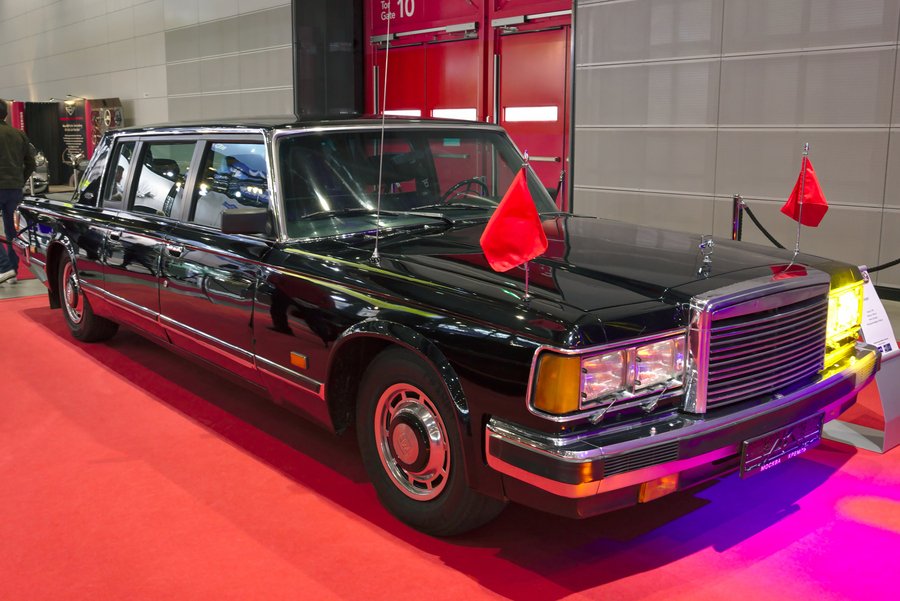
In the second half of the 20th century, the Lihachev Plant (ZIL) was the top of Soviet automobiles, and its limo represented power and state status. ZIL 41047, which appeared in 1985, became not just another government car, but the last serial Soviet-era limo, its technological and symbolic final chord. This model completed the evolutionary line that began with ZIL 114 and remained the standard for domestic representative transport for two decades.

History
Work on a family of cars belonging to ZIL-41047 began in October 1974. The designers, by modernizing ZIL-114, created a new, heavier and monumental design, in which the main element was a massive radiator grid designed to highlight the integrity of the car. In 1978, the production of the basic model, ZIL-4104 (ZIL-115), introduced by the new 315-strong V8 engine, began. This is the car that became Leonid Brezhnev’s last service car, by the way. In 1985, the production of the updated version of ZIL 41047 began. The changes were both cosmetic (corresponding double headlamps, new radiator bars, updated rear lamps) and technical changes related to the upgrading of the transmission and the development of the engine to meet international environmental standards.
The production of ZIL-41047 for the main customer, the government, continued until 2002. In total, more than 150 vehicles were produced.

Technical characteristics
The design of ZIL-41047 represented an approach that focused more on maximum reliability and safety than on technological innovation. Under the hood, the limo had a 7.7-litre petrol engine V8. Despite its impressive volume, it was only 315 horsepower, which was modest enough for the end of the 20th century. The engine combined aluminum cylinders with iron casings, two tops, and a four-cam carburettor designed specifically for this family’s cars. The transmission was operated in pairs with a three-stage hydromechanical (automatic) transmission of its own development of ZIL.
The vehicle was more than 6.3 metres long and had a mass of about 3.55 tons and was based on a powerful peripheral frame. The front independent torso and rear respirator suspension provided the famous «Zylian» smoothness of the course. The car was built with special Granit tyres with rigid sidewalls that allowed even when the wheel was down. The spacious three-seat salon was separated from the driver by an lifting glass partition. In order to protect the passengers, there was a unique technology: the body of the car was built around a non-removable armoured capsule («armour-capsule») made at a defense company. This pod has suffered from several bodies in its lifetime.
Auction and cinema
In 2021, an online auction in the United States was placed for sale on the 1989 edition of ZIL-41047 in Ohio. The history of his appearance in the States is undisclosed, but the car remains in excellent condition (including even original tyres). The seller valued this artifact of the late age at $190,000. A little less than a decade earlier, a documentary on the completion of the release of ZIL-41047, directed by Daria Clastkin, made a film about it called «The Last Limo». The painting, among other things, devoted to the complex relationship of the plant with the State under new capitalist conditions, was warmly welcomed by critics.
Heritage and Impact
ZIL 41047 became a swan song of an entire direction in the domestic autoprom. He was the last mass (by manual production) limo created for the Soviet and first Russian political elite. It was completed in 2002 and with it the age of classic full-size ZIL limo went away. Despite the highest quality of manufacture in the USSR, the car was morally and technically obsolete at the end of its production. Its frame structure, espressive suspension and carburettor engine no longer met world standards. The attempt to create a brand-new limo with a load body and modern technology (the ZIL-4102 project) in the late 1980s was unsuccessful due to economic difficulties. This has put a cross on the further development of the light track on ZILA.
ZIL-41047 is a monument to the engineering thought of its time, a witness to political upheavals, and a reminder of the extent of domestic industry that could create such machines but failed to adapt to the demands of the new century.