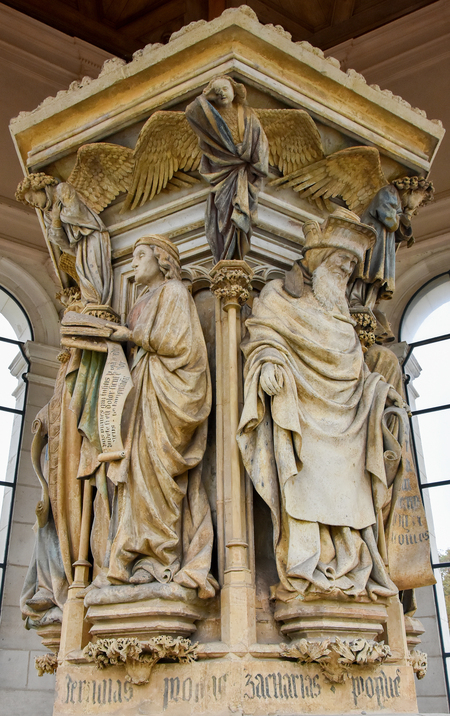
Concept
The subject of this study is drapery from Archaic Greece through the 14th century. Drapery is examined as an independent semiotic system. Through the form and direction of the folds, the artist conveys information about the body, social status, and emotional state of the depicted subject.
The fold of fabric remains one of the most subtle details in works of art. A viewer’s gaze is typically directed toward the face, a gesture, or the narrative, and draping is perceived merely as background. However, throughout the centuries, it was the textile itself that served as the space through which the artist could articulate what could not always be conveyed directly.
The central research question
How does drapery in art transform from a means of depicting the body into an independent symbolic system, and what characteristics of folds are typical for each period?
Hypothesis
Drapery in art, from Archaic Greece through the 14th century, functions as a visual code—its interpretation depends directly on how an era perceives the relationship between the physical and the spiritual. The higher the value placed on the body in a world view, the more closely the fold relates to anatomy and movement. Conversely, the stronger the emphasis on the spiritual, the more the fold detaches from the body and transforms into a symbol.
Chapter 1. Greece
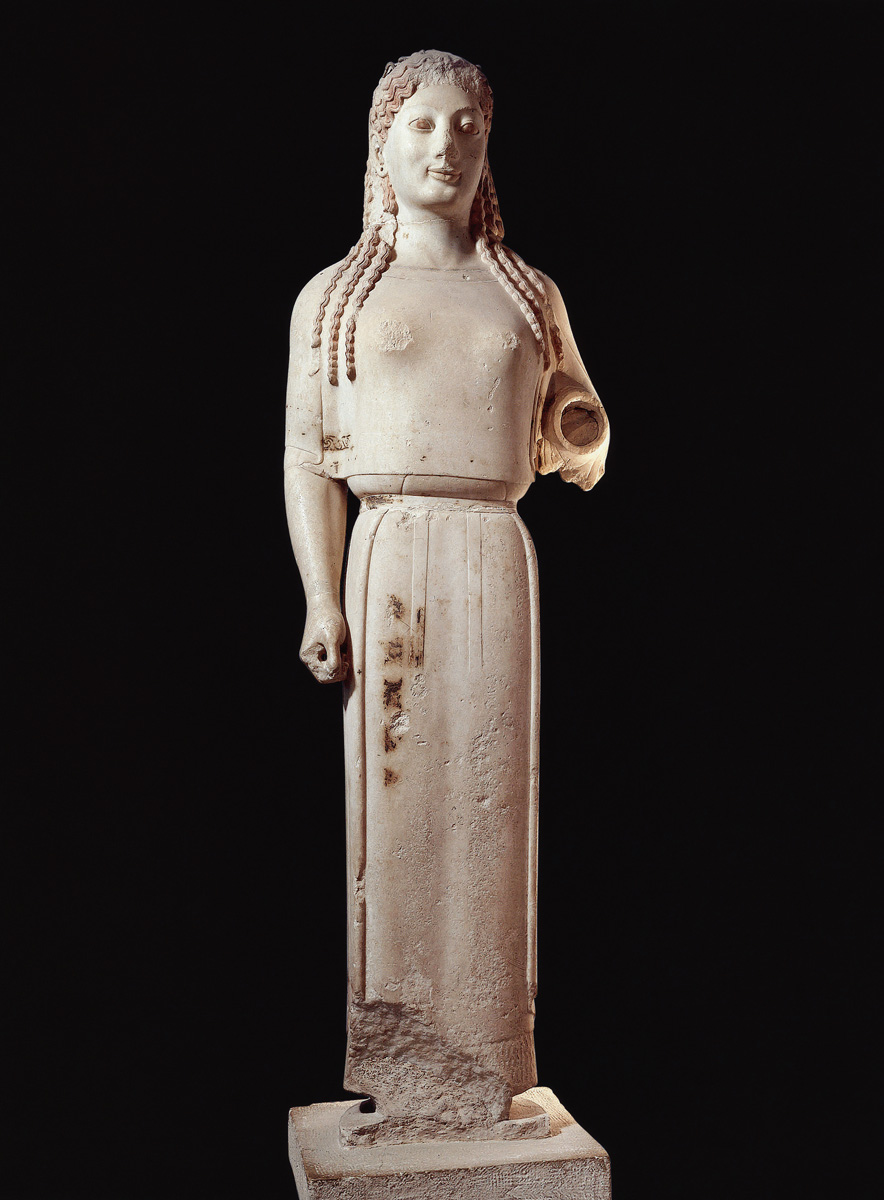
Peplophoros (Korai in peplos), c. 530 BCE, Acropolis Museum, Athens
In the archaic period, fabric has not yet been molded to the body. The pleats of the peplos run in straight, parallel lines. The fabric serves as a surface.
Wagon Driver from Delos, c. 478–470 BCE, bronze, Archaeological Museum of Delos
The wagoner from Delphi takes the first step. The vertical folds of the chiton resemble columns, yet a living figure can already be discerned beneath them. In classical art, the «wet drapery» comes to life.
Sculptures of the eastern pediment of the Parthenon, Phidias' workshop, circa 438–432 BCE. Marble. London, British Museum.
On the goddesses of the Parthenon and Nike, the fabric adheres to the body as if wet, and the folds begin to take on the contour of the anatomy. It wraps around the chest, knees, and hips, revealing the figure’s anatomy.
Circa 190 BCE, unknown artist. Paros marble, height 2.75 m. Paris, Louvre.
In Hellenism, the fold acquires its own will. Nike of Samothrace stands against the wind, and the drapery tears backward. The fold no longer merely reveals the body; it communicates movement. This is how a language emerges—one that would later become independent.
Chapter 2. Rome
Rome borrows the technique from Greece but changes its meaning. The toga served as a document. It was only worn by citizens, and the width, the color of the border, and the way the folds were arranged conveyed rank and office.
Fragment of the south frieze of the Altar of Peace (Ara Pacis Augustae), 13–9 BCE, marble, Rome, Altar of Peace Museum.
In the Altar of the World, the Augustus family proceeds in a procession, and the dense, ordered folds create a rhythm to the march.
Statue of Patricius with busts of ancestors, late 1st century BCE. Marble, 1.65 m high. Rome, Capitoline Museums (Montemartini Center).
In Togatus Barbieri’s work, the fabric is gathered into a heavy umbo knot on the chest—a sign of dignity.
1st century CE, likely a copy of a bronze original from around 20 BCE. Marble, H 2.04 m. Vatican, Vatican Museums.
August from Prima Porta wears armor with a cloak draped over his arm, and the drapery becomes part of the image of power.
The fold code becomes social for the first time: it speaks not about the body, but about a person’s status.
Part 3. Byzantium and Romanesque
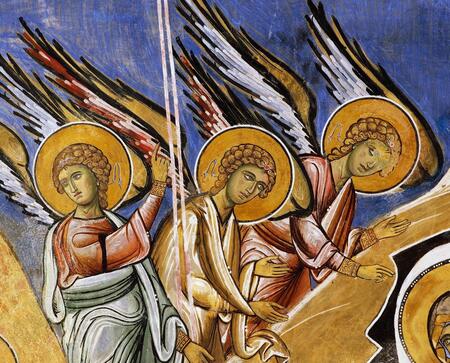
In Christianity, the body loses value while the spirit gains it, and the role of the fold changes.
The Vladimir Mother of God, Constantinople, early 12th century. Wood, tempera. Moscow, Tretyakov Gallery (Church of St. Nicholas in Tolmachy).
In the Vladimir Icon, the folds of the maphorion are rendered with assisting golden lines—this is the light of the divine world.
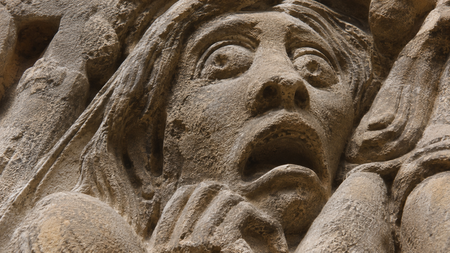
Romanesque sculpture pushes this language to its limits.