Temporary City: Festival as a Form of Ephemeral Urbanism
Rahul Mehrotra and Felipe Vera utilize the concept of ephemeral urbanism to examine settlements whose existence is inherently time-limited. They define these as «cities and settlements built with a predetermined lifespan.”¹ This includes temporary cities for religious festivals, camps, markets, resource extraction settlements, and major cultural events. The authors also consider music festivals as ephemeral settlements, as they briefly gather large crowds and require their own infrastructure. In this context, temporality signifies more than just a short duration—it implies a different principle of organization. Such an environment must arise rapidly, provide shelter, circulation, and essential urban functions, and then be dismantled. Therefore, reversibility, adaptability, and modular construction are particularly crucial. Using the example of the Kumbh Mela („the pot festival, ” a religious festival in India), Mehrotra and Vera demonstrate a city that, within a few weeks, develops roads, bridges, housing, and social infrastructure, only to be largely deconstructed back to its original state after the event concludes.
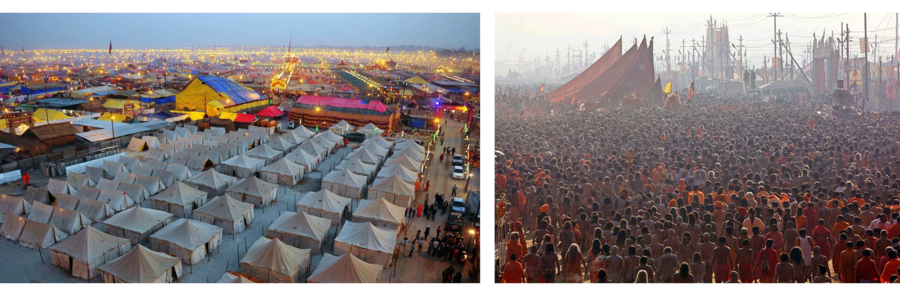
Temporary city at the Kumbh Mela festival in Prayagraj, 2025
Camp becomes a closely related concept. Charlie Hailey suggests viewing it not as a collection of separate tents, but as a spatial system that arises around a specific event or goal. In his formulation, camps «exist between the temporary and the permanent.”² Their structure includes boundaries, pathways, living spaces, common areas, and its own rules for using the territory.
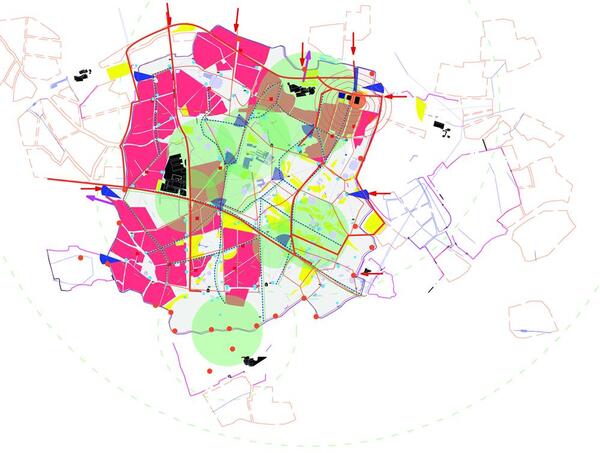
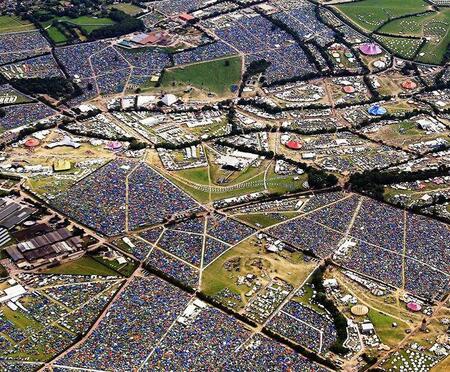
1. Glastonbury Analytical Plan from the Glastonbury Study: Instant City (2017), Amy O’Shaughnessy and David Kay. The diagram illustrates the intersection of residential areas, routes, services, and infrastructure. 2. Aerial view of Glastonbury, 2017
Pedro Pietarch transfers this logic directly to music festivals, defining them as a form of «pop-up urbanism.» Over several days, the festival constructs urban-comparable infrastructure: residential areas, public spaces, roadways, services, and focal points. Its architecture exists only as long as the event itself does. Pietarch calls this a «time-bound urban type.”³
That is precisely why this study examines the festival as a temporary city. To analyze it, it is crucial to consider not only the collection of temporary structures but also how the entire territory is organized: what the master plan dictates, where the residential and public zones are located, how routes and boundaries are structured, and what portion of the environment participants can shape autonomously. These parameters are subsequently used to compare Woodstock, Glastonbury, Burning Man, and Outline.
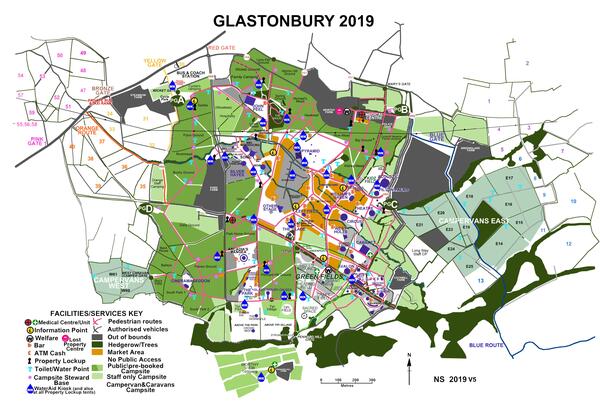
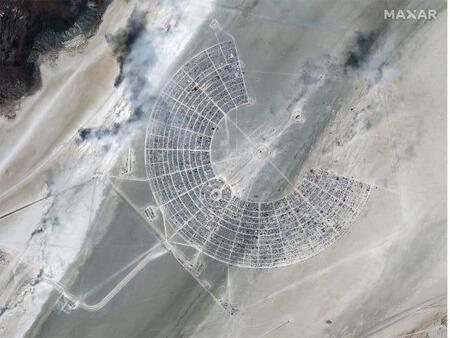
Two models of a temporary city. Glastonbury integrates into the existing rural landscape, inheriting its irregular structure. Black Rock City, by contrast, is created annually on virtually vacant land according to a predetermined geometric plan.
pppppp
ppppp