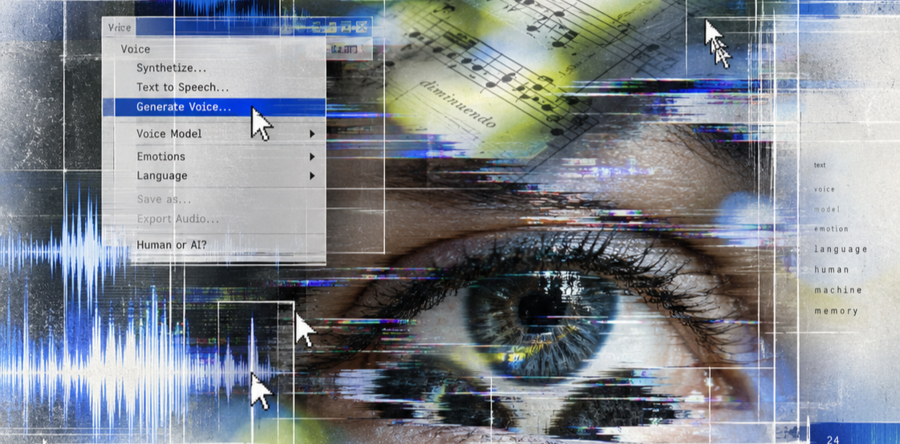
VoiceShift is a media platform dedicated to modern AI voice generation. Here, you can compare different voice options, listen to examples, and participate in small experiments.
AI can now voice texts and characters quite well. However, not every generated voice sounds natural or suits a specific situation.
This made me curious to investigate not only the quality of the voice generation but also how an average listener perceives that voice.
Main project question:
What makes an artificial voice convincing?
Project Goal
The goal of this media project is to demonstrate the capabilities of AI voice generation through simple examples and user feedback. I want to create a project where users don’t just read articles about neural networks, but can actually listen to and compare different audio variations themselves. This allows us to illustrate how profoundly intonation, pacing, speech rate, and emotional delivery affect perception. Another objective of the project is to gather input from a large audience. User responses can then be used to create new publications and subsequent experiments.
Themes
The main theme of the media will be AI voice synthesis. Additional topics include voice design, dubbing, game voice acting, animation voice acting, character creation, and emotional delivery in speech. The media will not be focused solely on news about new neural networks; the core interest lies specifically in the application of voice. For instance, one short phrase could be used to generate several voiceover variations. Users could then select the version they find most natural or appropriate.
How Media Works
First, the editor selects a short text or dialogue. Then, several AI voiceover variations are generated. For example, the same phrase might be spoken calmly, fearfully, or aggressively.The user listens to all the options and chooses the one that fits best. Following the voting, user responses are compiled into aggregate statistics. Subsequently, new material—based on these statistics—is created to present the results.
Publication Format
One of the core formats is comparing multiple voices.
For example:
Option A
Option B
Option C
The user can answer: Which voice sounds more natural? Which better suits the character? What emotion does it convey?
After voting, the results can be displayed.
For instance:
12 percent chose Option A
66 percent chose Option B
18 percent chose Option C
Following this, the publication explains the differences between these options. Thus, the user first forms their opinion and only then receives an explanation.
Content Areas
Track One: Emotion. Here you can explore how effectively AI conveys different emotional states. For example, one phrase is generated with emotions such as: fear or anger. Joy or exhaustion. Indignation or calmness. The user must identify the emotion based only on the voice. Afterward, the correct option is shown to them. Track Two: Characters. Here, the voice is tailored to a specific character. First, the user is shown an image of the character. Then, several voices are offered. This allows you to test which option the majority of the audience finds most appropriate.Track Three: Human vs. AI. Users are given several voice recordings. Some recordings are made by a human, and others are created by AI. The user must try to determine the difference. Following this, you can analyze which characteristics most often help identify the synthetic voice.
Fourth Direction: nuance in phrasing This explores how minor alterations can completely shift meaning. For example: «Everything is fine.» Versus: «Everything… is fine.» The text is almost identical, yet the pause creates a different feeling. Elements that can be manipulated include speed, pauses, volume, stress, breathing, and intonation.Fifth Direction: mismatched voice This involves intentionally creating a voice that doesn’t match the character’s appearance. For instance, a large, imposing character might speak very softly and calmly. Users decide whether this kind of contrast makes the character more interesting or conversely, hinders their perception.
User-Generated Content
Some materials can be created by users themselves. They can submit short texts, characters, or in-game dialogue. The editorial team selects some of these and produces several voiceover options. Afterward, the other subscribers participate in a vote. This creates a constant source of new publications. Content is generated not only by the editorial team but also by the audience itself.
Product
Within media, there is a distinct product called VoiceMAP.
This is a service for testing different AI voiceover options.
Users can upload text or a scene and receive several voice options. Afterward, other people evaluate them. The service can gather results based on several parameters: naturalness, emotion, character consistency, vocal trust, and memorability.
Platforms and Classrooms
Telegram can serve as the main platform for this project. It is convenient for posting short audio clips, conducting polls, and gathering reactions. Additionally, you could utilize VKontakte, short videos, and a dedicated website for an archive of experiments.
The primary audience for this project includes people interested in AI, game developers, animation creators, aspiring voice actors, sound designers, and general users curious about voice comparison.