Navigation Menu
1. Concept
2. Main Body:
I. Space Beyond the Surface II. Scale and Image Continuity III. Fusion of Real and Illusory Architecture3. Conclusion
4. Bibliography
5. Image Sources
Concept
Today, immersion in virtual spaces is most often associated with digital technologies that allow a person to feel as if they are inside an artificially created world, without being physically present in it.
However, in philosophy, the concept of virtuality carries a broader meaning, connecting to questions about the relationship between the possible and the actual, the real and the imagined.
We are capable of representing places we have never visited, mentally traversing them, and sensing the distances between objects. Even if such a place doesn’t exist physically, in our imagination, it can possess depth, scale, and defined boundaries.This perceptual ability lies at the foundation of many spatial illusions in art. Artists have created not just individual images, but entire fictional worlds perceived by the viewer as spaces existing beyond the plane of the image. In the context of research, these illusory spaces are examined as a form of virtuality.
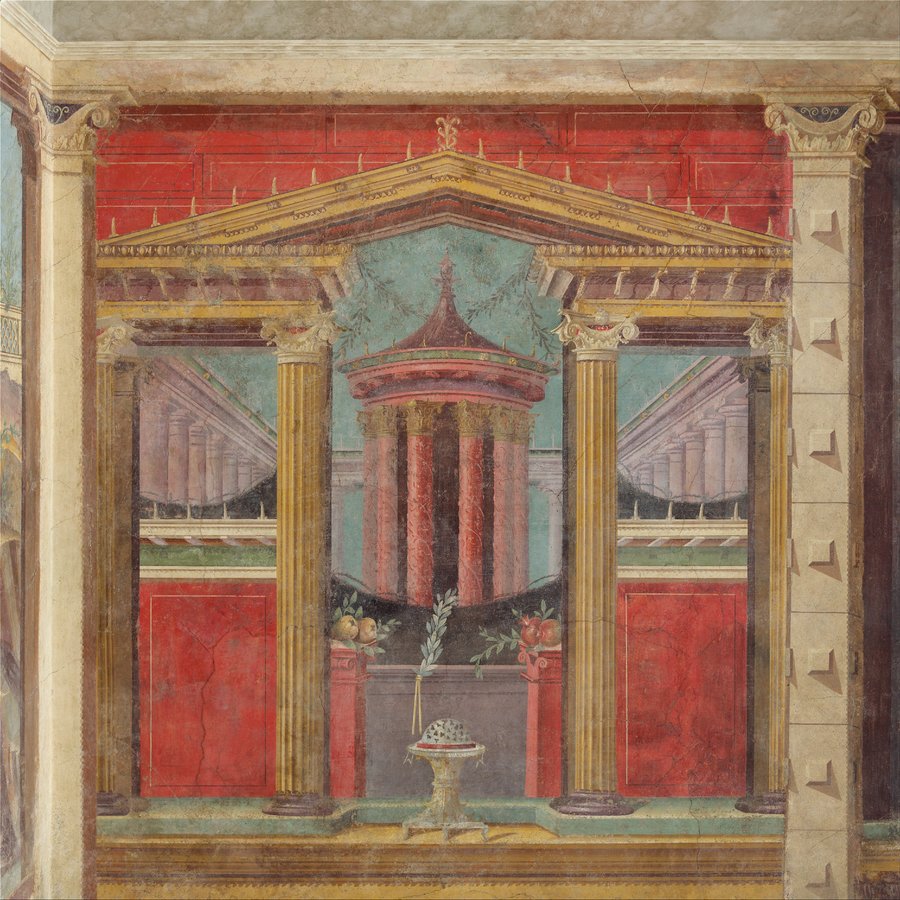
Villa of Publius Funnius Sinistor in Boscoreale, 50–30 BCE
Examples of such environments can also be found in antiquity. In Ancient Rome, artists decorated walls so that, instead of a flat surface, the viewer saw columns, open passages, and receding spaces.
In the 15th century, new approaches to conveying depth and volume developed. Artists strove to create increasingly believable illusions, overcoming the flatness of the image. However, convincingly rendering space does not yet equate to creating a sense of presence within it. The viewer can perceive depth and volume while still feeling like an external observer.
This leads to the central research question: by what means did artists of the 15th–17th centuries create a sense of presence within the depicted space, blurring the boundaries between it and surrounding reality?
The study is premised on the hypothesis that the principles of spatial immersion existed long before digital technologies. Artists achieved the effect of immersion through a combination of various techniques of spatial illusionism.
The works of Western European fine art from the 15th to the 17th centuries were chosen deliberately: during this period, various methods for creating illusory (virtual) space developed, including techniques for conveying depth, the illusionary continuation of architecture, and the artwork’s interaction with the viewer.
The selected pieces are those in which the illusion of space is connected to the viewer’s actual position and the features of the surrounding interior.
The research is structured chronologically to trace the evolution of ways to create a sense of presence.
Space Beyond the Surface
Linear perspective became a crucial step in convincingly rendering image depth. One of the early examples of this technique’s application is Masaccio’s fresco, «The Holy Trinity,» located in the Santa Maria Novella church in Florence.
Mazzocchio, «The Trinity, ” circa 1427
The perspective construction plays a key role here: the lines of the coffers converge at a single point positioned roughly at the viewer’s eye level. Because of this, the architecture is perceived from a natural viewpoint for the observer—the vault rises above him, and the space of the chapel seems to continue beyond the surface of the wall.
Fragment: Chapel Framing
The illusion is complemented by the framing of the chapel. The columns and pilasters depicted in the fresco create the impression of an opening separating the church interior from the crucifixion scene.
Fragment: kneeling patrons, the Virgin Mary, the Apostle John the Theologian
The connection to the real world is intensified by the placement of the figures. The kneeling patrons are positioned before the main characters of the scene, as if on the threshold of a chapel. The Virgin Mary looks toward the viewer and gestures toward the crucified Christ, drawing the observer’s attention to the events unfolding.
Thus, the perspective and composition create the impression that the chapel depicted in «The Trinity» is a continuation of the church interior. However, the viewer remains in front of an illusory opening, perceiving the space behind it from the outside.
Another approach to creating a spatial illusion can be seen in the ceiling painting of the Camera degli Sposi, executed by Andrea Mantegna between 1465 and 1474 in the Palazzo Ducale in Mantua.
Andrea Mantegna, Camera degli Sposi, 1465–1474.
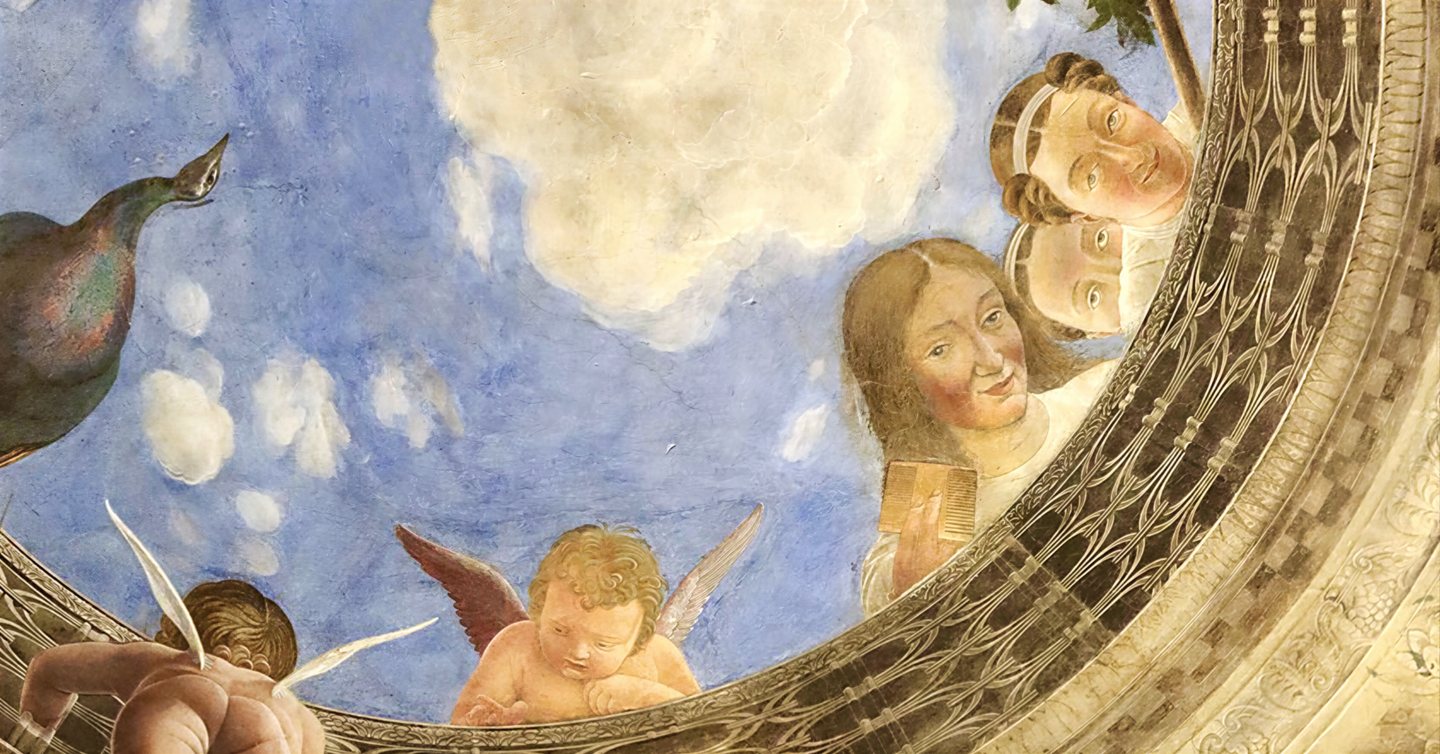
Unlike Masaccio, who creates the illusion of an opening in the wall, Mantegna addresses the ceiling. In the center of the vault, he depicts a circular opening through which the sky is visible. This opening is surrounded by a balustrade, above which female figures and putti lean over, as if looking down into the space.
Fragment: figures peek out from the opening
To achieve this effect, the artist employs the di sotto in sù perspective technique, which involves depicting figures from the viewpoint of an observer located below them. Due to the angle and the characters’ downward gazes, the impression is created that they are truly above the viewer, observing what is happening in the room [4].
Mantenga creates the illusion of an opening into another world directly above the room. Due to the characters' positioning and gaze, the imaginary space is perceived as connected to the real setting.
Scale and Continuity of the Image