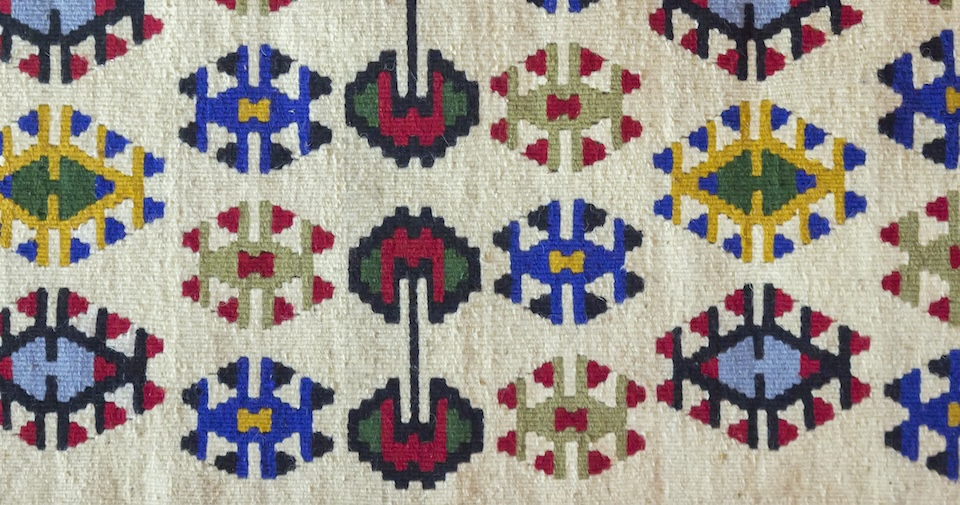
Влияние коврового орнамента Османской империи на килимы из Балкан
Navigator
- Concept
- Ottoman Empire Carpets
- Balkan Carpets
- Conclusion
- Bibliography
- Image Sources
Concept
My interest in this topic emerged while studying traditional Balkan rugs. I became fascinated by how the historical and cultural connections of the Balkans with the Ottoman Empire might have influenced the visual aesthetic of local carpets.During my literature review, I noticed that the influence of the Ottoman Empire on Balkan carpet art and the resulting ornamental changes during that period are often treated rather cursorily. Therefore, I would like to examine this connection in greater detail—to trace which Ottoman compositional and ornamental solutions spread throughout the Balkans and how they related to existing local traditions.
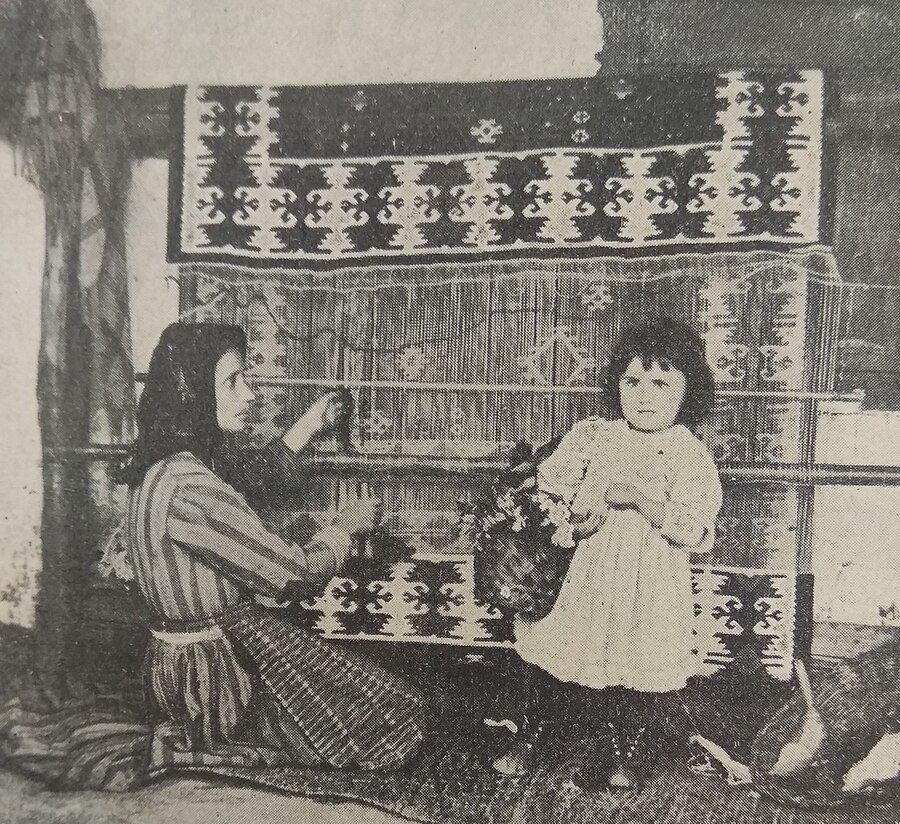
The research focuses on how Ottoman decorative culture may have influenced the ornamental tradition of 18th-century Balkan kilims. Particular interest is given to the historical interaction between the Ottoman Empire and the Balkan territories, which involved the development of trade and cultural ties, the dissemination of artworks, and the exchange of artistic traditions.
Research Question
How did Ottoman ornamental and compositional principles spread and transform within Balkan rug traditions?
Hypothesis
The spread of Ottoman carpet art throughout the Balkans contributed to the formation of shared decorative principles in regional carpet traditions. Concurrently, borrowed or closely related motifs underwent local interpretation, shifting according to regional artistic characteristics.
Historical trade and cultural connections explain why Ottoman carpets could become a source of visual influence; early Ottoman works illustrate the original decorative principles; Balkan carpets allow for the exploration of their possible diffusion and regional transformation.
Material Selection Principle
The research is based on a visual analysis of Ottoman carpets from the 15th–16th centuries, followed by a comparison with Balkan carpets from the 17th–18th centuries.The selection of early Ottoman pieces is determined by the historical and trade connections between the Ottoman Empire and the Balkan territories. The movement of textiles, the development of trade routes, and cultural interaction created the conditions for the diffusion of artistic motifs and decorative principles precisely during the 15th–16th centuries, providing a basis for studying the carpet ornaments of that era.
Based on an analysis of the first part, we will examine which features of Ottoman carpet ornamentation are discernible in Balkan traditions and how they may have adapted to local artistic preferences as early as the 17th–18th centuries.
historical context
In the 16th century, the Ottoman presence in the Balkans became more entrenched. The conquest of Belgrade in 1521 solidified the empire’s position in the region. A significant portion of Balkan lands was incorporated into the Ottoman administrative system, and cities became vital hubs for governance and trade. Trade routes expanded, connecting the Balkans to Constantinople and Western Europe.
The Ottoman Balkans represented a space of interaction between various religious and cultural traditions. Islamic culture developed alongside Orthodox and Catholic communities, and trade and urban connections fostered an exchange of art objects and decorative items. Therefore, Ottoman carpets from the 15th–16th centuries are valuable for studying early visual examples, allowing us to examine the characteristic features of ornamentation, composition, and color. Comparing them with later Balkan kilims will help reveal possible similarities and peculiarities of regional reinterpretation.
Ottoman Empire Rugs
Prayer rug with a series of niches, 15th century, Turkey (fragment)
The rug’s composition is built upon the repetition of several rectangular fields featuring geometric niches, within which symmetrical motifs resembling pendant lights, rhombuses, and stars are placed. These niches are bordered by several ornamental bands that form a distinct border.
Several types of ornament can be distinguished in the rug: geometric, stylized floral, figural, or symbolic (elements reminiscent of pendant lights). Geometry forms the rug’s visual structure, directs the viewer’s gaze, and creates a balance between large and small elements.
Ushak Rug, 16th Century, Turkey
The rug’s composition is built upon the sequential alternation of large octagonal medallions and groups of four smaller octagonal elements, arranged along the central longitudinal axis. The space between these motifs is filled with small geometric and botanical designs, creating a unified ornamental rhythm. The motifs on the rug are quite sharp and feature geometric stylization. Among them, the six-pointed star rosettes, hook-like elements, and stylized leaves and flowers are noteworthy because they maintain a balance between the naturalistic elements and something sharp and crisp.
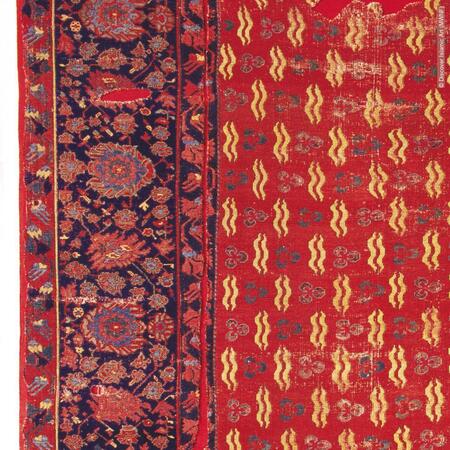
Rug, 16th century, Turkey
The central field is filled with repeating motifs of Chintamani and Pelenk, associated respectively with leopard spots and tiger stripes. Yellow wavy bands are combined with dark spotted elements. They are arranged along diagonal axes, forming a regular rhythm and an effect of infinite repetition. The outer border features a more complex floral ornament, including flower rosettes, stylized leaves, and winding shoots.
Prayer rug; late 18th–early 19th century; Lesser Asia, Kula
It is important to extract auxiliary information from the object card that will later aid in the analysis of Balkan rugs: In the 16th–17th centuries, rug artistry in Lesser Asia and Persia reached a high level of development. Traditional geometric forms gradually gave way to floral motifs and arabesques.
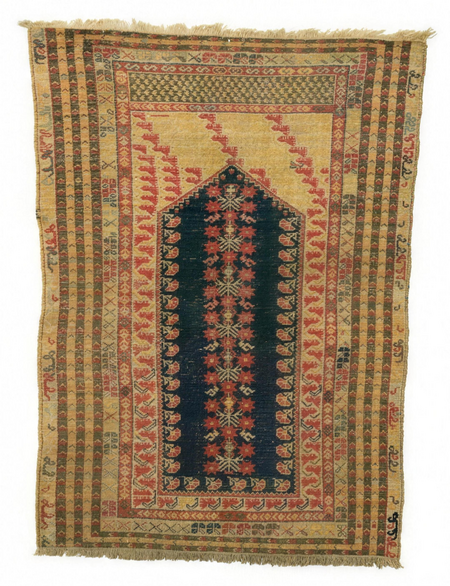
Visually, the rug possesses a rather strict, symmetrical composition organized around a central vertical axis. The main element of the composition is the dark blue central field, enclosed in an architectural form with a pointed top. The ornamentation is arranged symmetrically relative to the central axis.
In the central area, you can observe repeating floral elements arranged in vertical rows. These are significant due to their stylization towards geometric abstraction and the specific way they interweave to create a recurring motif.
Summary of Ottoman Carpet Analysis
When comparing all four descriptions, several common features can be identified that unite them at the level of composition and ornamental design:
- Symmetrical organization of the composition.
- Recurring motifs of vegetation.
- Geometricization of forms combined with detailed elements.
- Clear division of the ornamental space.