«Like painting, like poetry”[1]
The Renaissance was characterized by a growing interest in the ancient heritage, including the literature and mythology of ancient Greece and Rome. Along with the revival of the ancient artistic tradition, ideas about the interconnectedness of various art forms became more relevant. One of the central themes of humanist aesthetics was the discourse on the relationship between painting and poetry, tracing back to the well-known saying by Horace, «Like painting, so too is poetry."[1] In the 16th century, this formula gained widespread acceptance in art theory: painting and poetry were viewed as related arts possessing common goals and methods of influencing the viewer and reader. Furthermore, discussions covered not only their similarities but also their differences in expressive means. As art historian Rensseler Lee notes, it was during this period that the conception of painting and poetry as «sister arts» became one of the foundational principles of humanist painting theory.[2]
Concept
Titian Vecellio holds a special place among artists who turned to ancient mythology. In his work, mythological narratives assume an independent visual form, where the composition, the interaction of characters, and the organization of space all contribute to unfolding the literary plot.
The key research question: How does Titian transform a static image into a narrative through artistic means?
Hypothesis: Titian employs several modes of visual storytelling: sequential depiction of mythic events, unification of multiple mythic events within a single space, and the exploration of myth through space and setting.
The research material consists of Titian’s mythological works created across different periods of his career. Primary sources include ancient literary works, most notably Ovid’s Metamorphoses, which allow us to establish the content and sequence of mythological events and correlate them with the pictorial representations. The second group of sources comprises art historical studies of Titian’s work, focusing on his engagement with ancient mythology, the history of individual compositions, and the characteristics of their artistic language. The works are categorized based on the methods of organizing the visual narrative: — Sequential depiction of episodes — Unifying temporal planes around a central event — Unfolding the myth through space and setting
Sequential illustration of episodes
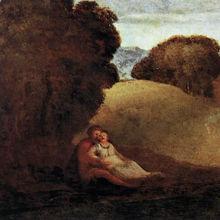
Тициан Вечеллио «Рождение Адониса» 1506–1508
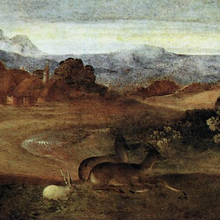
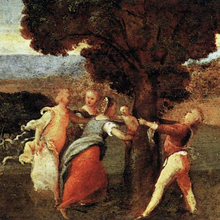
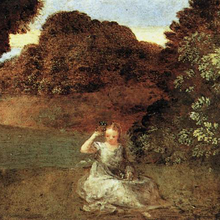
From left to right, the artist sequentially depicts a scene from Ovid’s «Metamorphoses.» In the painting, we see a pair of lovers: Cynara and her daughter. A rabbit and two deer, symbols of marital fertility. The birth of Adonis from the bark of the tree into which Myrrha was transformed. Venus, who is about to fall in love with Adonis.[3]
Titian Vecellio, «Orpheus and Eurydice» 1508–1510
In Titian’s painting, «Orpheus and Eurydice, ” the mythological narrative is presented through the sequential depiction of two episodes within a single space. In the foreground on the left, Eurydice is shown falling to the ground after being bitten by a snake. Her bent figure and unnatural body posture convey the suddenness of the event and the heroine’s physical helplessness.In the background on the right, the second episode of the myth—the return of Orpheus and Eurydice from the underworld—is depicted. Orpheus, having violated Hades’s prohibition, turns to look at his wife. This action leads to her final loss: Eurydice permanently returns to the realm of the dead.[4] Thus, the artist connects the beginning and the climax of the tragedy, allowing the viewer to reconstruct the intermediate events based on the literary source material.
Unifying temporal plans around a central event
Titian Vecellio «Bacchus and Ariadne» 1520–1523
In Titian’s painting, «Bacchus and Ariadne, ” he captures the moment Bacchus falls in love with Ariadne at first sight. The god jumps from his chariot, which is pulled by a cheetah. [5]
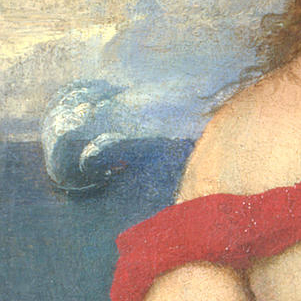
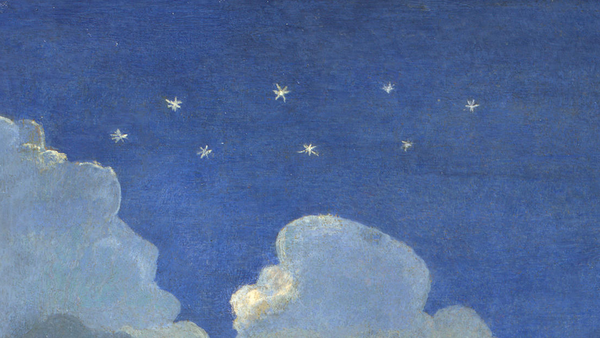
Princess Ariadne was abandoned by Theseus on the Greek island of Naxos. His ship is depicted in the distance, in the lower left corner. [5] Above Ariadne’s head is the constellation Corona Borealis. This detail alludes to the heroine’s future. She will become the wife of Bacchus, and her wedding wreath will be placed in the sky as a constellation.
Titian Vecelliio, «Venus and Adonis,» c. 1553
Titian depicts the moment of farewell between the heroes before the hunt. Venus tries to keep her beloved by embracing him, but Adonis breaks free from her grasp and moves to join the hunting dogs. His path leads toward the forest, where he is destined to perish from an attack by a wild boar.
The contrast in the characters' poses plays a crucial role in revealing the narrative. Venus turns toward Adonis, attempting to restrain him, while he twists his body in the opposite direction. Their movements create a compositional conflict: the goddess strives to halt the event, while Adonis, conversely, is already rushing toward his own fate. The tension is amplified by the dogs, which pull on their leashes, emphasizing the hunter’s impatience.
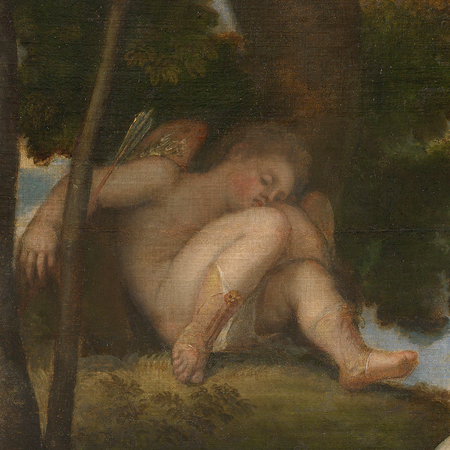
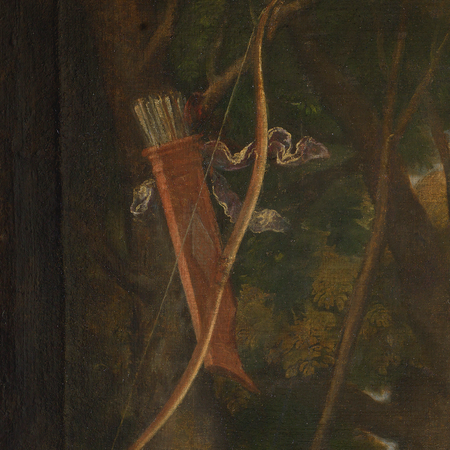
In the background, beneath the trees, Cupid is depicted asleep. Next to him are a bow and a quiver of arrows. These items allow one to reconstruct the preceding event of the myth: Cupid accidentally wounded Venus with his arrow, causing the goddess to fall in love with Adonis.[6]
Fragments of the «Venus and Adonis» variations, in which Venus' celestial chariot connects the scene of separation with the subsequent events of the myth.
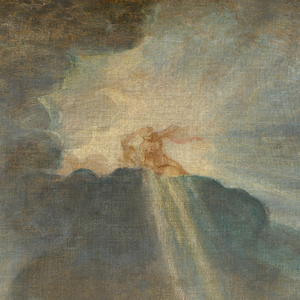
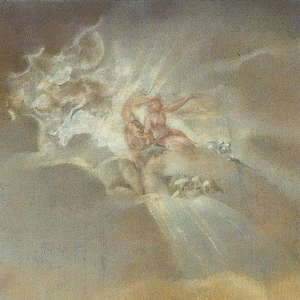
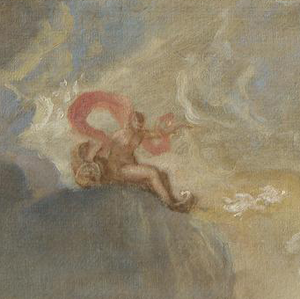
At the top of the painting, amidst the clouds, is Venus in a chariot drawn by birds. This figure refers to a subsequent episode of the myth described by Ovid: after parting with Adonis, the goddess journeys away in her chariot, but upon hearing his death cries, she returns to find her beloved mortally wounded.[6]
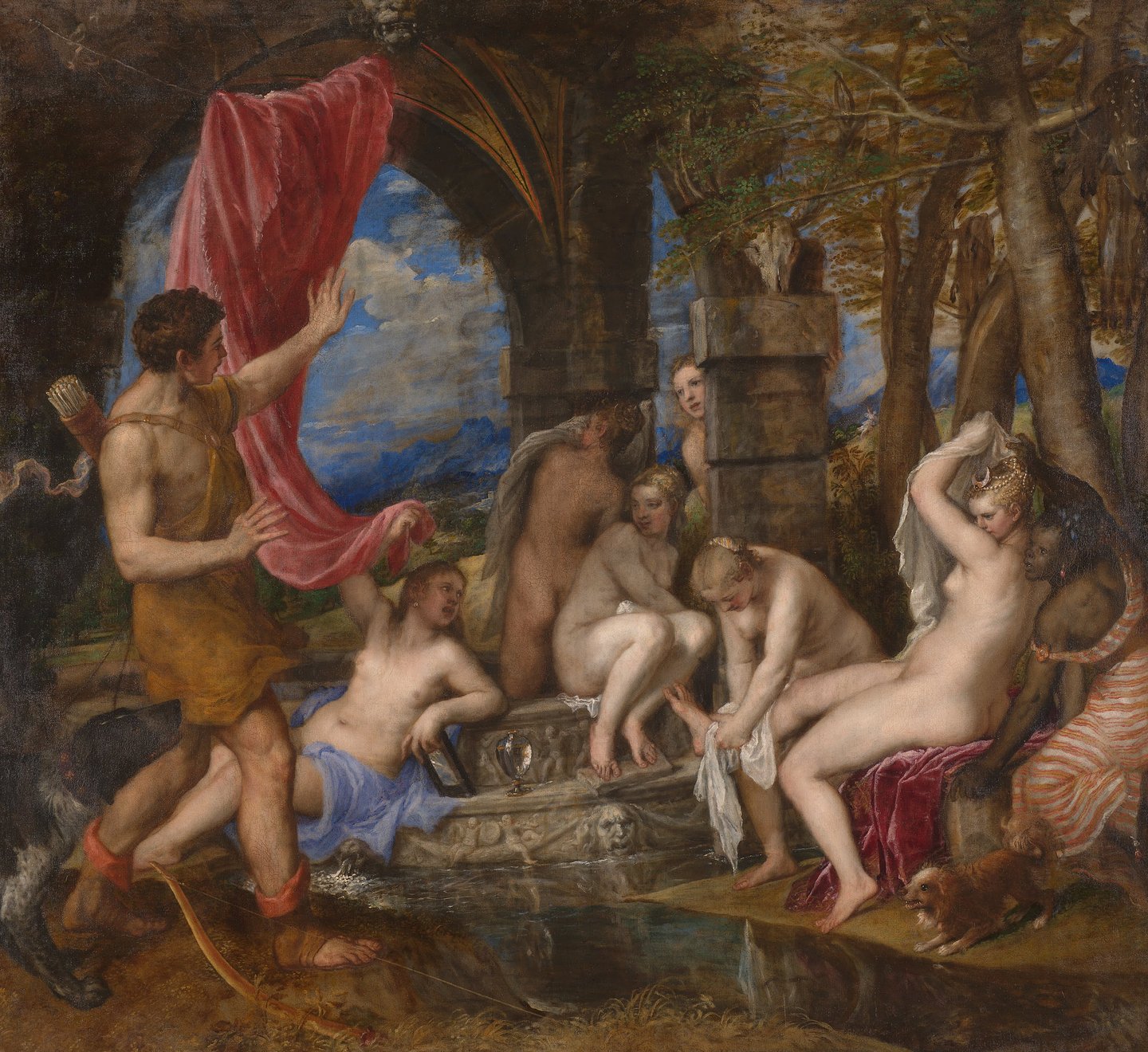
The central event of the painting is Actaeon’s arrival at the spring where Diana is bathing with her nymphs.
The composition revolves around the sudden intrusion into the goddess’s private space. The nymphs react to the unwelcome witness: some attempt to shield Diana, while others turn toward Actaeon. Diana herself finds herself at the epicenter of this reaction.
It is important to note that Titian depicts not merely an encounter between two mythological figures, but the moment when casual observation transforms into a crime against divine order. This very event precipitates the subsequent tragedy.[7]
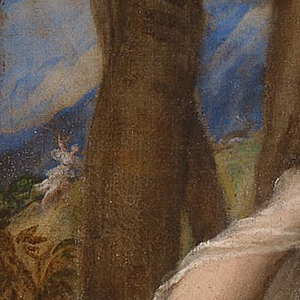
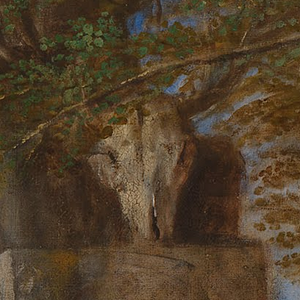
The most compelling feature of the painting is the presence of several details that foreshadow the hero’s future fate. Hunting trophies. In the ruins, there are skins and skulls of animals previously killed by Diana. They prefigure Actaeon’s transformation into a Stag and his death. The hunting scene in the background foreshadows Diana’s wrath over Actaeon’s intrusion into a sacred place.
Deconstructing the myth through space and environment