1. Concept 2. Under Pressure 3. Off the Beaten Path 4. A Cage in the Mind 5. Conclusion
CONCEPT
Hopelessness—a complex existential state of humankind with a long history of interpretation, ranging from the enclosed spaces of medieval cells to the vast yet suffocating landscapes of German Romanticism. In nineteenth-century aesthetics, hopelessness evolves beyond a mere plot point of confinement or physical torment; it becomes a specific form of spatial pressure exerted upon the viewer. Here, the emphasis lies not on turbulent drama, but on the method of visual restriction. It manifests as a draw toward confinement, paralysis, the absence of a visible horizon, and the desire to trap the human figure within impenetrable architecture. In this sense, hopelessness in the nineteenth century transforms into a stable artistic trope, allowing it to be discussed as an independent aesthetic category possessing its own visual lexicon and set of expressive tools.
The growing interest in the influence of hopelessness is linked to a change in the nature of the artistic experience—a shift in emphasis from external action to internal impasse. The art of this period investigates the subject, their isolation, solitude, and the atmosphere of claustrophobia and fatality, eschewing direct emotional declarations. Unlike Baroque dramatism or Neoclassical clarity, the hopelessness of the nineteenth century manifests in a more restrained, muffled, and static manner, drawing on Edmund Burke’s interpretation where the Sublime is born from the instinct for self-preservation and modifications of terror. This is particularly evident in painting, where dark or compressed spaces, dead-end perspective, a rigid frame, and the deliberate effect of a trap become central. Thus, hopelessness moves from the realm of plot into the realm of aesthetic practice, becoming a means to articulate invisible boundaries and the finitude of human freedom. The material selection principle is based on nineteenth-century visual examples where hopelessness is expressed both thematically and through the visual language—composition, light, color, scale, gaze, emptiness, and gesture. The material includes works from artists at the turn of the nineteenth century, provided the visual image depicts hopelessness not merely as an emotion, but as a mode of constructing reality.
In this context, the image is viewed as an aesthetic mechanism capable of forging an atmosphere of paralysis, despondency, and isolation. The visual sequence acts as an intermediary between an inner state and the external world.
In such art, the painting ceases to be a mere illustration of someone else’s misfortune. It transforms into a palpable trap: through the unbearable claustrophobia of space and the terrifying darkness obscuring the walls, the artist transfers the feeling of a dead end directly onto the viewer, forcing them to experience the prisoner’s entire terror and physical isolation.
Navigation:
Concept
Under Pressure An analysis of the technique where artists dedicate a large portion of the canvas to a oppressive, «dead» ceiling zone, physically pinning the human figures to the bottom edge of the painting.
Off Grid An examination of how total darkness and muddy colors consume the corners of a room, stripping the viewer of orientation and the ability to grasp the real scale of the trap.
Mental Prison The isolation trapped within a person’s mind—how social dead ends and mental snares are conveyed through gaze, facial expression, and paralysis of will.
Conclusion
UNDER PRESSURE
This visual type is built upon the intentional disruption of frame proportions. For example, artists employ the «heavy ceiling» technique: they place the horizon line extremely low, dedicating much of the canvas space to a oppressive, dull mass—cold sky, stone vaults, ceiling beams, or night darkness. This compositional shift physically presses the human figures toward the bottom edge of the painting, robbing them of air and room to maneuver, turning the canvas frame into the real boundaries of a trap.
Francisco Goya. «The Madhouse.» (1812–1819)
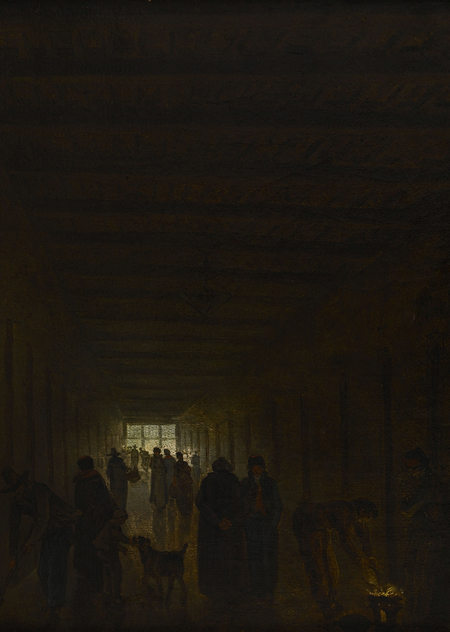
Goya executes a radical compositional shift, dedicating almost the entire canvas to mute, gray semicircular arches and high stone walls. The clinic’s vault looms over the figures like an insurmountable stone slab, transmitting a sense of physical suffocation and paralysis. The window of freedom stands above them, accentuating their helplessness.
Fragments from the painting
The left panel clearly shows people literally crumpled into a mass near the lower-left boundary of the painting, squeezed by the pressure of a «heavy ceiling.» Many have lost the strength to fight, and even those who retain some resilience understand that they can no longer escape. The space beneath the outermost arch serves as their final support.
In the right panel, the trap functions differently: here, the person has ventured deep into the darkness, dissolving within it. Residing there, in a secluded corner, he seems to have stopped thinking about anything; he no longer has the strength to resist, and he simply waits, having succumbed to this hopelessness.
It is a mistake to think that a compositional impasse only occurs in cramped basements and casemates. German Romanticism proves that boundless open space can be as oppressive, or even more so, suffocating.
Caspar David Friedrich, «Monk by the Sea» (1808–1810)
This sky does not convey a sense of freedom—it looms as a dead, heavy granite mass that literally crushes the tiny figure of a human into a narrow strip of land. In this moment, the visual trap of scale escalates to an existential level. The looming void and relentless elements leave the human no chance for dialogue or rescue.
Dissolving the boundaries of the horizon, Friedrich captures not a romantic triumph of the spirit, but a total stupefaction of the mind when confronted with infinity. The trap here is nature itself—its scale utterly paralyzes the human will, transforming the solitary figure into a powerless spectator of their own insignificance before eternal nature.
In the mid-19th century, Russian painting transposed this technique into the tight spaces of everyday life. But behind the trivial genre premise lies something greater—the artist’s passion and anguish, their acute psychological experience searching for an outlet, transforming a cramped hut into a hermetic existential tomb.
Fedotov Pavel. «Anchor, encore!» (1851–1852)
Fedotov’s last unfinished canvas is the ultimate benchmark for compositional entrapment. The artist radically shifts his style: instead of the usual engaging mise-en-scènes, the suffocating, dense atmosphere of the subject environment becomes paramount. About 70% of the canvas area is dedicated to oppressive night haze and heavy ceiling beams that literally compress the room’s space. The officer is pressed into the lowest edge of the frame, and the painting’s feverish, inflamed red palette evokes a sharp sense of anxiety. Time here is cyclical, and the frame of the attic transforms into the actual boundaries of a trap from which there is no escape.
Painting Fragments
In the left panel, the cramped framing strips the person of individuality: only the figure of an officer is visible, while everything else has dissolved into indistinct shadows trapped at the bottom of this box. Life has narrowed to the confines of this room.
In the right panel, there is a symbol of a dead end. The weak light of a candle is powerless against the darkness looming beneath the ceiling, and the nailed-up window severs the protagonist from the outside world. Fedotov visualizes the tragic transience of time: this log cabin is completely isolated, and the person is trapped in a loop of monotonous, meaningless repetition where time mercilessly slips through their fingers.
OFF-CAMPUS PROGRAMS
This visual type explores the mechanics of disorientation, transforming physical space into a psychological impasse. Gritty, muffled colors are used here not for atmosphere, but as a tool for deconstructing reality. Darkness literally «eats» the corners of rooms, erasing wall seams and floor boundaries. The viewer completely loses their bearings: the scale of the trap becomes fundamentally unclear—it could be a cramped crypt or an infinite, empty hall.
George Frederick Watts. «Hope.» (1886)
In this masterpiece, the title rings with pure visual irony. Watts employs the mechanics of boundary dissolution. The entire canvas is saturated with a dull, murky, blue-green haze. There is no sky, ground, walls, or horizon here. The environment is utterly amorphous.
Fragment of a painting
At the very center of this vacuum, atop the sphere, a female figure with her eyes bound is curled into a knot. She is completely disoriented: she has no sense of scale within this trap, no vector for movement. In her hands is a lyre, where all but one string is snapped. This single remaining hope will also soon break. Tilting her head toward the instrument, she attempts to coax a sound from what physically cannot make one. This is pure, paralyzing awareness of hopelessness—the finale of the struggle, where the ring of isolation has closed in the middle of infinite emptiness.
If Watts' symbolism unfolded the trap of scale across boundless space, in realistic painting, this technique is confined to the limits of a cramped stone box. However, the mechanism of disorientation remains the same. Artists drain the color from the space, leaving behind only faded, earthy tones where the walls lose their physical boundaries.
Nikolai Yaroshenko. «The Convict.» (1878)
Yaroshenko explores desperation through faded, muffled interior isolation. The artist completely abandons bright colors, plunging the canvas into a monochromatic, earthy-gray palette where familiar boundaries of space blur. The scene is constructed so that the viewer feels the fatal powerlessness of a person against a frightening emptiness that is consuming them. This is the point where panic subsides, yielding to the understanding that escape is no longer possible.