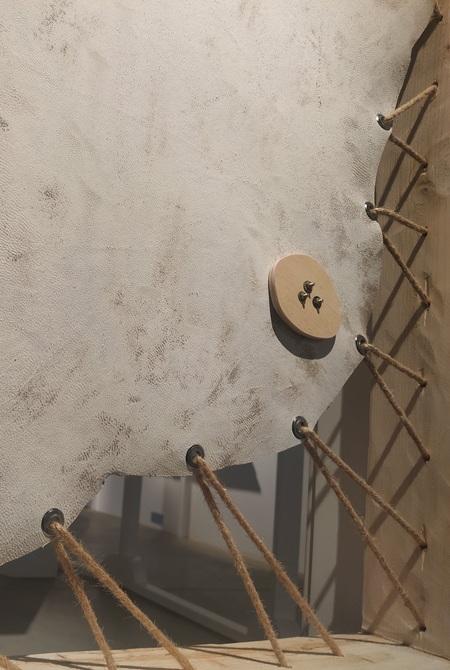
«Typically, the shamanic drum was perceived as a riding animal (reindeer, horse) or another mode of transportation (boat, raft) for the shaman during their journey; the rattle served as a whip, a goad, or an oar.»Shamanic Drum // Great Russian Encyclopedia. Vol. 34. — Moscow, 2017. — pp. 680–681
In the daily lives of nomads, leatherworking always held a crucial position; leather was used to create clothing, horse tack, water vessels, weapons, and even homes. It can be posited that the genesis of such an ancient musical instrument as the shaman’s drum has, at its core, a utilitarian object—a device for drying animal hides. The hide, stretched over a frame, is capable of producing a musical tone, much like the string of a bow or the string of a dombra.

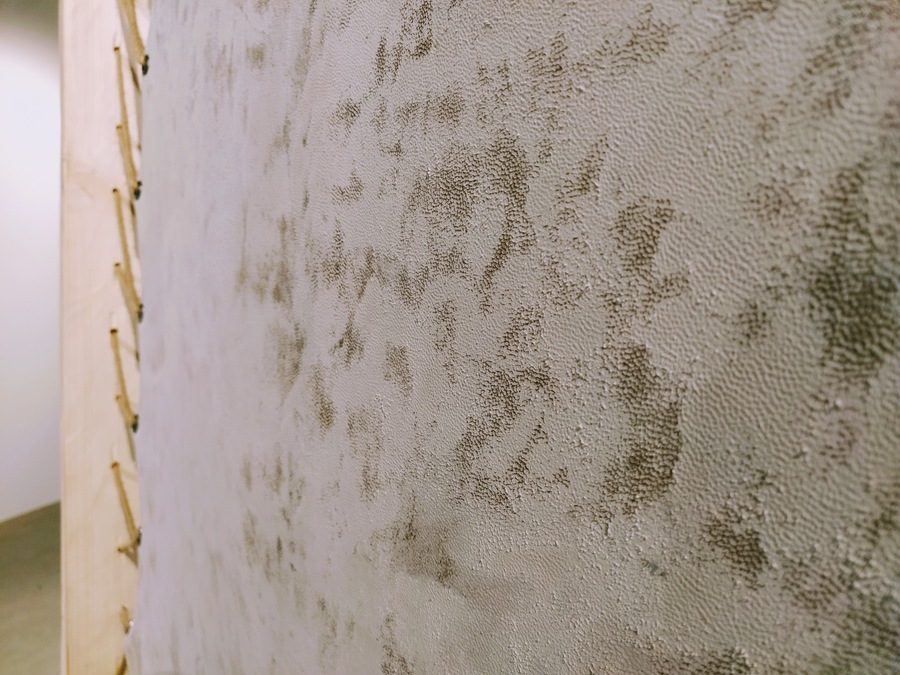
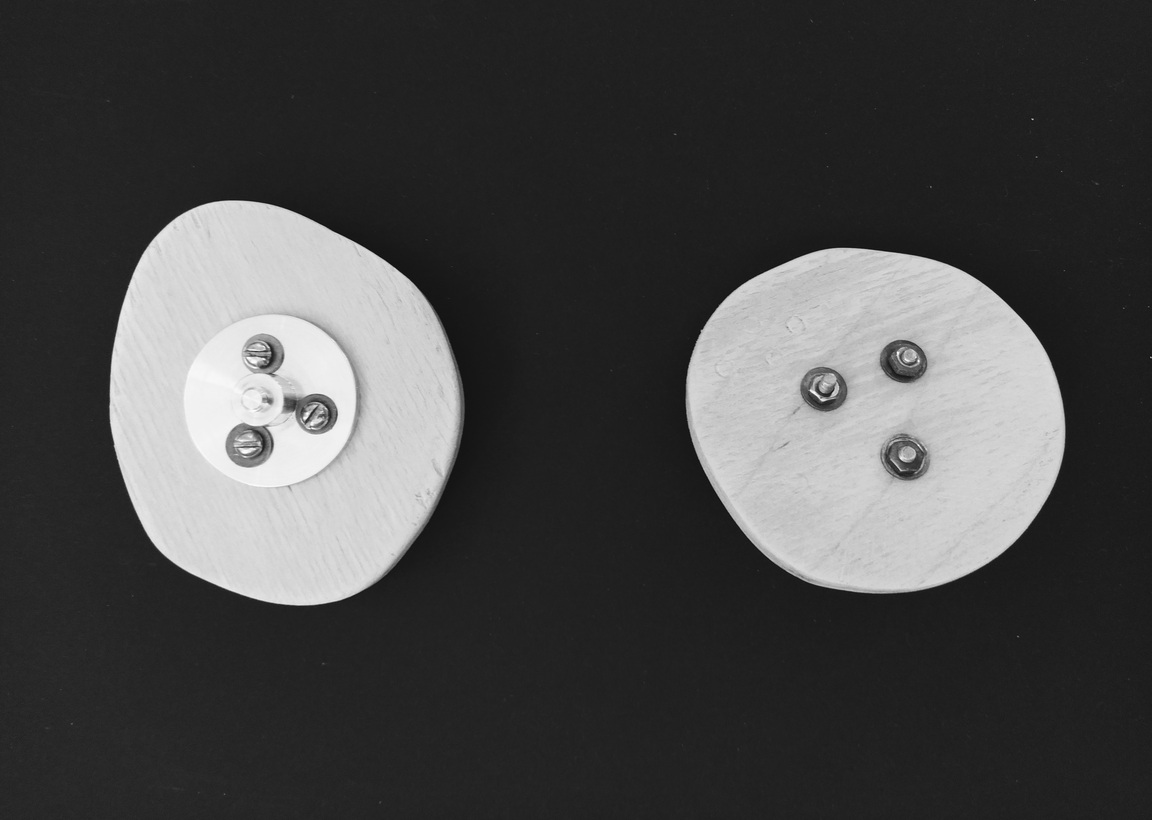
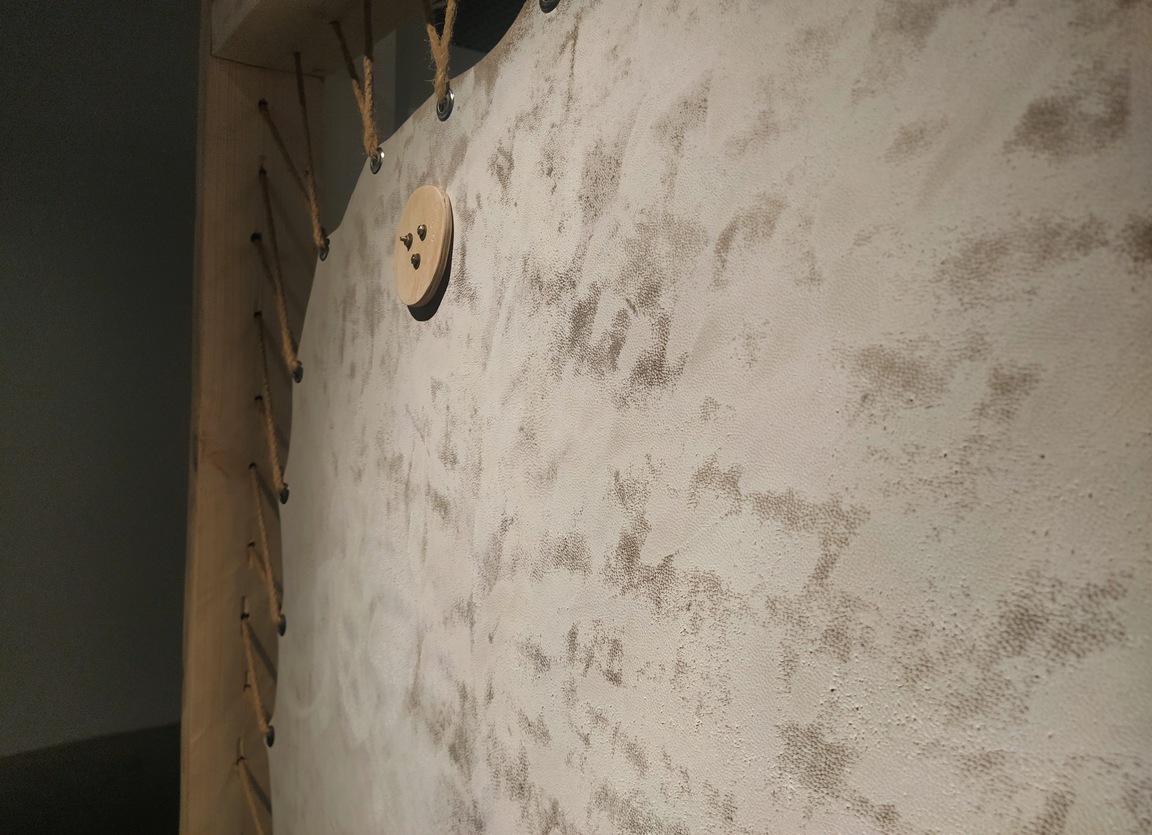
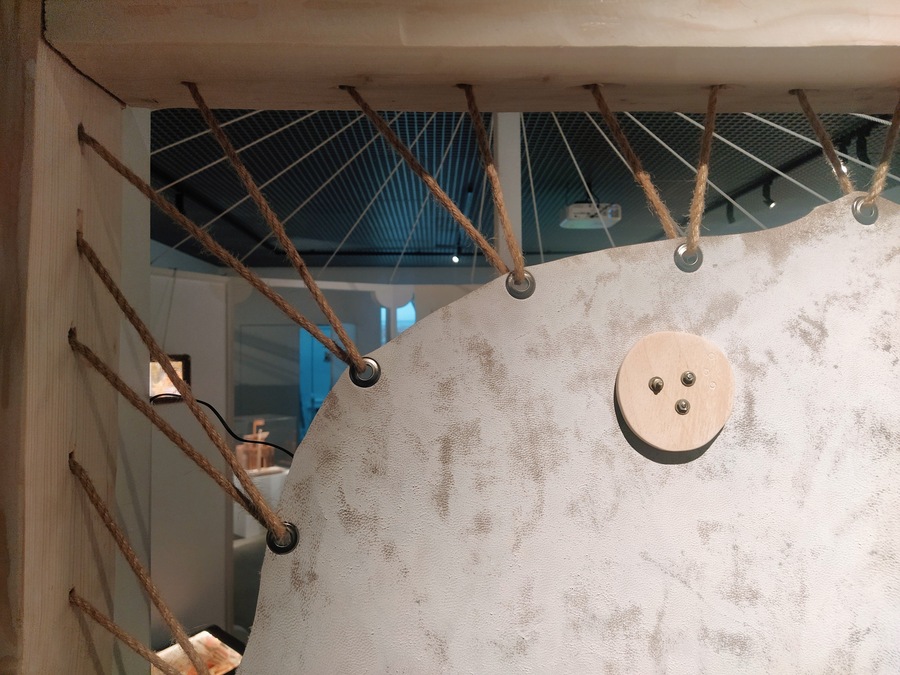
In this installation, the surface of the hide itself presents as a map of nomadic life—a territory of sound migration, a steppe model (a plane) tuned to a specific frequency and resonating with the sounds of the environment.

Exhibition view «The Steppe Hides Itself, ” featuring works by Lyokha G., Andrey Popovsky, Evgeny Antufyev, and Andrey Khlobystin. Photo: Konstantin Antipin. Courtesy: Golubitskoye Art Foundation
As for the soundscape, it represents an imagined, conceived, and reconstructed acoustic environment of the steppe, almost devoid of anthropogenic or industrial characteristics. The skin resonates, responding to the steppe noise, serving as a sort of auditory mirror that reflects the wind, horses, the scent of grasses, the crunch of insects, animal cries, and birdsong—low-flying clouds, the breath of rain, and the rustle of the wind.
The «Golubitskoye» Art Fund, curated by Varvara Busova.


