Preserve, destroy, or transform into art?
Sometimes we have items at home that we no longer need, but we still feel reluctant to throw them away. An old mug, a box of soap, or a broken kettle might be more meaningful than new purchases. I wonder why we cherish some objects, discard others without a second thought, and suddenly deem third objects to be works of art.Artists began openly debating the value of everyday objects in the early 20th century, as mass production transformed daily life. Marcel Duchamp proposed that a ready-made object could be considered a work of art if the artist selected it and changed its context. In the 1960s, Italian Arte Povera artists used rags, earth, and other inexpensive materials, challenging conventional ideas about expensive and «noble» art.Later, this theme began to be explored outside of the art world. Sociologist Jean Baudrillard wrote about consumer society, while anthropologist Igor Kopytov suggested viewing objects as entities with their own histories. Today, artists continue to challenge the habit of judging an object solely by its price or utility.But there is another question: does an artist have the right to destroy an object that holds memories for another person? Or, conversely, should we preserve everything? Some see old items as trash, while others see them as memories and traces of someone else’s labor. This determines what we keep, what we destroy, and what stories we pass on.I want to compare three projects where artists address the fate of objects differently: preserving them, destroying them, or giving them a new form.
Sun Dun — Waste Not, 2005
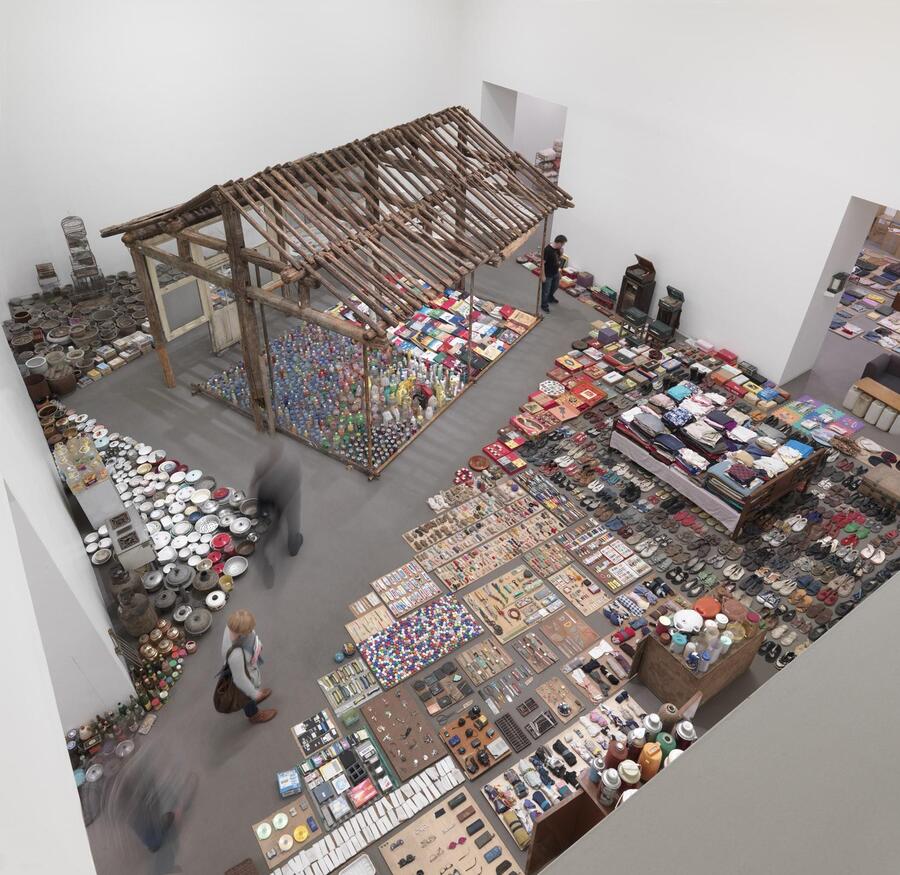
Collaborative project with the artist’s mother, Zhao Xiangyuan Beijing Tokyo Art Projects, Beijing, September 20 — October 23, 2005
In a 2012 interview with The Guardian, Sun Dun speaks about an old bar of soap that his mother kept at home for many years.
«When I started working on this project, I realized it wasn’t just soap; it was her love.»
What surprises me most about this piece is not the quantity of objects, but the fact that almost none of them hold conventional value. On the floor are neatly arranged cups, boxes, old slippers, and pieces of soap. In the center stands a wooden frame of a house. The whole arrangement resembles an apartment that has been disassembled piece by piece and moved into a museum.
The artist’s mother preserved these items for years because she was accustomed to never throwing anything away. After her husband’s death, these objects served as reminders of him. Sun Dong didn’t just display household remnants. Together with his mother, he organized them into groups, transforming the familiar clutter into a space through which the viewer can walk and examine individual details.
My main question here is: where does memory end and unnecessary accumulation begin? From an outsider’s perspective, these things could easily be dismissed as junk. But we do not know what events they are connected to. I am particularly moved by the pieces of soap. To a stranger, they are just old soap, but to the family, they are a sign of care that cannot be replaced by something new.
It seems to me that the very arrangement of the objects changes our relationship to them. In a museum, we look at every small detail more closely than we would at someone’s home. But simultaneously, a doubt arises: can someone fully convey personal memories through objects alone? We see them, but we only learn the true stories from the family’s narrative. This is why, for me, this work is not about a love for old things, but about the difficulty of letting go of a part of one’s life.
Michael Landy — Break Down, 2001
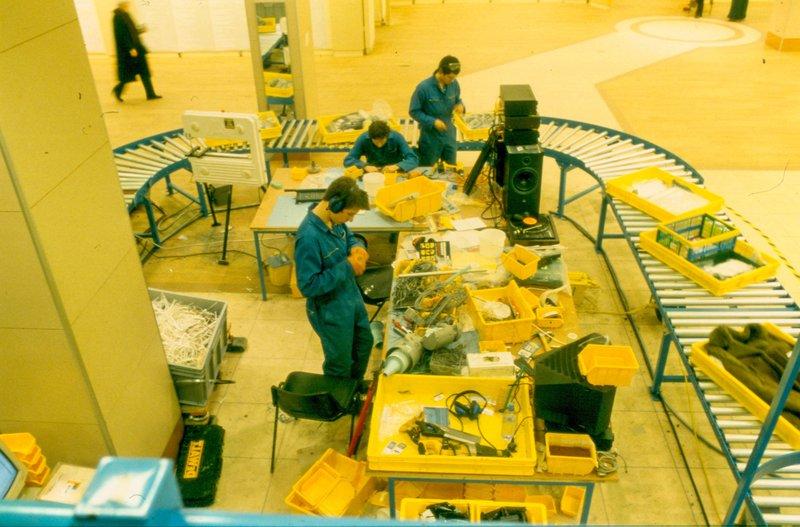
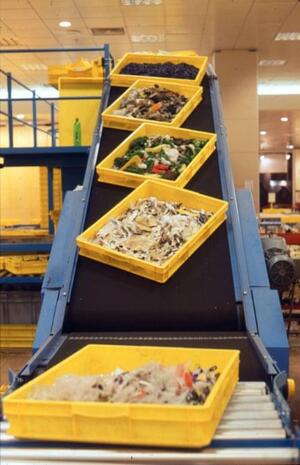
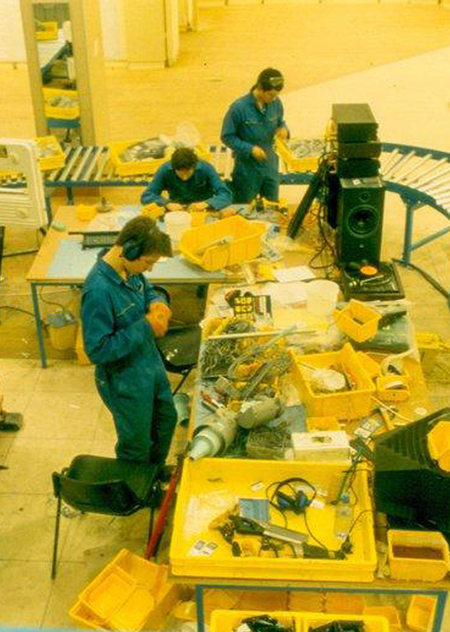
the former C&A department store on Oxford Street, London, February 10–24, 2001
In a 2001 interview with The Guardian, Michael Landy explains what interested him in this project.
This work examines the amount of raw material used to create objects and how long they endure.
I was struck by the fact that Michael Landry didn’t just decide to get rid of unnecessary items. He destroyed everything he owned—including clothing, books, his car, and gifted works of art. What’s more, he did this not at home, but in an empty store on a busy London shopping street.A real assembly line was operating in the hall. Items were laid out in yellow trays, and employees in identical overalls slowly disassembled, sorted, and destroyed them. Visitors watched the process almost like watching factory production. But usually, an assembly line creates products, and here it was turning them into waste.In my view, the core problem of this work is how deeply we tie our personal identity to what we possess. Landry compiled a complete list of items and then discarded all of them, including those that held not just monetary but personal value. I feel that destroying letters or gifts is perceived quite differently than breaking old electronics.The setting is also important. People who went into the building on Oxford Street—a place where they are accustomed to shopping—saw the exact opposite. This isn’t just a dramatic gesture; it’s a way to force the viewer to contemplate their own purchases and attachments. But a debatable question arises: must we destroy objects to prove our dependence on them? Perhaps they could have been donated to others. It is this brutality toward objects that makes the project so uncomfortable.
El Anatsui — Dusasa I, 2007
52nd Venice Biennale, Arsenale, starting June 10, 2007
In a 2014 interview with ArtAsiaPacific, El Anatsui discusses why he is drawn to recycled materials.
«I wanted to work with materials that people had already used, materials that their hands had touched.»
«Dusasa I» initially strikes me as a massive expanse of fabric. It glints, gathers into folds, and the colored stripes suggest a pattern. But upon closer inspection, you see that it is flattened bottle caps, joined by wire. Objects that would typically be discarded look precious here.I wonder why the artist doesn’t melt down the metal or conceal its origin. Colors and traces of packaging remain on the individual pieces. Furthermore, the caps no longer serve their original purpose. They have become part of a flexible canvas that can be displayed on the wall in various ways. The form, light, and sense of scale change depending on the folds.The central question here is: does an object lose its former life when it becomes art? Unlike Michael Landry, Anatsui doesn’t destroy things. And unlike Sun Dong, he doesn’t try to preserve them in their original state. He transforms them into something new, yet leaves the traces of the past distinctly visible.This is also significant because the caps are connected to the alcohol trade, and for the artist, this history leads to themes of Africa and Europe. It seems to me that the glossy surface might initially distract the viewer from such content. But then, once you understand what the work is made of, the beauty begins to be perceived differently. Here, the superfluous object doesn’t disappear or merely remain as a keepsake; it gains a new role and prompts reflection on where it originated.
Conclusion
These three works demonstrate how vastly differently we can approach everyday objects. Some keep them for years, others discard everything, and some transform discarded items into art. I am most drawn to the approach of El Anatsui. I appreciate the idea of giving old things new life. After this study, I realized that an object’s value doesn’t always depend on its monetary worth. Sometimes, its history and what it means to a person are far more important.
Sources
The Museum of Modern Art. Marcel Duchamp’s Readymades: Celebrating the Centennial. https://www.moma.org/explore/inside_out/2016/01/15/marcel-duchamps-readymades-celebrating-the-centennial/MoMA. Arte Povera. https://www.moma.org/collection/terms/arte-poveraBaudrillard J. The Consumer Society: Myths and Structures. Sage Publications, 1970.Kopytoff I. The Cultural Biography of Things: Commoditization as Process. In: The Social Life of Things, 1986. https://doi.org/10.1017/CBO9780511819582.004Tokyo Gallery + BTAP. Zhao Xiangyuan and Song Dong: Waste Not, 2005. https://www.tokyo-gallery.com/en/exhibitions/4949.htmlNeedham A. Chinese artist brings five decades' worth of clutter to London exhibition. The Guardian, 2012. https://www.theguardian.com/artanddesign/2012/feb/14/chinese-artist-clutter-london-exhibitionArtangel. Michael Landy: Break Down, 2001. https://www.artangel.org.uk/project/break-down/Artist at breaking point with show of destruction. The Guardian, 2001. https://www.theguardian.com/culture/2001/feb/10/artsfeaturesThe Nelson-Atkins Museum of Art. Dusasa I, 2007. https://art.nelson-atkins.org/objects/54936/dusasa-iLin M. Material World: Interview with El Anatsui. ArtAsiaPacific, 2014. https://www.artasiapacific.com/ideas/material-world-interview-with-el-anatsui/