Navigation
- Concept
- The Appearance of the New Human
- War
- Youth Rebellion
- Conclusion
- Sources
Concept
Soviet fashion is not merely an aesthetic category; it is also a socio-cultural and political phenomenon. It completely reflects societal changes, values, and ideals, as well as the evolution of national identity. Fashion in the USSR differed from any elsewhere in the world, and this was evident in the people. Throughout different decades, Soviet fashion underwent significant transformations influenced by the ideological propaganda instilled in the populace, regardless of economic conditions or global trends. The initial era of Soviet fashion, expressed through constructivism and primitivism, aimed to create practical and functional clothing. However, over time, the state’s concept of fashion evolved—it transitioned from being an instrument of ideological propaganda to becoming an opportunity for shaping national identity.
Also, just as the state had plans for Soviet fashion, it also did for cinema. In the Soviet Union, cinema became a powerful tool for disseminating the ideals promoted by the Party. In early Soviet cinema, everything was done to satisfy the government. Films served not only as entertainment but also as an educational medium, showcasing the ideal citizen and the integral role of work in their lives—work that was supposed to be the priority for a respectable citizen. Fashion and film began to merge immediately; initially, a person’s appearance had to underscore their decency and readiness to work right away. Over time, everything changed. Cinema became more complex—its characters were no longer simple archetypes but living people who possessed their own opinions, stances, and, most importantly, their own taste.
Clothing is no longer a tool of propaganda, but an embellishment of the individual. It accentuated the boldest traits of characters on screen, capturing the affection of the entire Soviet audience—making them desire to look and behave similarly. This visual study aims to examine the relationship between Soviet fashion and cinema, analyzing how fashion emphasized the films' content and how, in turn, cinematography shaped societal perceptions of style. We will examine key films and significant figures, exploring how notions of fashion—and fashion itself—evolved over the decades. We will also explore how people and their reality changed.
The Shape of the New Human
Fashionable Girls of the 1920s
The 1920s–1930s in the USSR. Post-war devastation, material shortages, and poverty—all of this was reflected in the appearance of the new person. People repurposed and mended old clothing, making do with pre-revolutionary garments; beads were fashioned from bread and paper, and furs were sometimes crafted from domestic animals, particularly cats and dogs. New fashion magazines began to emerge.
Journal «Crocodile, ” No. 03 [99], 1922. Author unknown.
Rejecting bourgeois networks was the main goal of the new era. Restraint and severity replaced opulence. Any decoration or embellishment was considered indecent and vulgar.
V. Tatlin. «Norma» costume. In the journal «Red Panorama, ” on the page „New Life.“ 1925.
In 1922, the second famous journal throughout the Soviet Union, «The Peasant Woman,» was launched. It was established by the Department for Women’s Work of the Central Committee of the RCP. There were other notable publications that did not last long, such as «Worker and Peasant Woman» (1932–1941) and «Women’s Journal» (1926–1930), among others. These publications featured articles on topics deemed interesting or potentially interesting to Soviet women; the journals molded women into the ideal communist—those who paid little attention to their appearance and bodies, and who disregarded discomfort for the good of the Party.
Journal — «The Peasant Woman»
«Women’s Journal»
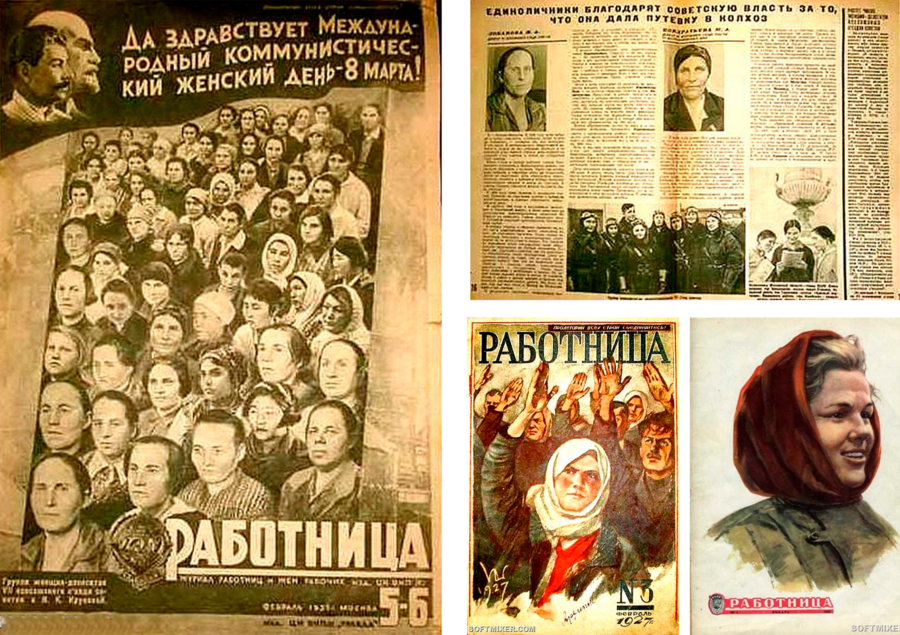
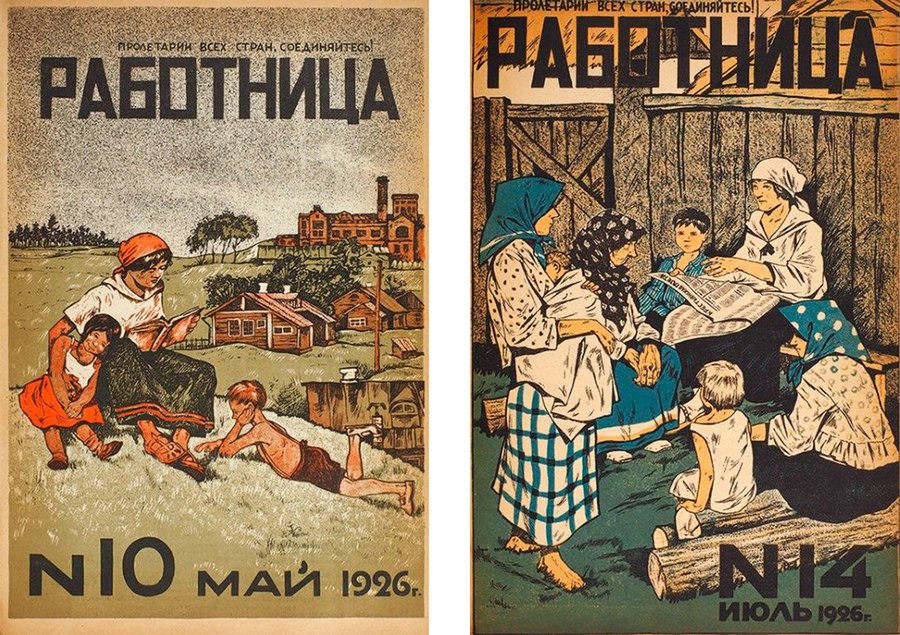
«Worker»
following the end of the internal party struggle in the late 1920s–early 1930s
In the cinema of that era, the image of the new person was actively promoted. The state completely controlled this image, creating on screen a person who was extremely submissive and convenient for Soviet authority. Furthermore, the cinema should not encourage thought—this was considered a distraction from work, and that could not be allowed.
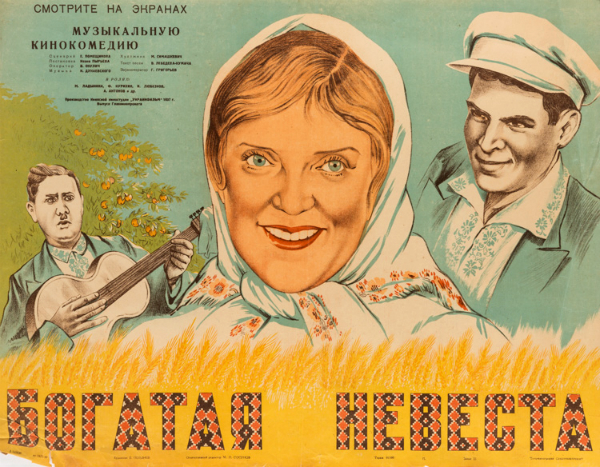
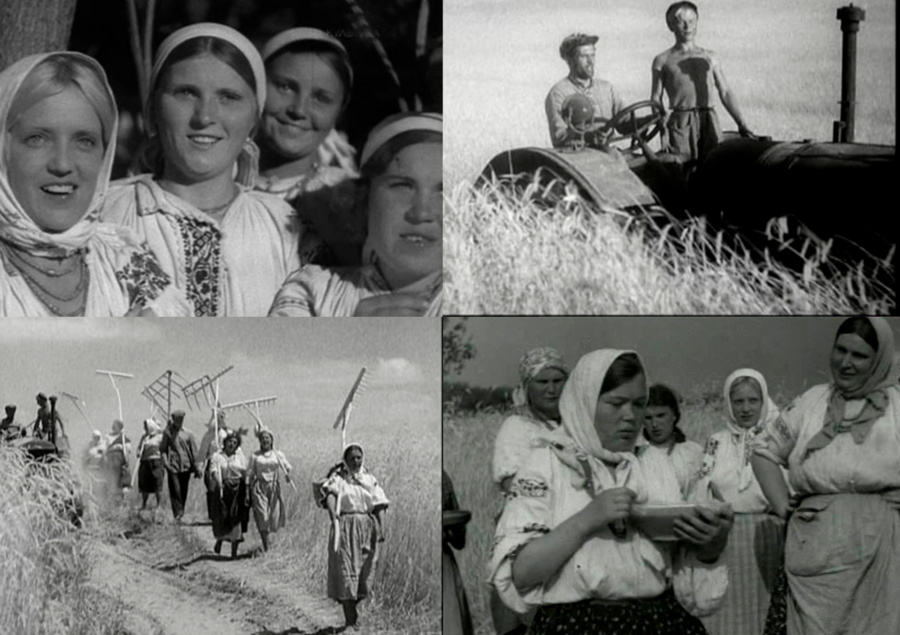
Rich Bride 1938 · Comedy/Musical
Volga, Volga 1938 • Comedy/Musical
All films from that era are mainly light comedies—the kind you can watch to relax after work. The protagonists in these films are diligent workers who contribute to the betterment of the country. They have no time to worry about appearance; as seen in the images, they wear comfortable work clothes. These clothes must in no way resemble European styles—they must be free of embellishment or decoration, lest they distract from their work. In rural settings, traditional folk costumes predominate, symbolizing patriotism and a lack of connection to bourgeois life, so various variations of these costumes can be found in the films of that period.
War
Territory of the USSR, date of photograph—approximately the summer of 1941.
For the Soviet person at that time, fashion and clothing were far from a priority; the focus was on saving their own lives and the lives of their loved ones. But this doesn’t mean they didn’t want to dress beautifully and go for a walk. People craved stability and clear skies overhead. And for many at the time, a walk in a beautiful new dress was that stability.
The primary function of cinema during the Great Patriotic War was to boost the morale of the soldiers, showcase the strength of the national army, and convey that everything would be alright no matter what.
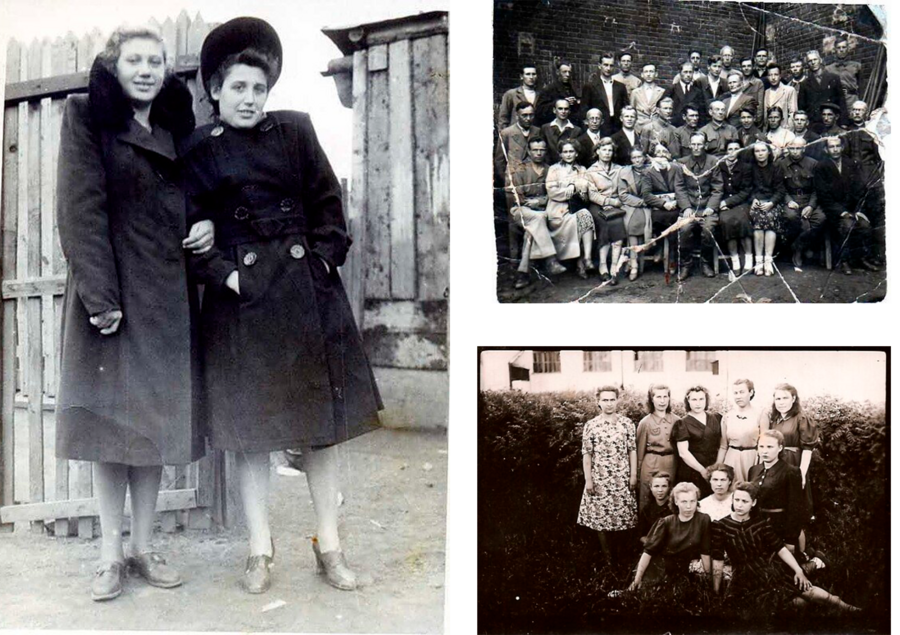
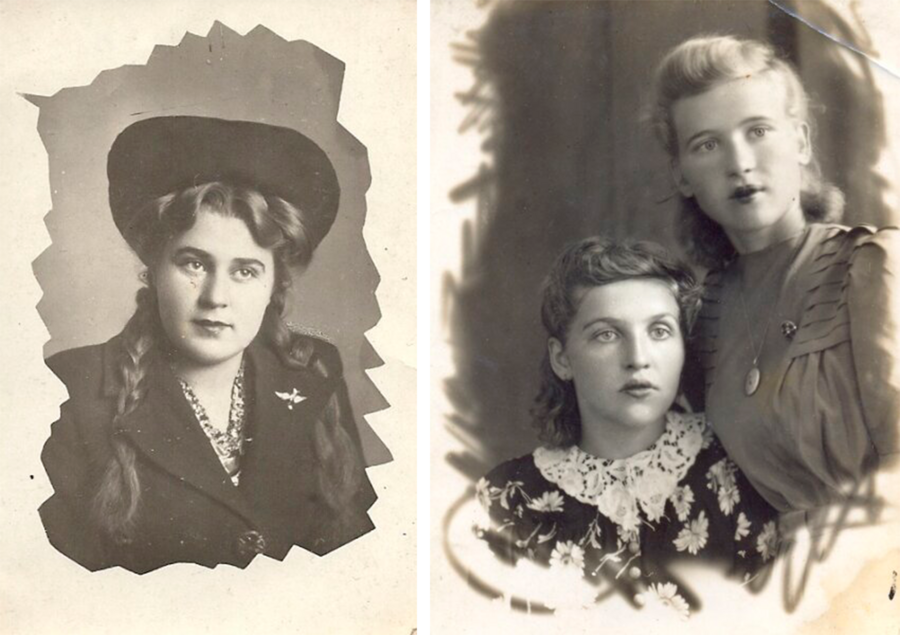
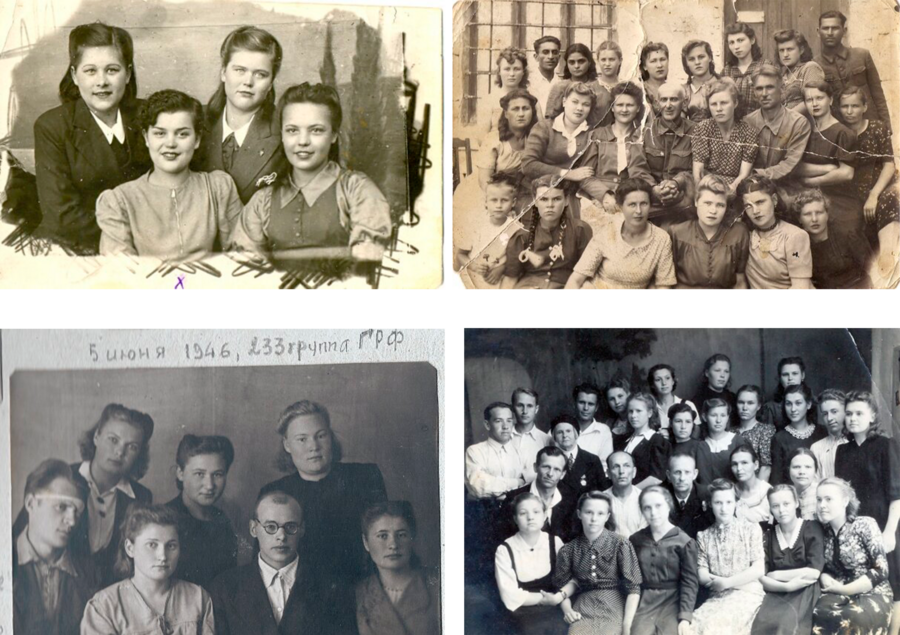
Soviet Fashion, 1945–1946, Based on Photographs from Family Albums.
Photo by G. Borisov, Smena magazine, November 1945
There is a prevalence of muted, subdued colors. Military uniforms become symbolic, and the soldier’s rank carries honor. Stemming from this, everyday items worn by ordinary people become more rigid in a military style—garments begin to feature button-down shirts, pencil skirts, blazers, straight-silhouette dresses, and much more. There is a reinterpretation of military uniforms, which we can clearly observe through cinema.
Clothing was unavailable, so people made new items from old ones, altering and patching them—a process we can also witness through cinema.