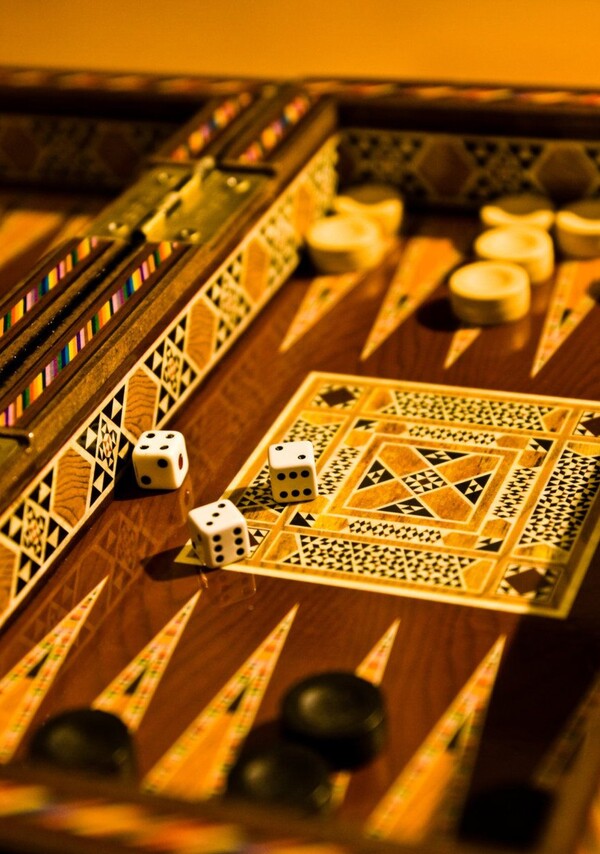
Concept
Randomness in board games is often perceived merely as a constraint on the player. However, its role is not always limited to blindly submitting to circumstances: even after receiving an unfavorable dice roll or a random card draw, the player retains the capacity to make decisions, alter strategy, and seek new paths to victory.
It is precisely this tension between the uncontrollability of game events and the freedom of choice that will form the basis of this visual study. Using historical and contemporary board games with elements of chance as examples, we will analyze how game mechanics reflect a Stoic attitude toward fate—accepting circumstances that cannot be changed while maintaining the readiness to act and influence the available outcome.
Thus, the main research question can be formulated as follows:
How do tabletop games incorporating elements of chance demonstrate a person’s capacity for stoicism toward random circumstances?
My hypothesis is that stoicism in board games manifests in accepting uncontrollable events and in attempting to build a winning strategy even with unfavorable circumstances.
Games that utilize randomness as a core element of gameplay remain among the most recognizable and memorable in the industry. My work proposes viewing familiar mechanics from a different, more philosophical perspective, tracing the pattern between those mechanics and how a player acts in a game situation despite random circumstances, displaying Stoicism. This work holds theoretical significance because it illustrates the manifestation of Stoic philosophy in an unusual context—the realm of pre-digital tabletop games. The goal of this work is to clearly demonstrate how the ideas formed by Epictetus and Marcus Aurelius relate to the concept of randomness in games described by Roger Caillois. In terms of practical application, the work can serve as a clear illustration of Stoic philosophy and may be useful for drafting reports and academic papers focused on researching this philosophical current.
The research employs illustrative material that logically complements the themes and ideas presented in the sections. When selecting textual sources, I prioritized books and internet articles that explore the essence of Stoicism as a philosophical current. I also referenced Roger Caillau’s book, «Games and People,» specifically his classification of alea games, or randomness. Additionally, I used articles explaining game rules where randomness is a primary element. The principle of visual research categorization is based on sequentially examining board games through several interconnected analytical perspectives. First, the research concept and the philosophical foundations of Stoicism are unveiled; subsequently, the concept of Alea and its manifestation in game rules and mechanics are examined. Particular attention is given to how the player interacts with randomness, what tools they use to overcome its consequences, and the extent to which their decisions can influence the course of the game. In the conclusion, the observations gathered are synthesized to determine how board games reflect the confrontation between uncontrollable circumstances and humanity’s capacity to choose, deliberate, and act.
Rubric:
Concept
Stoic Philosophy
How does the player fight against «Alea»?
Conclusion
The Philosophy of Stoicism