Navigation
Contents:
- Introduction
- Concept
- Chapter 1. The Bird as Guide of the Soul (Psychopomp and Heavenly Messenger)
- Chapter 2. The Bestiary of Vice (Medieval Period and Northern Renaissance): Temptation, Sin, and Folly
- Chapter 3. Nocturne, Shadow, and Vanitas (Baroque and Romanticism)
- Chapter 4. Birds in the 20th Century: Fears, Dreams, and Aspirations
- Conclusion
- Bibliography
- Image Sources
Introduction
The image of the bird in visual art occupies a unique liminal space. Due to its ability to defy gravity and belong to the celestial sphere, the bird has historically been perceived as a medium between earthly and sacred realms—an incorporeal conduit of the soul (psychopomp), a herald of divine revelation, and a symbol of spiritual liberation. However, upon encountering earthly flesh and the material world, this image gains ambivalence. In visual tradition—from medieval bestiaries to Dutch allegory and 20th-century Surrealism—the bird simultaneously functions as a key marker of human sinfulness, embodying lust (luxuria), pride, garrulousness, and the inevitability of corporeal decay.
Concept
This project is a visual album exploring how artists across different eras have utilized the image of the bird to represent two diametrically opposed entities: the pure human soul and human vice. The goal of this visual investigation is to trace the evolution and semantic divergence in the representation of birds throughout the history of visual art, demonstrating how the same symbol has come to signify both sanctity and sin. • Research Subject: The transformation of the zoomorphic metaphor of the bird from Ancient Egypt to 20th-century Surrealism. • Research Object: Compositional, color, and scale-spatial techniques for visualizing the dualism of «Soul—Sin.»
Core Concept
Birds — an ideal dualistic symbol in art: • When in flight, they are light, free from burdens, and resemble the soul aspiring toward God or another world. • When grounded, feeding, tormenting prey, or appearing massive and menacing, they transform into symbols of greed, chatter, lust, and imminent death.
The primary visual contrast of the project is the struggle between two directions:
- Upward and toward the light: soaring, white and golden tones, small and graceful birds (doves, finches).
- Downward and into the darkness: weight, dark and murky hues, giant monster birds, owls, and crows.
The research juxtaposes two opposing archetypes:
- The bird as soul and guide: from the Egyptian bird Ba and the Christian dove as a symbol of forgiveness to the representation of the spirit in 19th-century art.
- The bird as a symbol of sin: from Hieronymus Bosch’s giant monster birds and Bruegel’s gossiping magpies to the fears and hidden desires of 20th-century Surrealism.
The methodology of this study is built upon comparing the species characteristics of birds, their compositional movement (ascent/descent), and spatial context, revealing how the same natural motif became a vehicle for contrasting theological and philosophical concepts.
The structure of the research follows the dynamic transformation of the image—from a sacred guide of the soul (psychopomp) to an allegory of human downfall and sin. Within each thematic block, the works are arranged in strict chronological sequence.
The visual presentation is supplemented by an analysis of myths, Christian texts, and art historical essays, which help clearly trace how different eras’ conceptions of the soul and human sins evolved into painted imagery.
Chapter 1. The Bird as a Guide of the Soul (Psychopomp and Celestial Messenger)
1.1. Antiquity and Ancient Egypt: The Idea of the Soul as a Bird
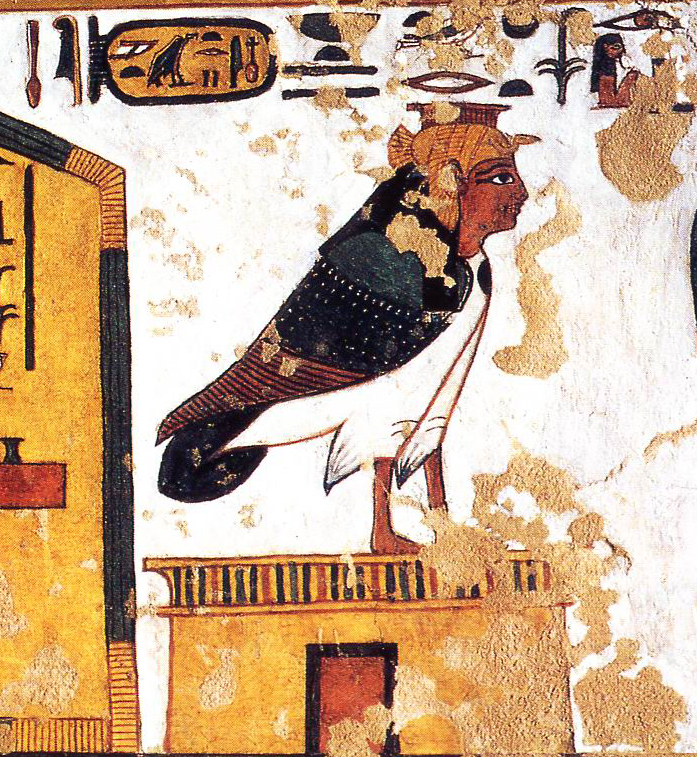
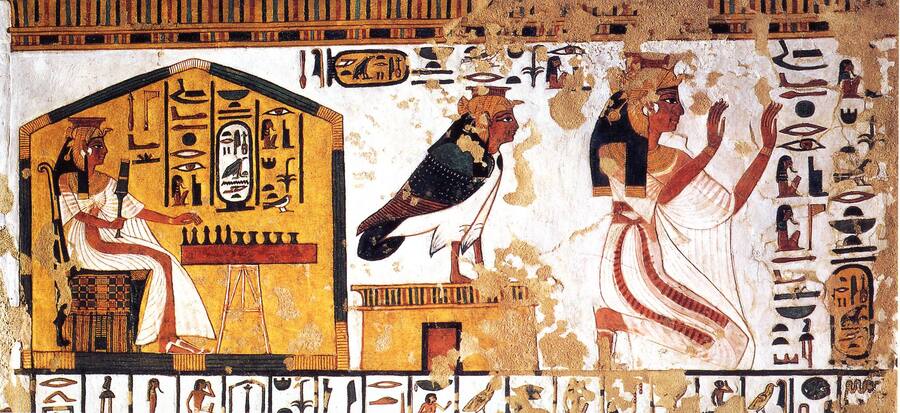
1.1.1. Ancient Egypt: The Ba Bird—the winged soul.Egyptians depicted the soul of the deceased person in the form of a bird with a human head. It could freely fly out of the tomb during the day and return at night, connecting the world of the living and the dead. In art, the Ba is often shown descending near the deceased, with spread wings in a humble posture, acting as a guardian on the journey to the afterlife. • Portrait Likeness: The face of the Ba bird in the papyri of the Book of the Dead replicated the face of the deceased person. • Personal Connection: For the Egyptians, the Ba was not merely a mythical figure—it reflected individuality, emphasizing personal identity and the human connection to their spiritual essence.