
1. Introduction 2. Body and Idol: Deforming Images 3. Matter as a Paleontological Archive 4. Pseudoarchaeology and Artistic Mystification 5. Reconstructing Pre-Literate Sign Systems 6. Deconstruction and Form Assemblage 7. Conclusion

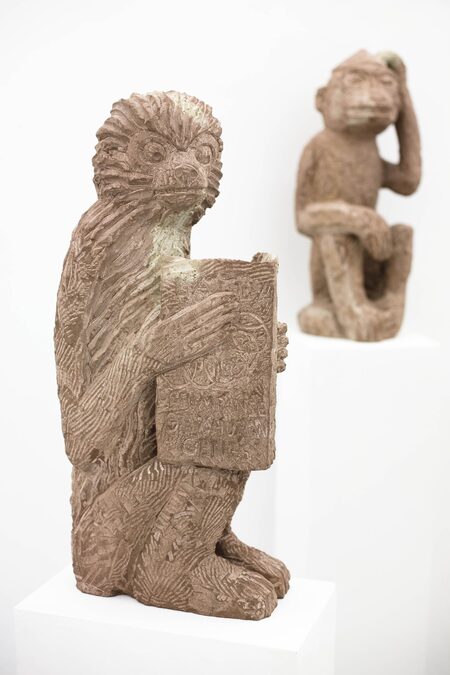
The artistic discourse of the 21st century is marked by an «archaic turn, ” expressed through a rejection of post-industrial simulacra and total digitization in favor of tactile, primary mediums: stone, wood, fired clay, coarse textiles, and organic materials. The research problem lies in analyzing the use of pre-literate visual codes employed by contemporary artists to counter the dematerialization in the digital age’s culture. The philosophical lens adopted for this work is the methodology of „new materialism, ” which views physical matter not as a passive substrate, but as a paleontological archive possessing its own memory and complete autonomy.

Contemporary 21st-century artists engage with archaic codes, undertaking a revision that rejects the European mimetic canon, anatomical accuracy, and portraiture’s individualization. Paleolithic art features deliberate distortion of form, enlargement of volumes, monumental frontal posing, and the erasure of personal characteristics. According to Mircea Eliade’s theory, myth reveals absolute sacredness and «becomes a model for emulation in any sufficiently significant manifestation of human activity.»1
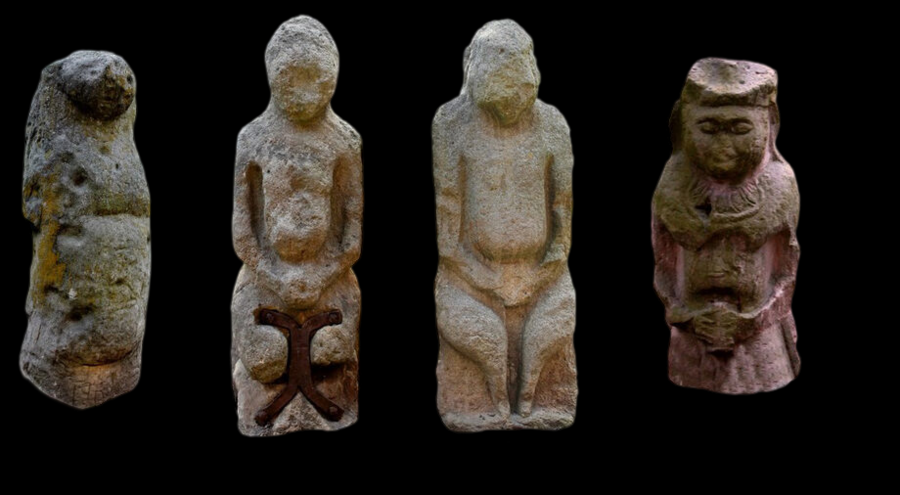
Polovtsian anthropomorphic statues («Polovtsian Women»). 11th–13th centuries. Limestone, sandstone.
Within this logic, primitive anonymity serves as a prerequisite for fixing the ritual function of the idol object, becoming a key strategy for authors who employ direct carving techniques. The open trace of the chisel is the «primary gesture» of form liberation. The contemporary idol asserts the natural weight of the raw material and functions as a tool for returning to a primary, natural form within the dematerialized digital environment.
Evgeniy Antufiev
In the anthropomorphic sculpture «Untitled» (2015), Evgeny Antufyev engages with systemic research and reinterprets the plastic canon of the steppe Polovtsian statues. The artist consciously reproduces the logic of the archaic idol, executing a strategy of total abandonment of academic detail.
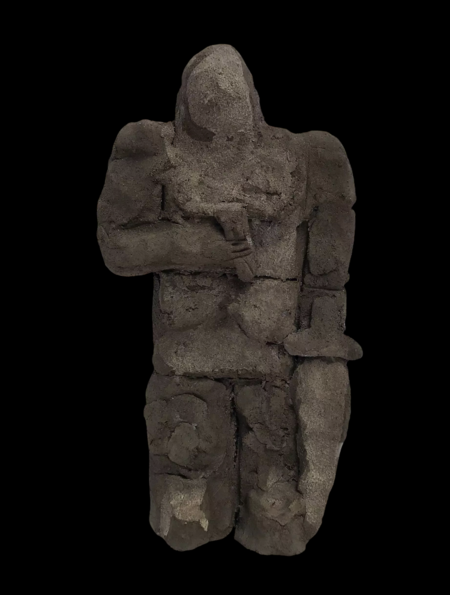
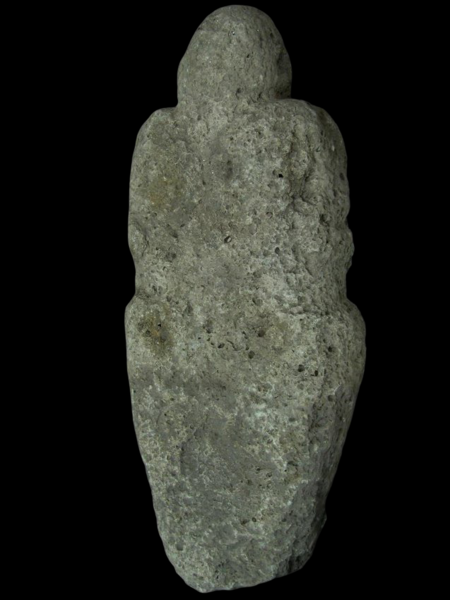
Evgeny Antufyev. Untitled. 2015. Plaster, mixed media. Author’s Collection // Polovtsian Sculpture («Polovtsian Woman»). 11th–13th Centuries. Limestone. GIM, Moscow.
The work is an oversized, monolithic torso featuring an exaggerated shoulder line. The deliberately rough, porous, and «earthy» texture of the mixed-component plaster mimics the physical effects of erosion, creating the illusion of the object having long resided in the earth and recalling the «Polovtsian Grandmother» from the 11th–13th centuries.
In his work, Antufyev recreates the mindset of primitive man not through the reconstruction of archaic forms, but by reproducing their «imperfection» and amorphousness. The character’s face is completely undifferentiated and devoid of individual features, shifting the form from the plane of representing a specific subject to the field of a universal, timeless archetype.
Since myth recounts the deeds of supernatural beings and the manifestation of their power, it serves as a model for emulation whenever human activity demonstrates any significant manifestation.
Stefan Rink
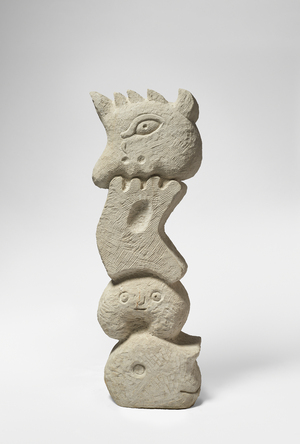
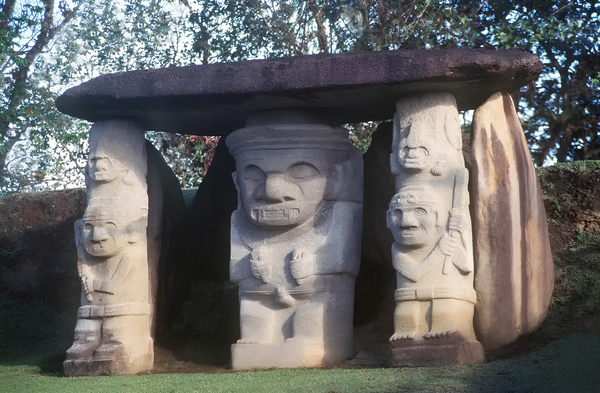
Stefan Rink. Work for the «Sorry we’re Closed» exhibition. 2019. Sandstone. // Sculpture «The Double Man.» 1st–8th centuries AD. Volcanic rock. San Agustín Archaeological Park, Colombia.
In the presented vertical sculptural composition, Stefan Rink directly engages with the architectonics and mythological structure of the archaic totem. The piece is a monolithic vertical axis, its composition assembled by superimposing four grotesque zoomorphic and anthropomorphic heads one upon the other. This canon—the «tiered totem”—traces its origins to the most ancient tribal practices of recording genealogical trees and the hierarchy of ancestral spirits in non-literate cultures.
Yes, the megalithic funerary structure—a tomb in the San Agustin Archaeological Park in Colombia, complete with its anthropomorphic statuary—serves as an archaic reference not only for the composition and form of a contemporary work but also for expressing the ideas of generational change, hierarchy, and memory.
As part of the «new materialism» strategy, organic mediums (natural leather, resin, fabric, threads) are imbued with autonomy. Artists are moving away from sterile industrial surfaces in favor of natural, deconstructing substances. The focus shifts from visual contemplation to a synesthetic, immersive experience—one that reconstructs a primal, sensory environment where the trace of human presence was fixed through the most rudimentary means.
Giuseppe Penone
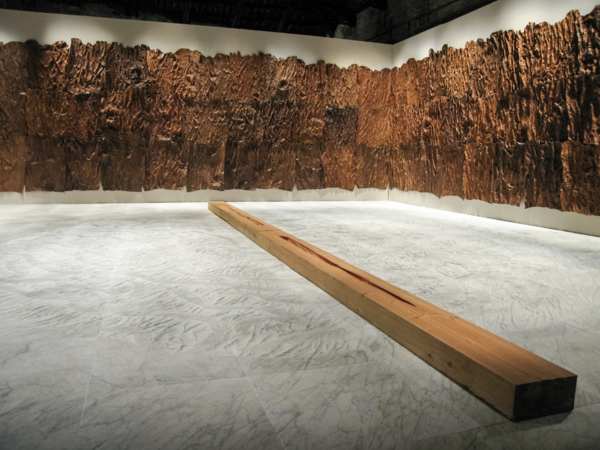
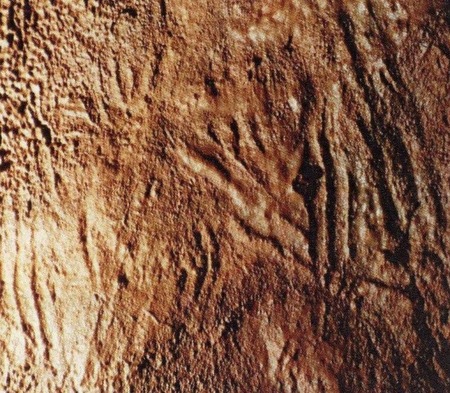
Giuseppe Penone. Sculture di Linfa. 2007. Duplicated leather, marble, wood, resin. Centre Pompidou, Paris // Fingerprints. Paleolithic. Grotte des Potiers de Gaud, France. MPP Archive.
Penone’s total installation transforms the exhibition space into a tactile environment. The walls are entirely draped in animal hide, which has been tightly pressed against tree trunks, replicating their texture and transforming into «bark.» Penone activates mechanisms of sensory perception of the surrounding world—the scent of tanned leather, the stickiness of sap—to allow the viewer to experience the art physiologically, returning the person to the Paleolithic experience of a cave as a single, living organism. In this way, the contemporary work can be compared to a Paleolithic fragment of a wall bearing fingerprints. On a compositional level, the vertical and wave-like rhythms of the tree bark, impressed onto the leather, echo the trajectory of prehistoric fingerprints. This is where the rhyme of tactile contact manifests. Just as early humans asserted their presence in space through direct touching of cave walls, Penone captures nature’s physiological effort through the contact of natural hide and bark. Both images fix a primary, pre-written gesture, where the bodily trace on the material becomes the main method of memory archiving.
Giuseppe Penone. Excerpt from the work Sculture di Linfa. 2007. Dubled leather, marble, wood, resin. Centre Pompidou, Paris
Evgeny Antufyev
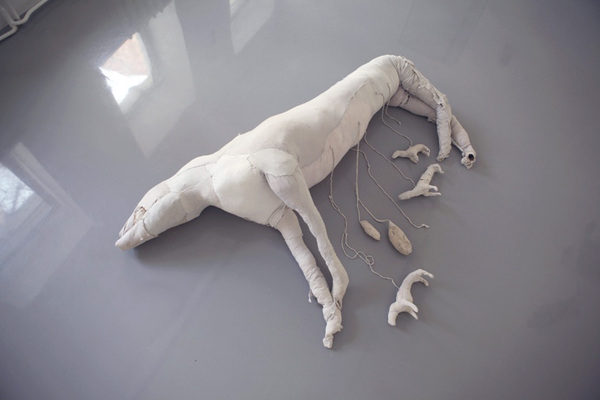
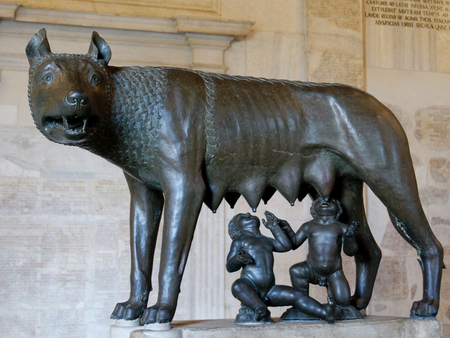
Evgeny Antufyev. Untitled. 2011. Fabric, stuffing, thread. Signa Gallery, Georgia // Capitol Wolf. 5th century BCE. Bronze. Capitoline Museums, Rome.
The textile object mimics the fragmented anatomy of a zoomorphic creature, balancing on the boundary between a biological relic and a ritual charm doll. The key visual technique involves deliberately exposed, rough hand-stitching and thread-umbilical cords extending from the body, connecting the central volume to small, extruded embryonic protrusions. Antufyev rejects monumental rigidity in favor of vulnerable materiality (coarse, light-colored canvas).
At a substantive level, this work engages in a direct conceptual and plastic polemic with the monument of Archaic antiquity—the Capitoline Wolf (Lupa Capitolina). Antufyev performs a deconstruction of the myth of the monumental maternal totem-provider. If the ancient bronze original affirms the idea of unshakeable state power through the rigid, tense frontal posture of the beast, beneath which the figures of twin infants are fixed, the contemporary artist translates this narrative into the plane of biological decay. The pose of the animal weakly lying on its side directly contrasts with the canonical statics of ancient metalwork. The protruding figures of embryos, connected to the mother’s body by delicate threads, replace the rigidly secured figures of Romulus and Remus, shifting the focus from the imperial narrative of power establishment to the vulnerable process of parturition and lineage succession.
The radical collision of mediums—cast bronze and soft canvas material—exposes the seams as markers of the artist’s presence. Through the deformation of a classical zoomorphic silhouette, Antufyev returns the image of the she-wolf to an archaic understanding of the cyclical nature of time, where the decay of the shell becomes the condition for life’s continuation.
Indeed, words are not archeologized, but many «gestures"—that is, the actions of the ritual participants—can be reconstructed to some degree through their material traces.