Navigation Menu
1.0 Concept 1.1 Introduction 1.2 Hypothesis 2.0 The Dualism of the Female Image 2.1 Eve: What burdens the image of the first woman, and to whom is she considered similar? 2.2 Sarah: 2.3 Virsavia: 2.4 Judith: 2.5 Susanna: 3.0 Conclusion 3.1 Confirmation of the Hypothesis 3.2 Summary
1.0 Concept
2.1 Eve: what burdens the image of the first woman and who is she considered similar to?
Many paintings depicting the scene of the Fall of Man feature some quite interesting elements that, one might say, compromise Eve—and not without reason: for it was she who disobeyed God and decided to take the forbidden fruit under the persuasion of the serpent tempter. What are these elements? The answer lies in posture and form.
Eva curves, her hand reaching for the forbidden fruit, and her legs intertwine. Her entire body stretches, as if she herself were the tempting serpent.
Often, concurrent with this artistic gesture, one can observe that the entire silhouette of Eve, or a part of it, such as her arm, is nearly identical in form to the snake’s body, which is also deliberately emphasized in its curves. This is how artists convey this spiritual kinship.
So, is Eve similar to the serpent? Is the feminine principle serpentine, tempting, and sinful?
On one hand, we have the following argument: if Eve was the one who chose to disobey God and eat the forbidden fruit, then she is the «weak link» that leads to sin and emulates the serpent. On the other hand, the serpent itself, even if it embodies the Devil, is often depicted with a female body and head, or with Eve’s specific head. This similarity can be explained by the fact that it was easier for the serpent to gain Eve’s trust, but it also sparks debate over whether the serpent is truly a serpent or if it possesses a feminine nature.
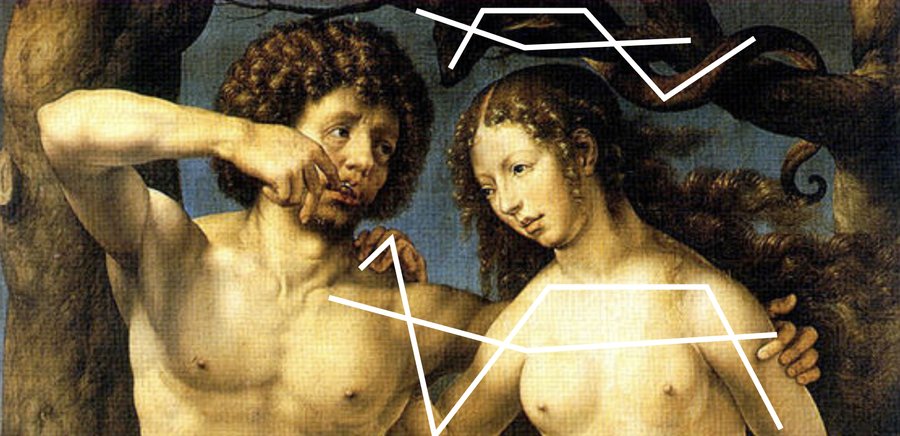
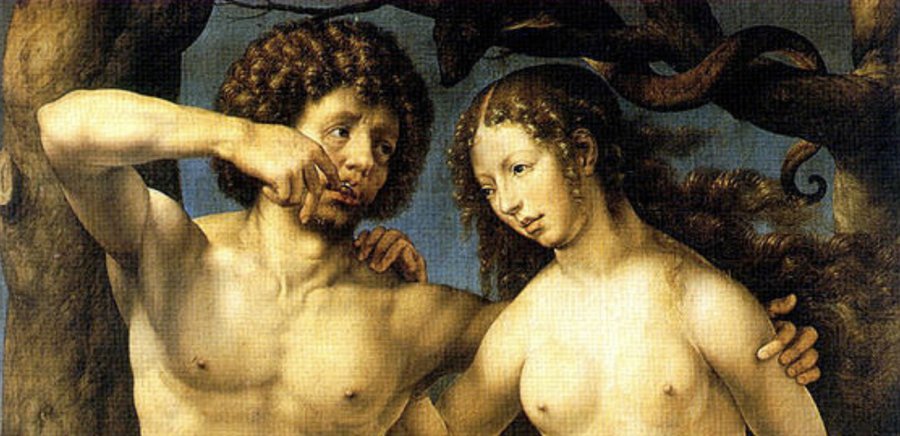
Jan Mabuse Gostart, «Adam and Eve» (excerpt)/curves of Eve’s body around Adam’s arm and the snake’s curves around the tree