Vivian Maier and the Art of Being Unseen
Navigation
1. Introduction: The Photographer Who Almost Goes Unseen
2. Behind the Lens: Vivian Maier’s Life and Photographic Practice
3. The City as a Space for Observation
4. Observing Without Intervening
5. Everyday Life as a Spectacle
6. The Emergence of the Author: A Self-Portrait Without Direct Gaze
7. Reflections: Presence Through the Surface
8. Shadow and Silhouette: The Body in Place of the Face
9. Between Observer and Participant
10. Conclusion: The Art of Being Visible While Remaining Unnoticed
Research Concept
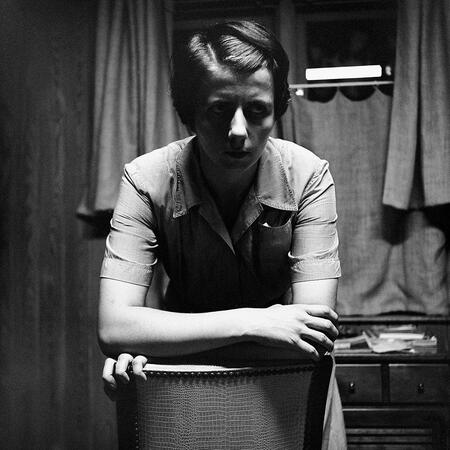
Vivian Maier is one of the most compelling figures in 20th-century American photography. Her photographs draw attention not only to the everyday life of New York and Chicago but also to the photographer’s unique presence. In most of her street photography, Maier remains outside the frame—the camera is directed at strangers, city streets, chance encounters, and isolated episodes of daily life. However, in her work, there is a constant sense of a person observing the events without becoming a direct participant.
This contradiction is precisely what forms the starting point of the research. The focus is not so much on the photographer’s biography as on her visual method of interacting with the surrounding world. Meyer photographs people in moments when they are not posing and, judging by the image, are not paying attention to the camera. She captures their gestures, facial expressions, body posture, and relationship with urban space. Furthermore, the photographic composition does not look like a simple, random occurrence—it shows a precise selection of the moment, careful work with perspective, light, shadow, and the geometry of the urban environment.
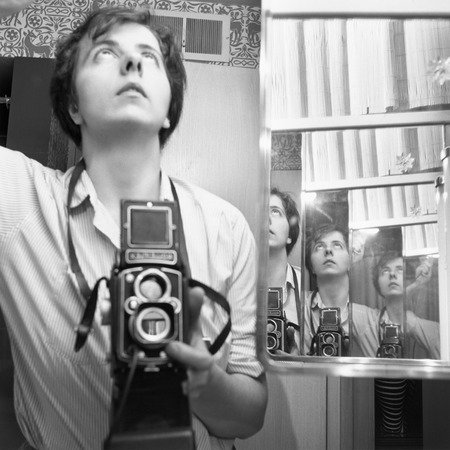
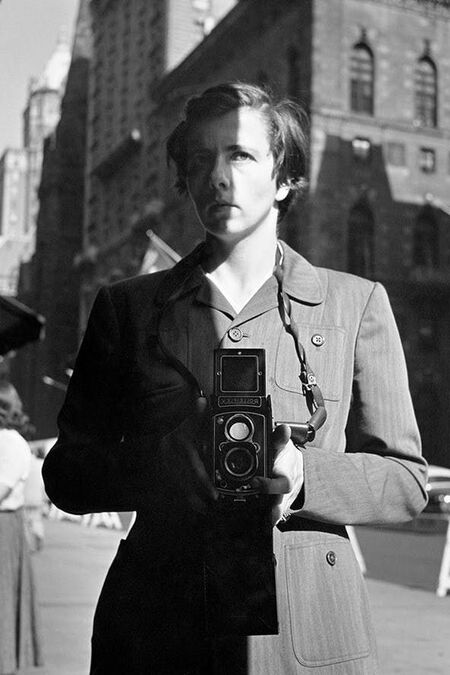
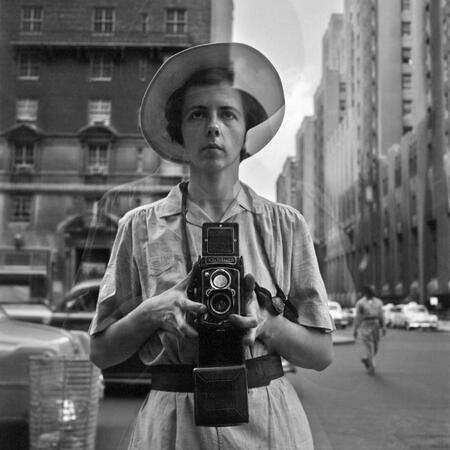
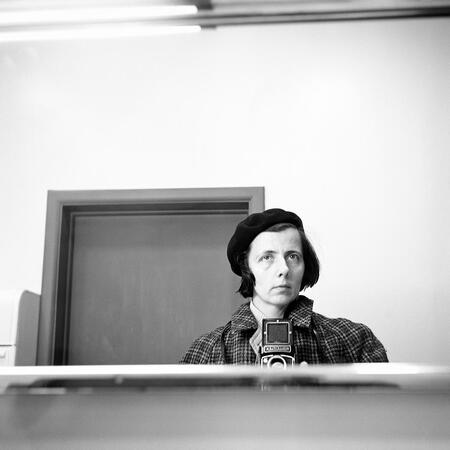
Meyer’s self-portraits are particularly compelling. Unlike traditional portraiture, they often forgo a direct depiction of the face. The photographer appears in mirrors, display windows, glass doors, and other reflective surfaces. At times, instead of a recognizable image, only a shadow or silhouette remains in the frame. In this way, the artist integrates herself into her own photograph while continuing to employ techniques that maintain a distance between the subject and the viewer. These self-portraits do not contrast with street photography; rather, they continue its visual logic: the photographer remains an observer of the surrounding space while simultaneously becoming a part of it.
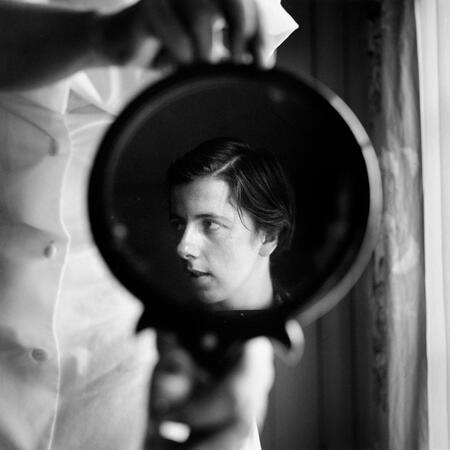
The theme of invisibility in this study is not treated as a psychological trait of Mayer, nor as evidence of an intentional desire to hide. Instead, it is understood as a visual effect stemming from specific photographic decisions. Therefore, the research focuses on how the frame is constructed, how figures and space are distributed within it, how reflections and shadows are utilized, and what role camera placement plays. This approach allows us to avoid biographical speculation and rely primarily on the available visual material.
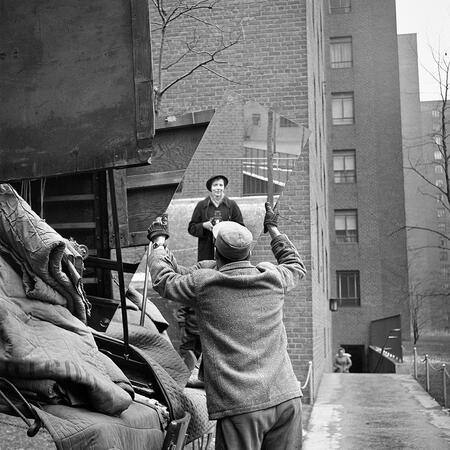
The research material is selected based on several principles. First, street photography is examined, featuring people who do not interact with the camera and continue with their daily routines. Second, images constructed around the distance between the photographer and the subject are analyzed: frames through glass, storefronts, windows, and other architectural boundaries. Third, the study includes self-portraits where Meyer utilizes reflection, shadow, silhouette, or fragmented representations of his own body. A separate group consists of photographs of urban spaces and objects that allow for an examination of how light, architecture, and everyday items become part of the author’s visual language.
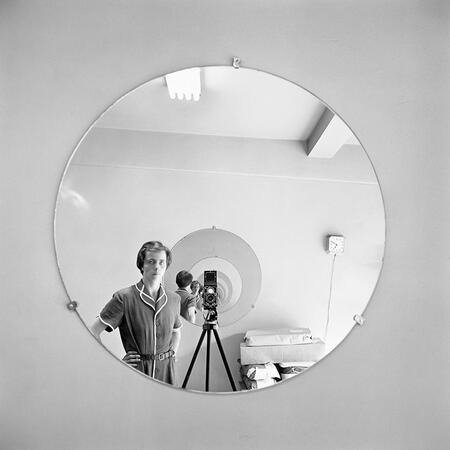
A key requirement for selection is the ability to compare photographs against each other. An individual shot is not viewed in isolation but as part of a broader system of recurring motifs. For example, reflection in a shop window is analyzed not only as a technique for creating a self-portrait but also as an extension of Meyer’s interest in multilayered urban space. Similarly, shadow is considered simultaneously as a formal compositional element and as a means of including the photographer in the frame without direct depiction.The structure of the study is built around the principle of the author’s progressive shift in perspective. The first section is dedicated to the historical context and the characteristics of Meyer’s street photography. The second examines the human subject as the primary object of observation: gestures, faces, daily situations, and the interaction of people with the urban environment. The third section focuses on spatial boundaries—windows, shop windows, glass, and reflections. The study then moves to self-portraits and shadows, in which the photographer becomes a visible part of their own visual world. The concluding section compares different modes of the author’s presence to determine what connects the street photographs and the self-portraits.
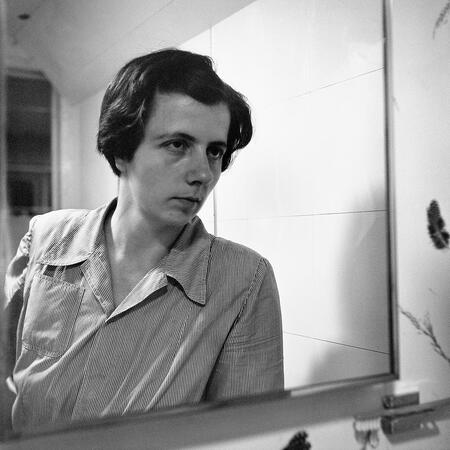
Textual sources are selected based on their reliability and relevance to the research subject. The factual section is anchored by Vivian Meyer’s archive, the collection of the Chicago History Museum, and the research description of the archive at the University of Chicago Library. These materials allow for the refinement of dates, photograph titles, the author’s life circumstances, and the history of her legacy’s formation. Additionally, museum and publishing materials dedicated to Meyer’s self-portraits are utilized. The textual sources do not replace the analysis of the images; rather, they help establish context and verify the information upon which the study is built.
Key Question: How does Vivian Maier create a sense of the photographer’s invisible presence, and why is the act of observing other people’s lives perpetually intertwined with her own self-portrayal in her work?
Hypothesis: Vivian Maier’s visual language is built upon the author’s dual position. In her street photography, she acts as an observer who is near the action yet remains outside the depicted situation. In her self-portraits, the photographer begins to incorporate herself into the urban space, but does so primarily through indirect means—through reflections, shadows, and fragments of her own body. Therefore, her photographs can be viewed as a successive examination of the boundary between presence and absence, observation and participation, the other’s image, and her own reflection.
Behind the Scenes: The Life and Photographic Practice of Vivian Maier
Who is looking at the city?
Vivian Maier. Street photography, Chicago. 1950s–1960s.
In Meyer’s photographs, the city often appears as a self-contained stage upon which new characters continually appear. People pass by the camera, converse, wait for transportation, stroll, and accidentally intersect with one another. Meanwhile, the photographer almost always remains outside the frame. This study addresses the question of how this absent figure continues to be felt within the frame.
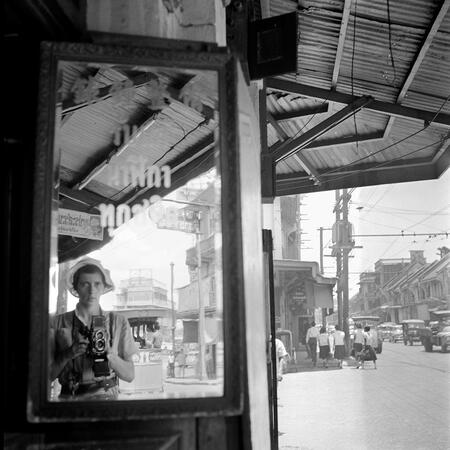
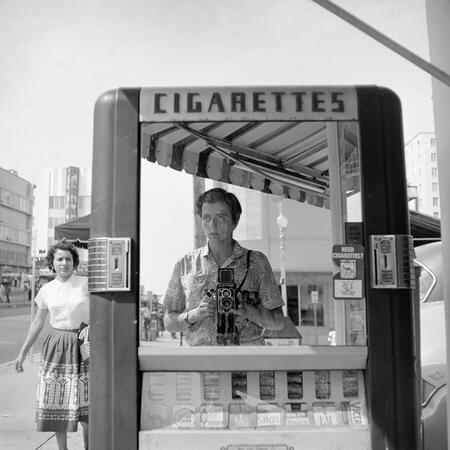
1957. Self-Portrait 1959. Self-Portrait in Bangkok, Thailand, June 15
Vivian Maier (1926–2009) was born in New York. For most of her life, she worked as a nanny and pursued photography in her spare time. Her photographs were never exhibited to the general public during her lifetime. A significant portion of her archive gained notoriety after the photos were discovered at a storage unit auction in 2007. Maier’s story is unusual not only because of the sheer scale of the recovered archive but also because of the vast gap between her private practice of photography and her subsequent public recognition.
Vivian Mayer Archive. Negatives, photographic materials, and film. 1950s–1990s.
The Mayer Archive contains over 100,000 negatives, in addition to film, audio recordings, printed materials, and personal belongings. A significant portion of the photographs was never printed or shown to the public during the author’s lifetime. This circumstance allows one to view their work as a sustained private practice, where the very process of observing and documenting the world existed independently of any future viewer.
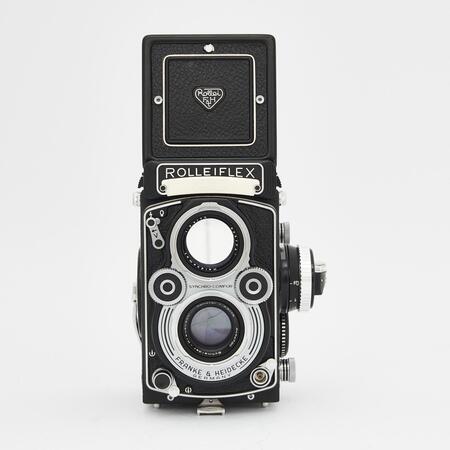
In 1952, Meyer acquired a Rolleiflex camera. Its twin-lens design allowed the photographer to view the image through a viewfinder positioned above, rather than raising the camera directly to the eyes. This technical detail is important for understanding her photographic practice: the camera’s positioning allowed her to shoot from chest or waist level. However, the camera’s design itself does not prove the photographer’s intent to remain unnoticed—it merely provides additional context for analyzing the distance between the camera and the subjects.
Rolleiflex—the camera Vivian Meyer used. 1950s.
The City as a Space of Observation
In 1951, Meyer returned to New York, where she continued her work in photography. The city streets became the space in which her visual language was formed. In these photographs, the mundane does not become staged; people remain engaged in their own lives, and the photographer selects the moment when individual figures, gestures, and details compose an expressive image.
Vivian Maier. Street Photography, New York. 1950s.
In 1956, Meier moved to Chicago, where she spent the majority of her life. The city became the central space for her photographic practice. Her Chicago images capture not only individual people but also transformations in the urban environment—streets, buildings, storefronts, transportation, and residents' daily routes. Here, photography functions simultaneously as observation of the individual and as a visual document of urban history.
Vivian Maier. Pedestrians on Clark Street. c. 1956–1962.