The first Labor Day in New York almost went without music. Spectators had already taken their seats near the City Hall, the police were ready to escort the procession, and the organizer, William McKeybo, nearly had nowhere to lead the parade onto Broadway. The situation was saved by jewelers from Newark. They crossed the river with the orchestra. It was Tuesday, September 5, 1882. The first Monday of September would not receive the status of a federal holiday for another twelve years.
How a Column Forms
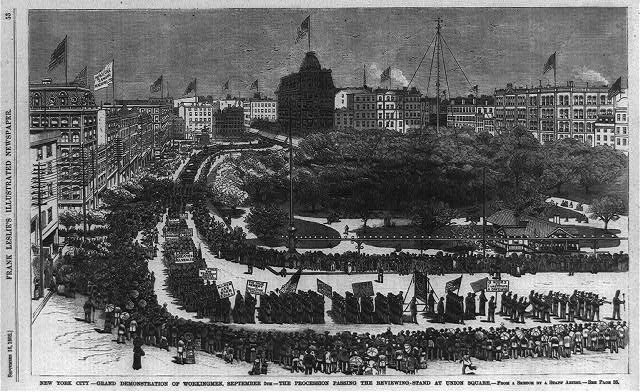
When jewelers headed to Broadway, musicians were playing a tune from the Gilbert and Sullivan comic opera «Patience.» McCabe and his assistants trailed behind them. People who had come to watch began joining the marchers. This transition is especially noticeable in a story from that morning preserved by the U.S. Department of Labor. Just a minute ago, the procession seemed short of participants, but now the boundary between spectator and demonstrator could be crossed with a single step from the sidewalk.Frank Leslie’s illustrated newspaper preserved another moment from that day. The artist looks down upon Union Square. The column circles the square and passes by the tribune. At the bottom of the page, the spectators are visible almost from behind. In the depth of the drawing, they blend into a dark band. Among the participants, flags of various organizations are clearly distinguishable. This allowed the city to see two things at once—a multitude of different professions and their ability to march in unison.
Workers also planned the latter half of the day
The New York Central Labor Union, which brought together various trade unions, organized the march. The program intentionally combined the public procession with leisure time for workers and their families. This detail explains why the holiday’s history features two completely different settings. The parade was held on the streets of Lower Manhattan. To attend the picnic, attendees had to travel to Wending Park, near Ninth Avenue and 92nd Street.At noon, the column concluded its route at Reservoir Park. Afterward, people chose different ways to spend the day. Some returned to work, while others headed to the picnic, where even union representatives who had missed the march traveled. Celebrating on a workday Tuesday still required individual initiative. If the First Labor Day were only remembered for the image of the parade, it would be easy to imagine a city-wide holiday. The story of people who had to go back to work after the parade restores the true meaning of the word «first.»
Two Contenders for the Same Idea
When asked who invented Labor Day, the American Department of Labor provides two answers. The first candidate is Peter McGuire, a figure from the Carpenters and Joiners Union. He is credited with proposing a special day to honor workers. The second is Matthew Maguire, a machinist and secretary of the New York Central Labor Union. Even in English, their last names differ by only a few letters. Both participated in the first parade.Matthew has a rather unusual piece of evidence supporting him. When the president signed the holiday act, a Paterson newspaper suggested awarding a commemorative pen to the local resident Maguire. The article’s author considered him the holiday’s originator. This is a good document showing who was remembered in Paterson, although it is not sufficient to definitively settle the dispute. What is known, however, is which organization succeeded in gathering people again. A year later, on September 5, 1883, the Central Labor Union held the second celebration.From a Date in the Program to the Day of the Week
Initially, cities recognized the holiday. Then, the process reached the states. New York was the first to propose the corresponding bill, but Oregon was the first to pass the law on February 21, 1887. In the same year, Colorado, Massachusetts, New Jersey, and New York itself joined in. Therefore, Labor Day has several different «first» locations. For the street parade, it’s Manhattan; for the state law, it’s Oregon.The federal decision was reached in June. The bill was introduced by Senator James Henderson Kyle of South Dakota. Congressional documents retain the bill number, S. 730, and the introduction date—June 22. There were only six days between this date and the president’s signature. If one traces the history of the holiday through legislative documents, it appears surprisingly brief. To grasp the speed of the resolution, one should recall how many cities and states had already accomplished the same task in their own jurisdictions by that time.
President Grover Cleveland signed the federal law on June 28, 1894. On page 96 of the Congressional laws session, Chapter 118 is easily located. It contains only one substantive sentence. Legislators designated the first Monday in September and placed it alongside other recognized holidays, including Christmas and Independence Day. There is a remarkable detail in the wording—the law refers to a day that people were already observing.
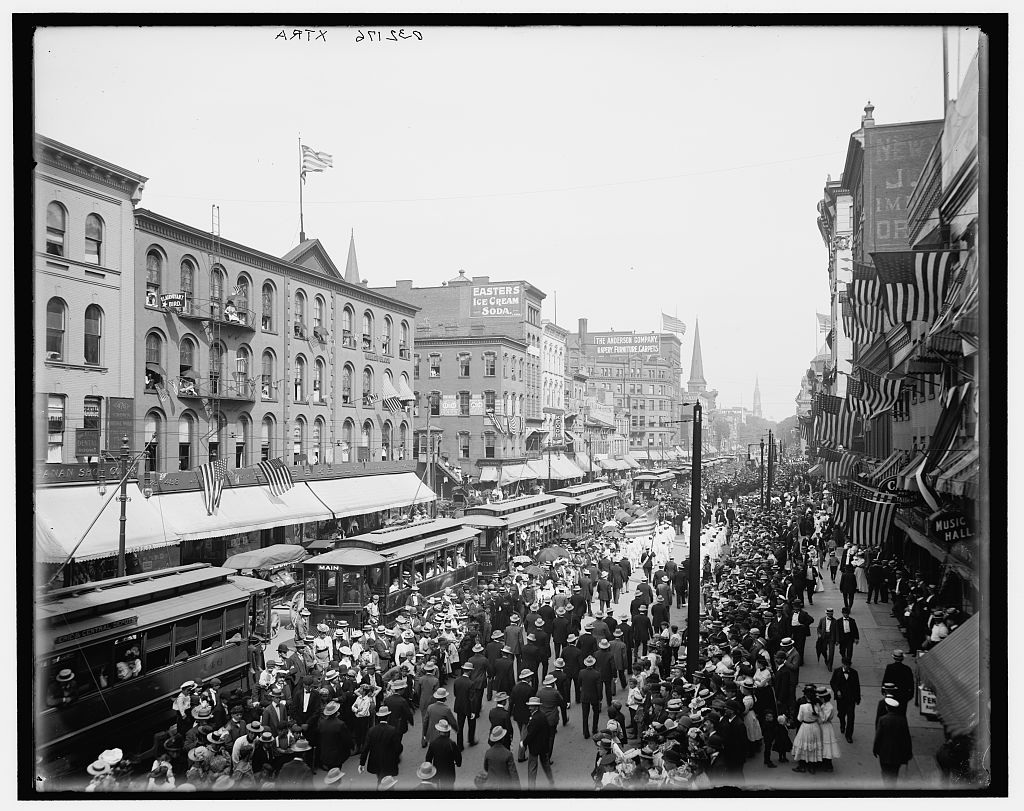
The photograph from Buffalo, taken between 1895 and 1910, shows the procession taking up Main Street. Store awnings stretch over the spectators, and flags hang from the facades. The snapshot is separated from the first parade by years and the journey from New York to another city. But the street scene is recognizable—a column in the center, a crowd on the sides. The calendar established Monday, while the custom itself is owed by Americans to the people who once took to the streets on an ordinary Tuesday.
Sources
U.S. Department of Labor — History of Labor DayU.S. Department of Labor — Memories of the First Parade
Library of Congress — Illustration of the Parade at Union Square, 1882
U.S. Congress — Act of June 28, 1894, Title 118
Library of Congress — Parade on Main Street in Buffalo
GovInfo — Bill S. 730 and its Passage