Navigator
1) Concept 2) Chapter 1 3) Chapter 2 4) Chapter 3 5) Conclusion 6) Bibliography (text and images)
Concept
Chapter 1. Introduction to Ancient Egyptian Mythology
For the inhabitant of Ancient Egypt, the gods were everywhere: in the rays of Ra banishing the night’s darkness, in the Nile floods granting fertility, and in the concepts surrounding the human journey to the afterlife. Unfathomable yet intimately present, majestic yet benevolent, these deities formed the foundation of the ancient Egyptian worldview. Ancient Egyptian mythology lacked a single, unified system of belief. Different cities possessed their own distinct understandings of creation, the origin of the gods, and the structure of the universe. One well-known version of the cosmogonic myth was the Hermopolitan version, centered on the Ogdoad—a group of eight primordial deities.
They embodied the original state of the Universe before the emergence of an ordered world:
Nun and Nuunet—the primordial waters from which life arose.
Huh and Hauchet—infinity and boundlessness.
Kuk and Kauket—primordial darkness.
Amun and Amaunet—the hidden, unknowable nature of the original world.
The Ogdoad deities were grouped into four pairs, consisting of male and female deities. They were symbolically depicted as aquatic creatures: men with frog heads, and women with snake heads.
According to myth, the interaction of these eight deities led to the emergence of a primordial mound, from which the sun rose, illuminating the world. Thus, the ancient Egyptians viewed the creation of the world as a transition from chaos to an ordered universe. Furthermore, different religious centers held their own versions of this event. Within this study, I will focus on the most well-known and revered deities whose imagery frequently appears on ancient Egyptian reliefs, frescoes, and other works of art.
Chapter 2. The Images of the Gods and Their Significance to the People of Ancient Egypt
Ra—the god of the sun and creator of the world
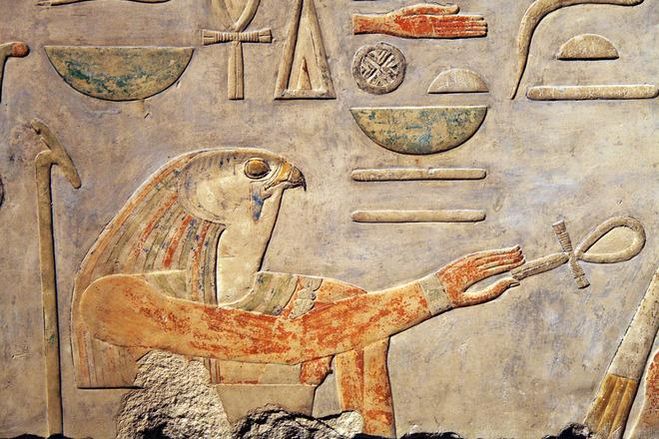
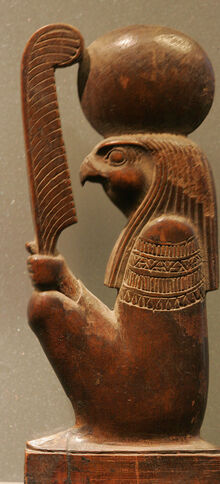
The relief dates to the beginning of the Twelfth Dynasty, the Middle Kingdom period. The fragment depicts a relief composition featuring the god Ra. This is a lintel—the transom above a doorway. Material: Limestone with polychrome painting. A statuette of the god Ra, made of wood, dates to the Late Period (7th–4th centuries BCE) or the Ptolemaic period (4th–1st centuries BCE).
Ra was one of the principal deities in the ancient Egyptian pantheon, personifying the sun, light, vital energy, and the cosmic order. His cult began to gain special significance during the Old Kingdom. The priesthood of Ra exerted particularly strong influence during the 4th and 5th Dynasties. Pharaohs emphasized their connection to this deity, calling themselves his sons. Some rulers even incorporated Ra’s name into their personal names: Djedefre, Khafre, and Menkaure. Heliopolis was one of the most important religious centers for the worship of Ra.
External Appearance and Symbolism Ra was most often depicted as a man with a falcon’s head, above which rested a sun disc encircled by a cobra—the uraeus. Each element of his depiction held a specific meaning: The falcon’s head symbolized the deity’s celestial nature, power, and connection to the sun. The sun disc embodied light, warmth, and vital energy. The uraeus (cobra) symbolized royal authority and divine protection. In some images, Ra holds the ankh—a symbol of life—as well as a staff signifying power.
To understand the image of Ra, it is also important to mention another deity—Atum. Atum was considered one of the most ancient creator gods and was especially revered in Heliopolis. He personified the completion of the solar cycle and was often associated with the setting sun. Atum was predominantly depicted in human form, usually wearing the double crown of Egypt, which symbolized the unification of Upper and Lower Egypt. Over time, the concepts of these deities converged, giving rise to the image of Atum-Ra, which combined the symbology of the sun god and the creator of the world. Thus, Ra personified not just the sun, but the constant renewal of life, the maintenance of cosmic order, and the victory of light over darkness.
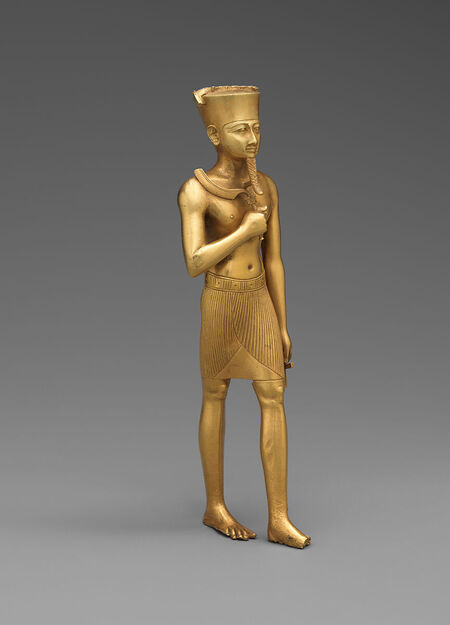
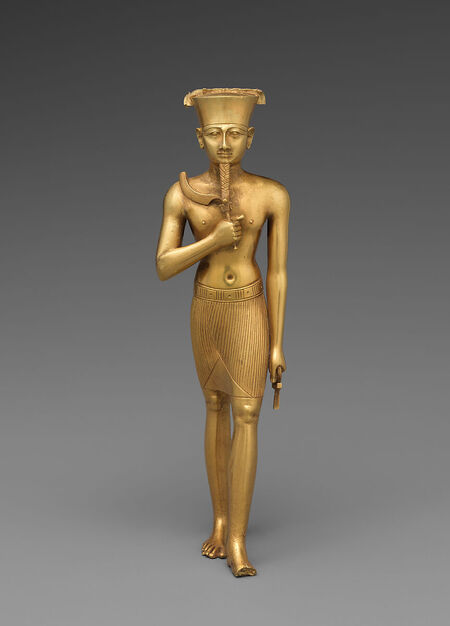
Statue of the god Amun Third Intermediate Period, 22nd Dynasty c. 945–712 BCE Gold Dimensions: 17,5×4,7×5.8 cm
Osiris—god of the underworld and rebirth
Osiris was one of the most revered deities in the ancient Egyptian pantheon. He was considered the ruler of the underworld, the judge of the dead, and a symbol of rebirth. According to mythology, Osiris was the son of the gods Geb and Nut, the brother and husband of Isis, and the father of Horus. Interestingly, the name Osiris did not become widely recognized immediately. Some of the earliest evidence of his veneration dates back to the end of the Fifth Dynasty. Furthermore, the symbols later associated with Osiris and Isis appeared on Egyptian monuments significantly earlier.
According to myth, Osiris was the first pharaoh of Egypt. He taught people agriculture and crafts, bringing them knowledge and establishing order.
However, his brother Set, envious of his power, killed Osiris and dismembered his body.
Isis, Osiris’s wife, along with Anubis, gathered the god’s remains and reassembled his body, creating the first mummy. Thanks to Isis’s magic, she was able to temporarily bring Osiris back to life and conceive their son, Horus.
After this, Osiris became the ruler of the underworld and the judge of the dead.
This is why his image acquired such profound meaning for the Egyptians: he symbolized the possibility of resurrection after death.
Osiris was most often depicted with green or black skin. These colors held deep symbolic meaning: Green symbolized rebirth, vegetation, and the renewal of life. It was associated with grain sprouting after a period of drought. Black symbolized fertility and the richness of the earth. The Egyptians called their country Kemet—"Black Land"—linking this name to the fertile silt of the Nile. Thus, even though Osiris was the god of the dead, he was portrayed using colors that symbolized life and renewal.
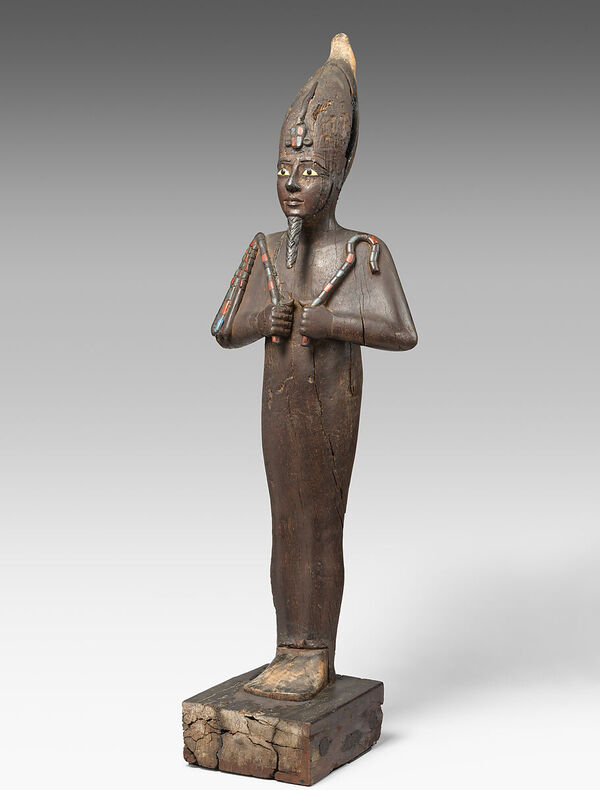
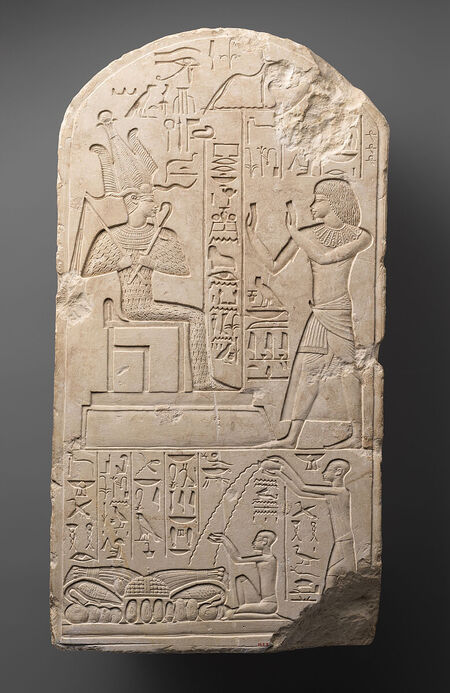
Title: Statue of Osiris, Ruler of Eternity Period: Third Intermediate Period Date: 945–721 BCE Geography: From Egypt Medium: Wood, jasper, obsidian, bone, chlorite, Egyptian blue, possibly modern glass and blue inlays Dimensions: H. 108 × W. 33 × D. 30.5 cm, 13.2 kg (42 ½ × 13 × 12 inches, 29 pounds) Title: Stele of Senus, worshipping Osiris Period: New Kingdom Dynasty
Osiris’s Attributes The Heka Staff—a shepherd’s crook symbolizing royal authority and the ability to govern the people. The Nekhakha Chain—an object resembling a whip. It also represented the Pharaoh’s power and was sometimes associated with agriculture and fertility. The Atef Crown—a tall crown flanked by two ostrich feathers, emphasizing Osiris’s royal status. The Djed Pillar—one of the god’s primary symbols, personifying stability, strength, and rebirth.
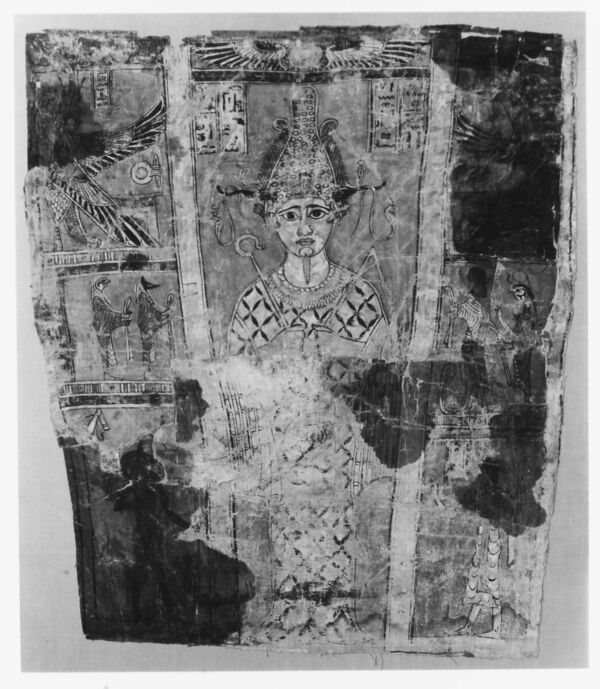
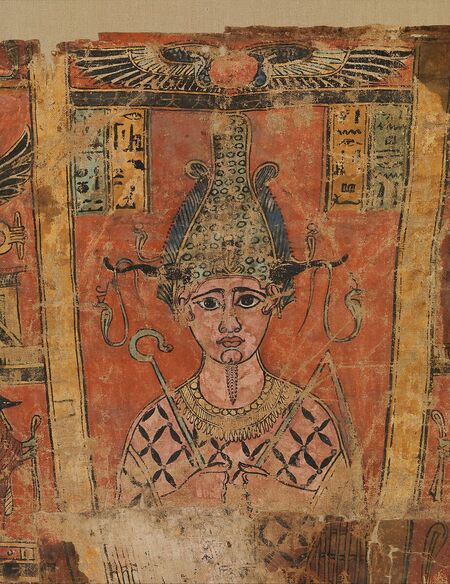
Title: Osiris Shroud Period: Roman Period Date: c. 125 CE Geography: From Egypt Material: Linen, pigments Dimensions: 98 × 82 cm (38 9/16 × 32 5/16 inches), in frame: 106,7 × 90,8 × 4.1 cm (42 × 35 ¾ × 15/8 inches)
Pose and Iconography
Osiris was typically depicted as a mummified figure, standing or seated on a throne. His body was wrapped in white burial linens from which arms holding a staff and a crook protruded.
This imagery is directly linked to the myth of his death and subsequent resurrection.
The mummy’s posture emphasized that Osiris had undergone earthly death and become the eternal ruler of the underworld.
Furthermore, there was a specific connection between the image of Osiris and the pharaohs: the living ruler was associated with Horus, while the deceased was associated with Osiris.
Thus, the image of Osiris can be interpreted as a symbol of life’s triumph over death. He died like a seed buried in the earth, but he was resurrected to become the lord of eternity.
Isis—goddess of magic, motherhood, and protection
Isis is one of the most revered goddesses of Ancient Egypt. She was the consort of Osiris and the mother of Horus, and was also regarded as a great sorceress, patron of motherhood, healing, and protection. According to myth, it was Isis who gathered Osiris’s remains, restored his body, and helped him gain new life. After the birth of her son Horus, she hid him in the swamps of the Nile Delta, protecting him from Set. Furthermore, Isis was reputed to have the ability to discern the secret names of the gods, which symbolized her exceptional magical power.
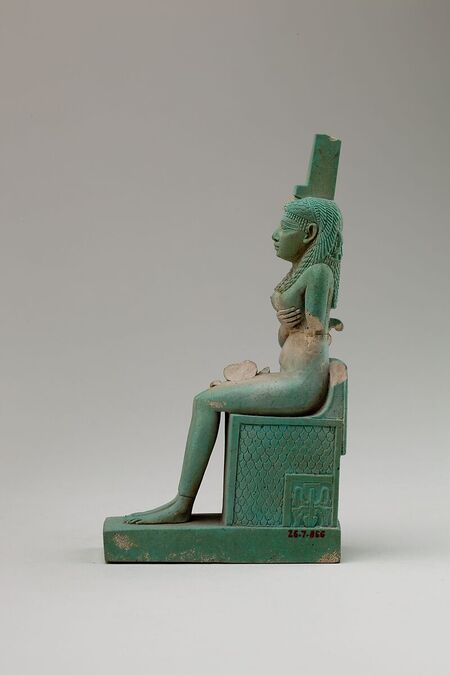
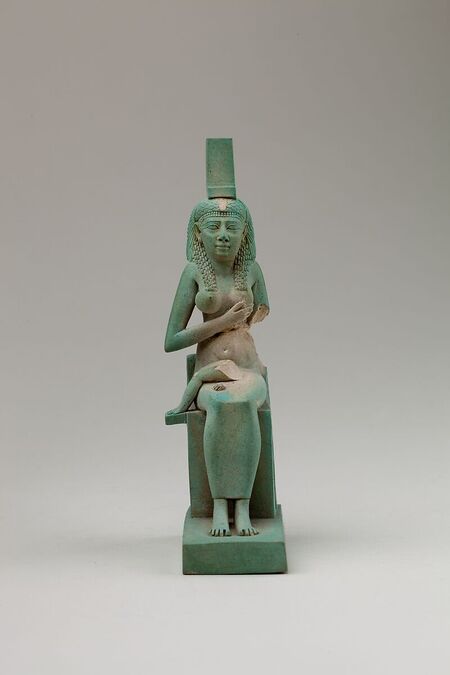
Title: Statue of Isis and the Mountain Period: Late Period–Ptolemaic Period Date: 400–200 BCE Geography: From Egypt; Likely from the Memphite region, Memphis (Mit Rahina) Material: Blue faience Dimensions: H. 12,9 × W. 3,7 × D. 7.2 cm (5 1/16 × 17/16 × 2 13/16 inches)
The most recognizable symbol of Isis was the throne depicted on her head. This sign simultaneously served as the hieroglyphic representation of her name—Isiset. Later, especially during the New Kingdom, headwear in Isis’s depictions began to incorporate cow horns with a sun disk between them. This development occurred due to the association of her image with the goddess Hathor. Each of these elements held its own meaning: The throne—a symbol of royal authority and Isis’s status as the mother of the heir to the throne. The cow horns—a symbol of motherhood and fertility. The sun disk—a connection to celestial powers and the solar deity. Isis’s Attributes The Ankh—a symbol of life and immortality. The Papyrus Staff—a symbol of prosperity and renewal. The Sistrum and Menat—musical and ritual objects associated with the cult of Hathor. The Tiet, or Isis Knot—a protective amulet often crafted from red stones. It symbolized the goddess’s protection, well-being, and magical power.
One of the most famous depictions of Isis is the woman with large, spread wings. This image is connected to the myth of Osiris’s resurrection. According to legend, Isis transformed into a bird and spread her wings over her husband’s body, protecting him and restoring his vital energy. Therefore, in funerary art, her wings symbolized the protection of the deceased and aid in the journey to the afterlife. There were also other common depictions of the goddess: Isis the Mourner—she was shown kneeling or leaning over the deceased Osiris. This image symbolized sorrow and devotion. Isis with infant Horus—the goddess was depicted nursing her son. This motif emphasized maternal care and protection. Later, the image of Isis with infant Horus became an important artistic motif and is often analyzed by researchers in comparison to Christian iconography of the Madonna and Child. Thus, Isis embodied maternal love, magical power, and protection. Her image was particularly significant to the Egyptians because it was linked to concepts of family, life, and post-mortem rebirth.