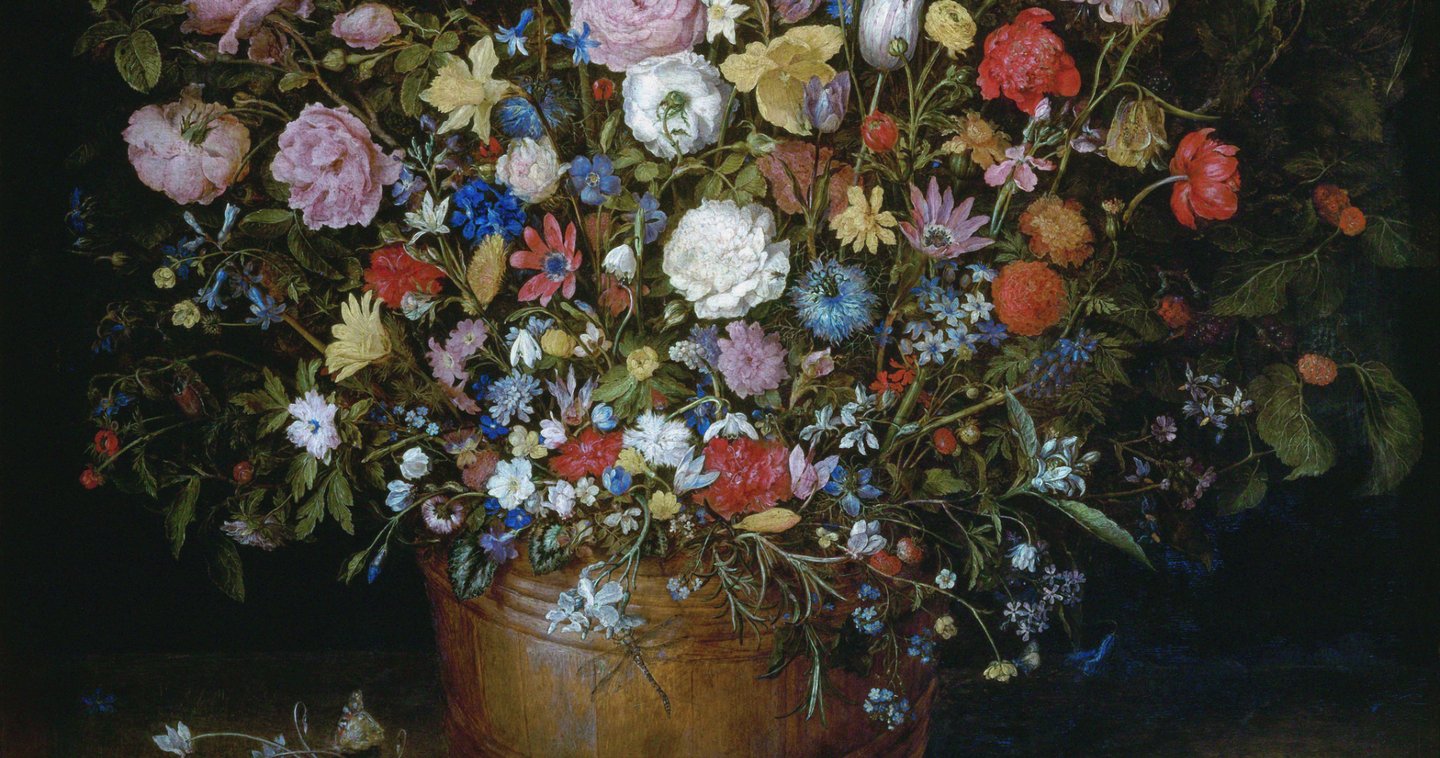
Образ цветов в голландской живописи XVII века
Topic Rationale
The seventeenth century was a period of economic and cultural flourishing in the Netherlands, known as the «Dutch Golden Age.» The development of international trade fueled the society’s economic rise and expanded the market for works of art. Private collectors and wealthy segments of the population became patrons and buyers of painting, which influenced the development of artistic genres such as portraiture, landscape, genre scenes, and still life.
Flowers held a special place in Dutch painting during this period. Interest in botany, the expansion of international trade, and the rise of collecting contributed to the appearance of works where artists strived to convey the diversity of the natural world and the complexity of floral arrangements. Flowers were depicted not only in still lifes, where they were the compositional centerpiece, but also became part of genre scenes and portraits, serving as a decorative element that complemented the overall picture.
Floral compositions frequently acquired deeper meaning, reflecting the era’s cultural, aesthetic, and moral values. The choice of specific plants, their combination, placement, and interaction with other objects could allude to beauty, wealth, purity, love, and so forth. Thus, the depiction of flowers became not just a way to convey natural diversity, but also a means of expressing ideas that extended beyond the immediate rendering of nature.
Beyond its symbolic content, the depiction of flowers provided artists with the opportunity to showcase the variety of painting techniques and mastery in rendering natural forms. Particular attention was paid to the detail of petals, subtle color gradations, the transparency of glass vessels, the reflection of light, and the interaction of plants with their surrounding space.
One of the crucial contexts for interpreting flowers in seventeenth-century Dutch painting is the tradition of Vanitas (from the Latin Vanitas—futility, vanity), which prompts the viewer to contemplate the transience of life and the impermanence of earthly goods. Withered flowers could serve as a reminder of the temporary nature of beauty and the inevitability of death. In some works, this meaning was amplified by the presence of other symbolic objects, such as skulls, clocks, and candles.
Thus, this study aims to examine the role of color in 17th-century Dutch art—its symbolism, as well as the methods of its depiction and interaction with other elements of the composition. Special attention is given to how the meaning of floral motifs changes depending on their placement within a work: from an independent object in the image to an element within a more complex artistic and philosophical narrative.
The key question
What role did flowers play in 17th-century Dutch art, and how did their artistic and symbolic meaning change depending on the context of the image?
Hypothesis
It is suggested that in 17th-century Dutch art, flowers served not only a decorative and aesthetic function but also acted as an important medium for artistic and symbolic expression. Their meaning was determined by the symbolism of the flowers themselves, their placement within the composition, and their interaction with other elements of the work. Depending on this, flowers could function as independent objects of appreciation for natural beauty, acquire philosophical depth within the context of Vanitas, or complement a more complex artistic narrative as a symbolic and compositional element.
Table of Contents
01. Floral Bouquet as a Compositional Center The beauty, variety, and symbolism of flowers 1.1. The Impossible Bouquet 1.2. Flower Symbolism 1.3. Tulip Mania 02. Flowers in the Context of Vanitas Waning and the ephemerality of time 2.1. Flowers and Animals: The Fragility of Life 2.2. Flowers and Fruits: Abundance and Transience 2.3. Flowers and Symbolic Objects: Time, Death, and the Frailty of Existence 03. Flowers as a Secondary Compositional Element Flowers in Portraits and Domestic Scenes 3.1. Flowers in Portraiture 3.2. Flowers in Genre Painting 04. Conclusion
01. Floral Bouquet as the Centerpiece of the Composition
Красота, разнообразие и символика цветов
1.1. Impossible Bouquet
Impossible bouquets in 17th-century Dutch painting represented more than just realistic depictions of flowers; they were meticulously constructed, idealized compositions. By combining plants from different seasons and regions, artists demonstrated their mastery, knowledge of botany, the richness of the natural world, and art’s capacity to preserve beauty unattainable in real life.
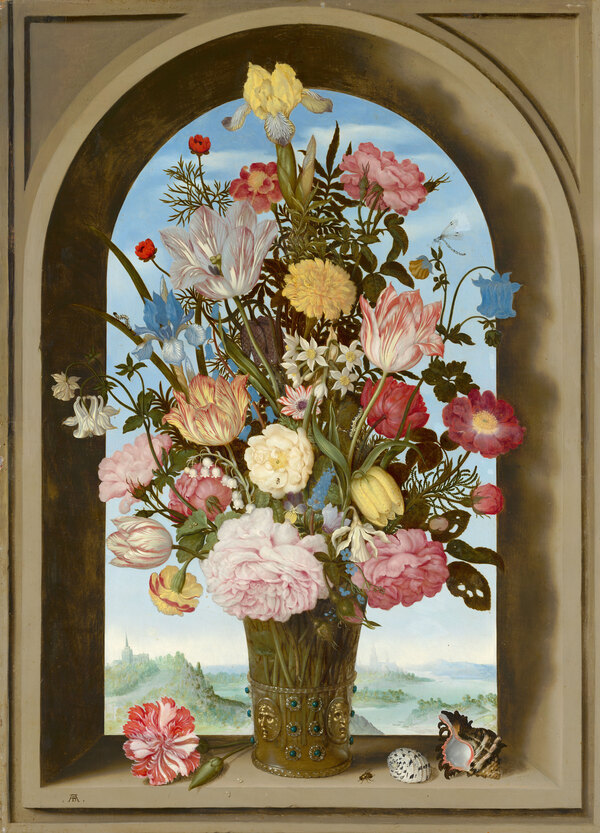
Ambrose Boschart Sr. «Vase of Flowers by the Window» (c. 1618)
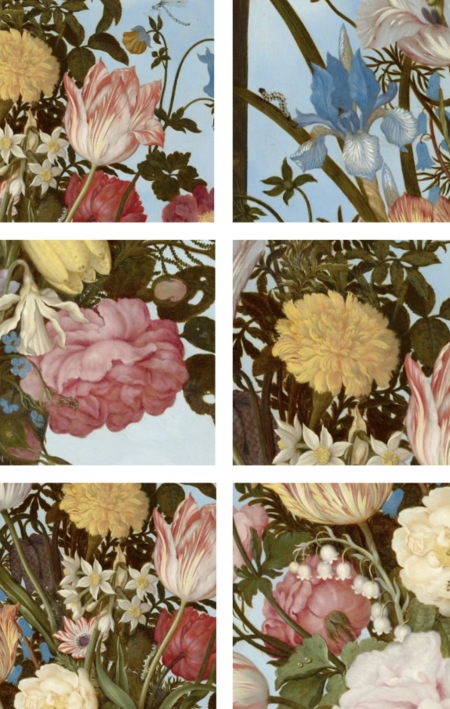
Let’s take a look at several flower types and consider their blooming seasons: — Tulip: March–May; — Iris: May–June; — Rose: Primarily summer; — Carnation: Primarily summer; — Narcissus: February–May; — Lily of the Valley: May–June.
The Mauritshuis catalog demonstrates that Ambrosius Bosschaert the Elder creates an idealized floral composition, uniting nearly thirty varieties of plants that bloom at different times of the year in nature. The artist composed the bouquet based on individual sketches made throughout the year, allowing him to combine flowers in a single work that would be impossible to see simultaneously in a real bouquet. Thus, the composition is not an exact depiction of an existing bouquet, but an artistic embodiment of ideal natural diversity.
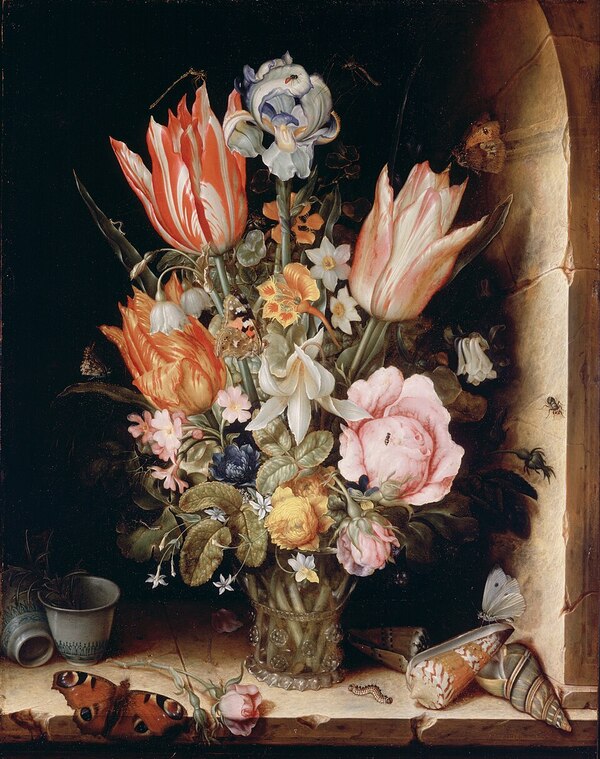
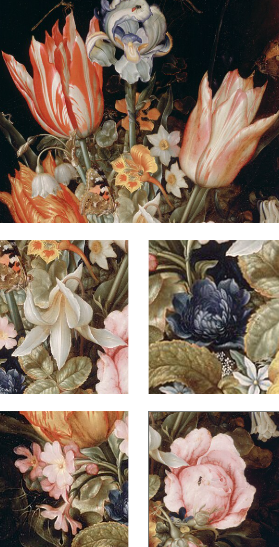
Christoffel van den Bergh. «Still Life with Flowers in a Vase» (1617)
Van den Berge also creates a so-called «impossible» bouquet: it features flowers that naturally bloom at different times of the year, a fact confirmed by the Philadelphia Museum of Art catalog. In this way, the artist creates a perfect composition that surpasses nature’s natural diversity. It is particularly interesting that the flowers are evenly illuminated, allowing each one to retain its distinct expressive quality and become part of a unified floral ensemble.
Let’s look at the blooming period for some flower varieties: — Striped tulip: March–May — Iris: May–June — White lily (presumed): Summer — Narcissus (presumed): February–May — Rose: Primarily Summer — Honeysuckle (presumed): Late Spring–Summer
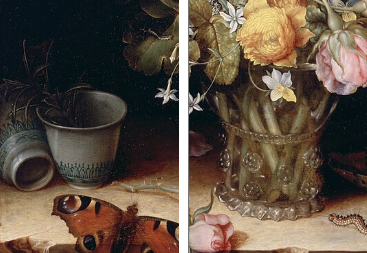
In this piece, besides the colors, note the following: — two small cups next to the floral arrangement. They were likely imported from the East, reflecting European interest in Eastern objects. — a glass vase, which demonstrates that in 17th-century floral still lifes, artists' attention was not limited to the plants but also extended to the objects within which they were depicted. The artist uses glass as an opportunity to showcase their mastery in rendering transparency, reflections, and complex surfaces.
1.2. Color Symbolism
In 17th-century Dutch painting, flowers were often imbued with symbolic meaning that extended beyond their natural beauty. This subsection examines the symbolism of individual plants and its reflection in 17th-century Dutch floral still lifes.
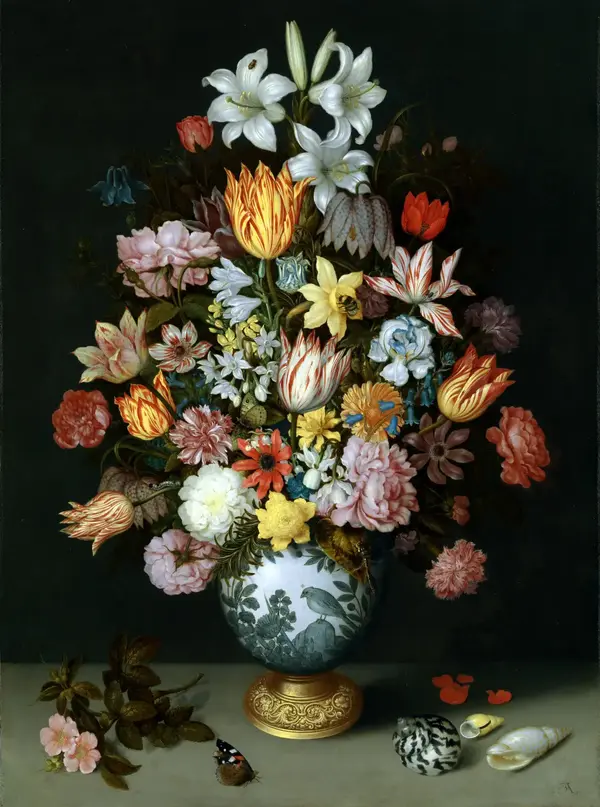
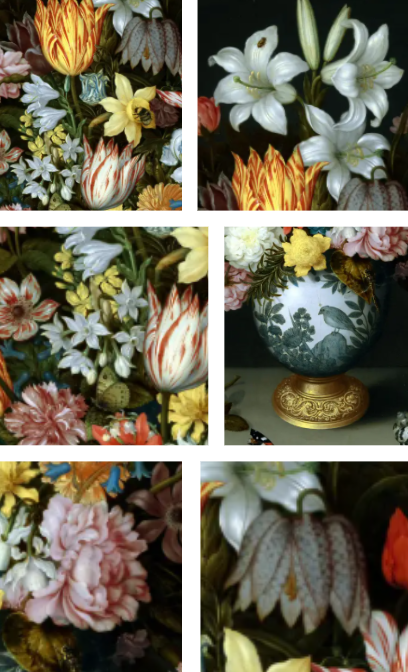
Ambrose Boschart Senior. «Still Life with Flowers in a Vandyke Vase» (1619)
At first glance, we see a traditional floral still life: a bouquet in a decorative vase against a dark background. However, the work possesses several unique features that make it particularly compelling. The bouquet is structured almost symmetrically. The flowers are depicted in their entirety wherever possible, and the lighting is distributed evenly, allowing the viewer to examine individual plants, their coloration, and shape. This allows for an examination of the symbolic meaning of the plants, as well as a demonstration of how the floral still life could merge aesthetic, botanical, and cultural functions.
Let’s examine the compositional details: — In the 17th century, the tulip was one of the most valuable and coveted plants in the Netherlands. Consequently, in traditional Dutch painting, it symbolized wealth, rarity, prestige, and an interest in exotic flora. — The white lily has a deep history of religious symbolism in European art. Even in Medieval Christian tradition, it became one of the primary attributes of the Virgin Mary, embodying her purity, innocence, and spiritual perfection. In Boschart’s composition, the white lilies stand out among the other plants due to their long stems and large, light flowers. Their placement lends a special solemnity to the bouquet. It can be speculated that the lilies in Boschart’s painting signify purity and spirituality. — The name of the flower is connected to the ancient Greek myth of Narcissus, who fell in love with his own reflection. Thus, narcissi can symbolize vanity, self-admiration, and a connection to mythological narrative. It is important to note that this is merely a hypothesis, as the Rijksmuseum catalog does not confirm the precise meaning Boschart imbued into the painting. — The rose has a long history of symbolic use in European art. It could be associated with love and beauty. — The checkered lily is interesting primarily because of its unusual appearance: the drooping flowers are adorned with a characteristic checkered pattern. In the early 17th century, such plants held particular value for European collectors and botany enthusiasts. Including the checkered lily in Boschart’s floral compositions can be seen as a demonstration of botanical diversity and an interest in unusual plants.
One detail I highlighted separately is the porcelain vase Wanli. It dates back to the reign of the 13th Chinese emperor, Wanli, of the Ming Dynasty. Such objects reached Europe through international trade, and their presence in the works of Dutch painters of that era testifies to European interest in Eastern culture.
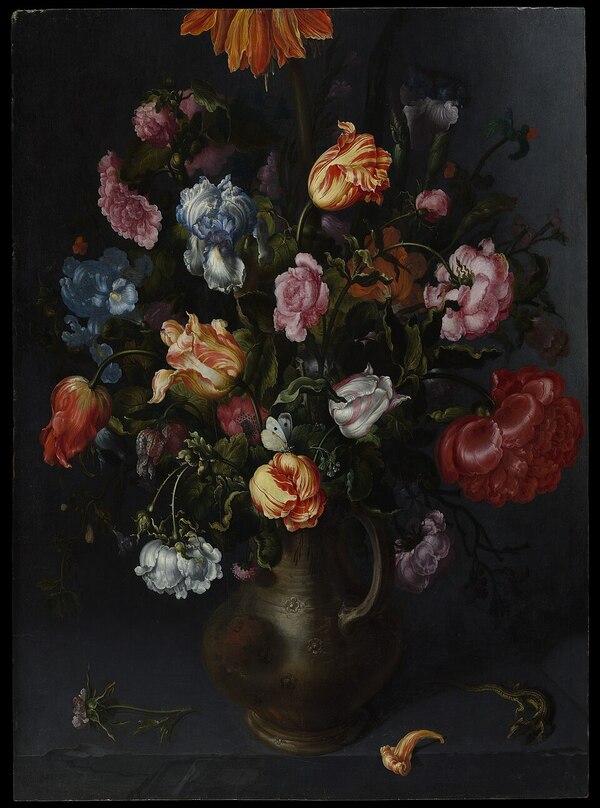
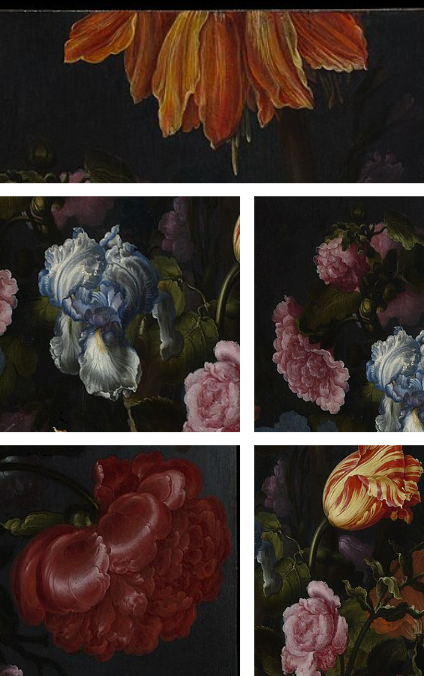
Jakob Wosmaer. «Vase with Flowers» (c. 1613)
Jakob Wosmeier’s painting is a floral still life, featuring plants that carry various cultural and symbolic meanings. Due to the diversity of the flora, the bouquet serves not only as a display of painterly skill and the beauty of nature but also as an opportunity to explore the significance European culture ascribed to individual plants.
Let’s look at the details of the composition: — The imperial pheasant became known in Europe in the 16th century and quickly captured the attention of botanists and collectors. It arrived in European gardens from Asia Minor via the Ottoman Empire and Vienna. To the viewer of the early 17th century, this flower could be not only a decorative motif but also a symbol of rarity, botanical knowledge, and an interest in exotic plants. Its name also created an association with imperial power. — In medieval Christian tradition, the iris was used as a symbol of protection against evil. Its sharp leaves were sometimes associated with the sufferings of the Virgin Mary. It is also often linked to nobility and regal dignity. However, it is important to note that by the 17th century, it was already a popular decorative and garden plant, so its presence does not necessarily signify a religious message. — In European Christian painting, the carnation often appeared in scenes with the Madonna and the Child Jesus, where it could denote divine love. In secular painting, it was also associated with love and marriage. The Metropolitan Museum of Art notes that in the Netherlands, there was a tradition where the bride would wear a carnation or a related flower at the wedding celebration. — The large red peony stands out particularly against the backdrop of the other flowers. Its rich color and lush form amplify the feeling of abundance and visual luxury in the bouquet. The peony is especially interesting as a flower with various symbolisms. In a European context, the peony could be perceived as a rare and striking flower, demonstrating the diversity and beauty of nature. The peony can also signify wealth, prosperity, and well-being, but this is only a supposition based on the flower’s traditional symbolism. — The bouquet also features tulips and roses, which appear in almost all floral compositions of 17th-century Dutch painting.
1.3. Tulip Mania