
The description of Fiskars scissors for left-handers mentions both the mirror placement of the blades and handles designed for the left hand. For me, this is an impetus to stop viewing the tool as a neutral form that can simply be passed from one hand to another. Comparing the published designs and instructions helps to uncover the movements prescribed by the instrument’s structure. Central to this analysis are the relationships between the geometry of the scissors, their intended use, and the way humans have already learned to cut.

Fiskars separates scissors for left-handed users into a distinct category and describes the spread of both the blades and the handles. The same page features various sizes and purposes: fabric, detailed work, and children’s craft. This information pertains to the proposed design and the manufacturer’s classification. I do not convert marketing promises of comfort into the results of independent research: the category title helps initiate a comparison, but it does not yet demonstrate how a specific item functions in the hands of a particular user.
This description leads to a useful question for the comparison itself. If we investigate only the shape of the finger holes, we risk missing the difference in the working parts. Therefore, I would suggest first establishing the relative arrangement of the blades, and only then moving on to the loops, size, and intended use. This is the analytical order I have chosen; it does not prescribe a new technique for handling a sharp tool. What is important here is to observe which relationships are preserved despite a superficially similar silhouette, and which ones change with the mirrored version.
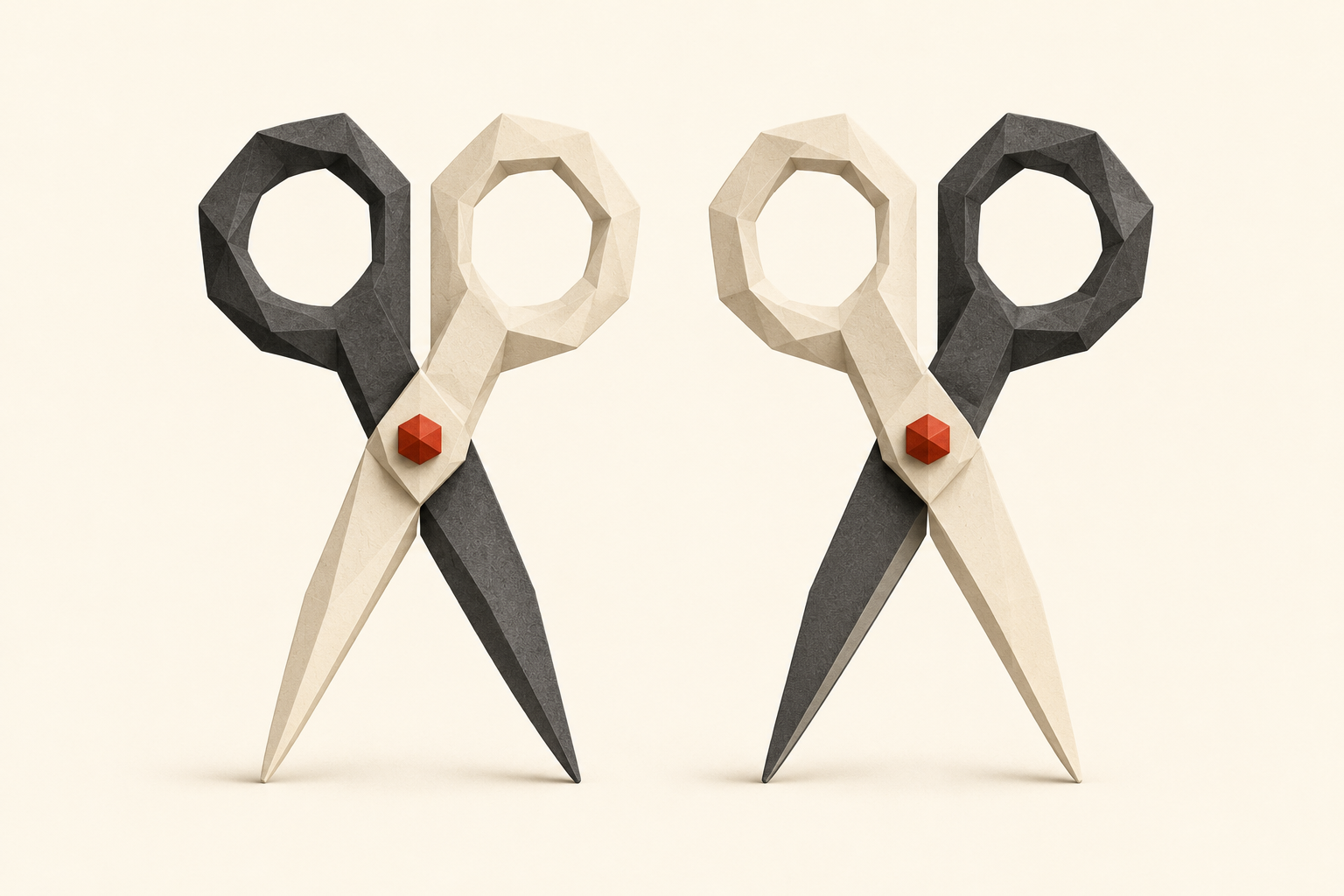
AI-generated original illustration. Conceptual reconstruction, not an image of a specific product.

Whiteley cautions in his response to questions that switching to left-handed scissors may require an adjustment period for individuals who have previously mastered right-handed tools. The manufacturer describes a scenario where the material initially folds instead of cutting and attributes this to the mechanism of action. This is a statement from the maker regarding the use of their product, not grounds to judge every left-handed person. It is especially important not to turn such an explanation into a remote assessment of a specific individual’s skills that we have not observed.
For me, this highlights the distinction between a design’s alignment and movement familiarity. A mirrored version may be engineered for the correct hand, but the user does not approach it with zero experience. My hypothesis is that when studying a change in tool, one must retain the history of what the person used previously. Otherwise, initial difficulties can easily be declared an inherent characteristic of the new object. This is an area for observation, not a proven outcome of a test—our material lacks its own participant group and comparative measurements.

The Fiskars Museum describes the transition from predominantly handcrafted scissors to new manufacturing methods in the 1960s. The museum narrative indicates that the production of the iconic orange scissors began in 1967, and the new technology is linked to the use of plastic. This source allows us to view the familiar form as the result of specific developments in materials and fabrication. It does not assert that every plastic handle is automatically superior to a metal one; the technological change and individual user comfort are distinct arguments.
For me, this distinction between the history of the product line and the examination of a single piece is crucial. Cultural recognition may make an object familiar for description, but it does not inherently establish its ergonomic fitness. From the museum’s history, I derive a more nuanced thesis: the instrument’s appearance was shaped not only by demands on motion but also by the available methods of production. To explain a particular detail, one must seek its documented origin; if it is absent, a compelling explanation remains the author’s interpretation rather than a discovered designer intent.
Original AI illustration. Conceptual reconstruction, not a depiction of a specific product.
In the D&T Association analysis, orange scissors are considered industrial design—a convergence of materials, manufacturing, and user task. The Association names industrial designer Olof Beckström and dates the model’s appearance to 1967. For this study, the manner of reading the object itself is crucial: analyzing the handles and blades as components of the designed product. I do not draw a conclusion from the design’s recognition that one historical model must suit all users or all materials.
Whiteley separately suggests considering the tool’s intended use and publishes the dimensions and mass of the models. The size, meanwhile, is described as being dependent on user preference. By cross-referencing these documents, I would not record the single word «scissors» for comparison, but rather the combination: model, working hand, material, and operation type. This approach does not promise to find a universal winner. Instead, it helps to understand why one person’s evaluation might not contradict another’s—perhaps they are assessing different actions, not the same experience.
My preliminary assessment is that a tool becomes clearer when its intended use is apparent. Symmetry, dimensions, and purpose do not necessarily restrict user freedom; rather, they allow for a more precise description of the interaction being proposed. However, calling it «for left-handers» is not a comprehensive explanation either. Between the design description and the actual action remains habit and individual working style. This intermediary space is what interests me more than attempting to categorize all scissors as definitively good or bad.
Continuing the research would involve comparing the technique described by the user before and after changing tools. I would not be looking to confirm a pre-selected evaluation, but rather to find out what changed: the way the material is positioned, the sense of control, or the number of attempts. These observations were not collected here, so they remain questions for the next phase. The existing documents have already shown something profoundly important: a seemingly simple action is simultaneously tied to the object’s construction and the history of movements that the user brings with them.